Homework Answers
Add Answer to:
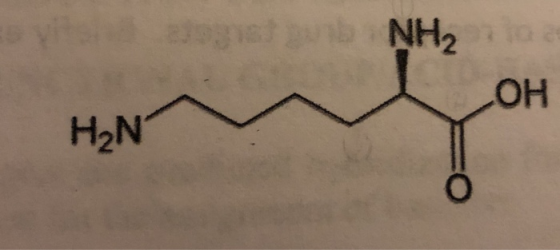
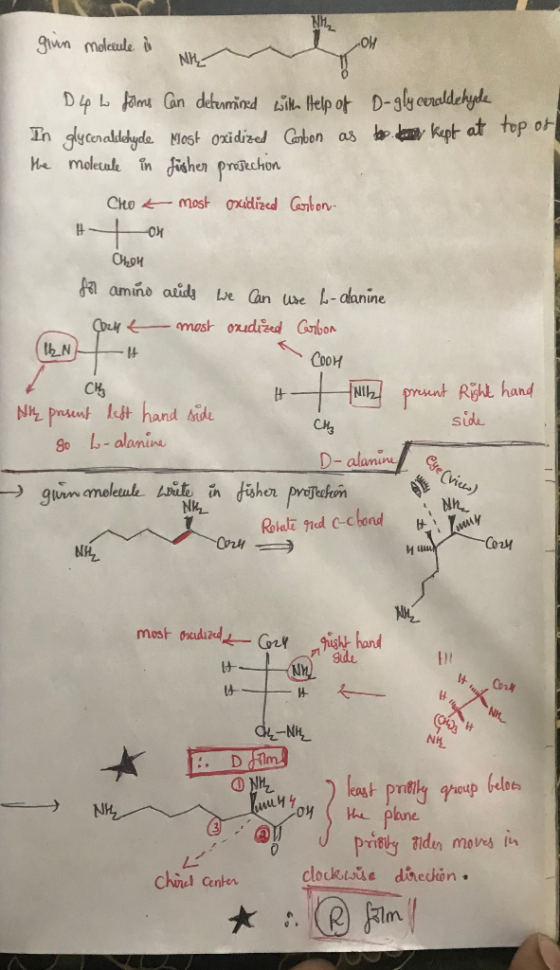
below is a stereoisomer of lysine. using the fisher convention
(D and L) and the R...
exam prep IV. Please draw the Fisher projection for each of the following molecules and determine the absolute confi...
 exam prep
IV. Please draw the Fisher projection for each of the following molecules and determine the absolute configuration (S or R) for all chirality centers. (8 pts) H3C OH C (1) H CH3 Вiн-С NO2 CH(CH3)2 (2) V. Please draw the most stable conformation of trans-1-tert-butyl-3- methylcyclohexane and cis-1-tert-butyl-3-methylcyclohexane. (6 points)
IV. Please draw the Fisher projection for each of the following molecules and determine the absolute configuration (S or R) for all chirality centers. (8 pts) H3C OH...
exam prep
IV. Please draw the Fisher projection for each of the following molecules and determine the absolute configuration (S or R) for all chirality centers. (8 pts) H3C OH C (1) H CH3 Вiн-С NO2 CH(CH3)2 (2) V. Please draw the most stable conformation of trans-1-tert-butyl-3- methylcyclohexane and cis-1-tert-butyl-3-methylcyclohexane. (6 points)
IV. Please draw the Fisher projection for each of the following molecules and determine the absolute configuration (S or R) for all chirality centers. (8 pts) H3C OH...
For 28, please explain the same stereoisomers ONLY USING R/S но он он он 0 он...
 For 28, please explain the same stereoisomers ONLY USING
R/S
но он он он 0 он но (A) H он но CH3 Cl-H 28. Which molecule is the same stereoisomer as the one in this Fischer projection? Ci30. How stere cen this CH3 (B) H CH3 Cl C-C CH3 H Cl CH3 (C) CH3 (D) CH3 Cl Cl CH3 Cl CH3 Answers to Study Questions 1..B 2. A 5. C
For 28, please explain the same stereoisomers ONLY USING
R/S
но он он он 0 он но (A) H он но CH3 Cl-H 28. Which molecule is the same stereoisomer as the one in this Fischer projection? Ci30. How stere cen this CH3 (B) H CH3 Cl C-C CH3 H Cl CH3 (C) CH3 (D) CH3 Cl Cl CH3 Cl CH3 Answers to Study Questions 1..B 2. A 5. C
1. Draw glyceraldehyde and use it to explain D versus L, and R versus S enantiomers....
1. Draw glyceraldehyde and use it to explain D versus L, and R versus S enantiomers. Explain chirality in brief terms. a) Draw a 3 , 4, 5, and 6 carbon monosaccharide b) Show how the cyclization of D-glucose is
Solve 12-14 12. Consider the molecule shown below. OH OH f. How many stereoisomers are possible?...
 Solve 12-14
12. Consider the molecule shown below. OH OH f. How many stereoisomers are possible? g. Draw each of these stereoisomers. h. Identify pairs of enantiomers and pairs of diastereomers. i. Build a model of the stereoisomer that has both OH groups pointing out. Also, build a model of the mirror image of this molecule. j. Do your two molecules represent enantiomers? Are they chiral? Fischer Projections 13. Build a model of 1-bromo-1-chloroethane. a. Draw a3D representation of this...
Solve 12-14
12. Consider the molecule shown below. OH OH f. How many stereoisomers are possible? g. Draw each of these stereoisomers. h. Identify pairs of enantiomers and pairs of diastereomers. i. Build a model of the stereoisomer that has both OH groups pointing out. Also, build a model of the mirror image of this molecule. j. Do your two molecules represent enantiomers? Are they chiral? Fischer Projections 13. Build a model of 1-bromo-1-chloroethane. a. Draw a3D representation of this...
I have completed some answers! I just really really need help with the rest! I am...
 I have completed some answers! I just really really need help
with the rest! I am so lost! please help me, if you can!
What information do you need? Can you see the pictures that I
posted?
#2-6 are using the FIGURE from question #2
#7-8 go together and uses #7 FIGURE
#9-12 uses #9"s FIGURE but #11 and #12 compares the two FIGURES
from #7	
#13 and 14 are together
# 15 and # 16 are their own problems...
I have completed some answers! I just really really need help
with the rest! I am so lost! please help me, if you can!
What information do you need? Can you see the pictures that I
posted?
#2-6 are using the FIGURE from question #2
#7-8 go together and uses #7 FIGURE
#9-12 uses #9"s FIGURE but #11 and #12 compares the two FIGURES
from #7	
#13 and 14 are together
# 15 and # 16 are their own problems...
1. Chirality (6pts, 2EA) Arethe following carbons indicated by the arrow stereogenic-a chiral carbon center). Write...
 1. Chirality (6pts, 2EA) Arethe following carbons indicated by the arrow stereogenic-a chiral carbon center). Write yes or DATE: 1104.19 No and explain? Н Нс. Br H Hас" Et 2 CONFIGURATIONS (2PTS, IEA) Assign stereoisomer configuration using R or S nomenclature (NOTE: priorities have been preassigned using Cahn-Ingold-Prelog convention) 3. Multiple Choice-Definition (1pt): Define enantiomers: (Circle the correct choice) Molecules with same molecular formula, and connectivity, but differ in 3-dimenisonal space a. b. Molecules with same molecular formula, and connectivity,...
(4 pts) Ephedrine, shown below, is a potent dilator of air passages. The naturally occurring stereoisomer is levo...
 (4 pts) Ephedrine, shown below, is a potent dilator of air passages. The naturally occurring stereoisomer is levorotatory with an (a) of -41º. Assign R or S to each stereocenter. How many stereoisomers of Ephedrine are possible? H NHCH3 HOW TO 4 stereo isomers - (12 pts) Are the following pairs of drawings representing identical, enantiomeric or diastereomeric relationships? 9 R HC a Hobo oh Diastereomeric HCOH C- Id CH pe H Identical Hace Diastereomeria $ (16 pts, 4 pts...
Shown below is the partial structural formula for the amino acid L-cysteine, HSCH2(NH2)CHCOOH. Th...
 Shown below is the partial structural formula for the amino acid L-cysteine, HSCH2(NH2)CHCOOH. The dotted lines represent connectivity of the atoms, but the structure does not show the correct bond orders (single, double, etc.). Complete the following activity for L-cysteine. ННО 2 4 H N-H 1. Write the name and chemical formula of the molecule shown above. 2. Determine the total number of valence electrons in the molecule. 3. Use the partial structural formula to draw a Lewis structure for...
imaginary axis crossing points, respectively (l any).] 9.3 The figure below shows a feedback control system with internal rate compensation r(s) y(s) S(s +2) Bs (a) Set K1-2 and K2-5 and sketch th...
 imaginary axis crossing points, respectively (l any).] 9.3 The figure below shows a feedback control system with internal rate compensation r(s) y(s) S(s +2) Bs (a) Set K1-2 and K2-5 and sketch the root locus with β the varied parameter where β> 0 (b) Can system be a marginally stable? if it is not marginally stable please explain why (c) Determine the value of B such that the closed loop system is critically damped.
imaginary axis crossing points, respectively (l...
imaginary axis crossing points, respectively (l any).] 9.3 The figure below shows a feedback control system with internal rate compensation r(s) y(s) S(s +2) Bs (a) Set K1-2 and K2-5 and sketch the root locus with β the varied parameter where β> 0 (b) Can system be a marginally stable? if it is not marginally stable please explain why (c) Determine the value of B such that the closed loop system is critically damped.
imaginary axis crossing points, respectively (l...
1. Consider the circuit shown below. Cl e, (0) c, e。(t) Find the transfer function below using t...
 Please help with this dynamics circuit
analysis.
Please show work and explain.
Thank you!!
1. Consider the circuit shown below. Cl e, (0) c, e。(t) Find the transfer function below using time-domain and impedance methods. (a) Determine the differential equation for the relationship between eo(1) and e(1) (b) Find the transfer function E, (s)/E,(s) and determine the system time constant in terms of the circuit element values C, C, and R 17 2 (c) Find the transfer function E, (s)/E,...
Please help with this dynamics circuit
analysis.
Please show work and explain.
Thank you!!
1. Consider the circuit shown below. Cl e, (0) c, e。(t) Find the transfer function below using time-domain and impedance methods. (a) Determine the differential equation for the relationship between eo(1) and e(1) (b) Find the transfer function E, (s)/E,(s) and determine the system time constant in terms of the circuit element values C, C, and R 17 2 (c) Find the transfer function E, (s)/E,...
 exam prep
IV. Please draw the Fisher projection for each of the following molecules and determine the absolute configuration (S or R) for all chirality centers. (8 pts) H3C OH C (1) H CH3 Вiн-С NO2 CH(CH3)2 (2) V. Please draw the most stable conformation of trans-1-tert-butyl-3- methylcyclohexane and cis-1-tert-butyl-3-methylcyclohexane. (6 points)
IV. Please draw the Fisher projection for each of the following molecules and determine the absolute configuration (S or R) for all chirality centers. (8 pts) H3C OH...
exam prep
IV. Please draw the Fisher projection for each of the following molecules and determine the absolute configuration (S or R) for all chirality centers. (8 pts) H3C OH C (1) H CH3 Вiн-С NO2 CH(CH3)2 (2) V. Please draw the most stable conformation of trans-1-tert-butyl-3- methylcyclohexane and cis-1-tert-butyl-3-methylcyclohexane. (6 points)
IV. Please draw the Fisher projection for each of the following molecules and determine the absolute configuration (S or R) for all chirality centers. (8 pts) H3C OH...
 For 28, please explain the same stereoisomers ONLY USING
R/S
но он он он 0 он но (A) H он но CH3 Cl-H 28. Which molecule is the same stereoisomer as the one in this Fischer projection? Ci30. How stere cen this CH3 (B) H CH3 Cl C-C CH3 H Cl CH3 (C) CH3 (D) CH3 Cl Cl CH3 Cl CH3 Answers to Study Questions 1..B 2. A 5. C
For 28, please explain the same stereoisomers ONLY USING
R/S
но он он он 0 он но (A) H он но CH3 Cl-H 28. Which molecule is the same stereoisomer as the one in this Fischer projection? Ci30. How stere cen this CH3 (B) H CH3 Cl C-C CH3 H Cl CH3 (C) CH3 (D) CH3 Cl Cl CH3 Cl CH3 Answers to Study Questions 1..B 2. A 5. C
 Solve 12-14
12. Consider the molecule shown below. OH OH f. How many stereoisomers are possible? g. Draw each of these stereoisomers. h. Identify pairs of enantiomers and pairs of diastereomers. i. Build a model of the stereoisomer that has both OH groups pointing out. Also, build a model of the mirror image of this molecule. j. Do your two molecules represent enantiomers? Are they chiral? Fischer Projections 13. Build a model of 1-bromo-1-chloroethane. a. Draw a3D representation of this...
Solve 12-14
12. Consider the molecule shown below. OH OH f. How many stereoisomers are possible? g. Draw each of these stereoisomers. h. Identify pairs of enantiomers and pairs of diastereomers. i. Build a model of the stereoisomer that has both OH groups pointing out. Also, build a model of the mirror image of this molecule. j. Do your two molecules represent enantiomers? Are they chiral? Fischer Projections 13. Build a model of 1-bromo-1-chloroethane. a. Draw a3D representation of this...
 I have completed some answers! I just really really need help
with the rest! I am so lost! please help me, if you can!
What information do you need? Can you see the pictures that I
posted?
#2-6 are using the FIGURE from question #2
#7-8 go together and uses #7 FIGURE
#9-12 uses #9"s FIGURE but #11 and #12 compares the two FIGURES
from #7	
#13 and 14 are together
# 15 and # 16 are their own problems...
I have completed some answers! I just really really need help
with the rest! I am so lost! please help me, if you can!
What information do you need? Can you see the pictures that I
posted?
#2-6 are using the FIGURE from question #2
#7-8 go together and uses #7 FIGURE
#9-12 uses #9"s FIGURE but #11 and #12 compares the two FIGURES
from #7	
#13 and 14 are together
# 15 and # 16 are their own problems...
 1. Chirality (6pts, 2EA) Arethe following carbons indicated by the arrow stereogenic-a chiral carbon center). Write yes or DATE: 1104.19 No and explain? Н Нс. Br H Hас" Et 2 CONFIGURATIONS (2PTS, IEA) Assign stereoisomer configuration using R or S nomenclature (NOTE: priorities have been preassigned using Cahn-Ingold-Prelog convention) 3. Multiple Choice-Definition (1pt): Define enantiomers: (Circle the correct choice) Molecules with same molecular formula, and connectivity, but differ in 3-dimenisonal space a. b. Molecules with same molecular formula, and connectivity,...
 (4 pts) Ephedrine, shown below, is a potent dilator of air passages. The naturally occurring stereoisomer is levorotatory with an (a) of -41º. Assign R or S to each stereocenter. How many stereoisomers of Ephedrine are possible? H NHCH3 HOW TO 4 stereo isomers - (12 pts) Are the following pairs of drawings representing identical, enantiomeric or diastereomeric relationships? 9 R HC a Hobo oh Diastereomeric HCOH C- Id CH pe H Identical Hace Diastereomeria $ (16 pts, 4 pts...
 Shown below is the partial structural formula for the amino acid L-cysteine, HSCH2(NH2)CHCOOH. The dotted lines represent connectivity of the atoms, but the structure does not show the correct bond orders (single, double, etc.). Complete the following activity for L-cysteine. ННО 2 4 H N-H 1. Write the name and chemical formula of the molecule shown above. 2. Determine the total number of valence electrons in the molecule. 3. Use the partial structural formula to draw a Lewis structure for...
 imaginary axis crossing points, respectively (l any).] 9.3 The figure below shows a feedback control system with internal rate compensation r(s) y(s) S(s +2) Bs (a) Set K1-2 and K2-5 and sketch the root locus with β the varied parameter where β> 0 (b) Can system be a marginally stable? if it is not marginally stable please explain why (c) Determine the value of B such that the closed loop system is critically damped.
imaginary axis crossing points, respectively (l...
imaginary axis crossing points, respectively (l any).] 9.3 The figure below shows a feedback control system with internal rate compensation r(s) y(s) S(s +2) Bs (a) Set K1-2 and K2-5 and sketch the root locus with β the varied parameter where β> 0 (b) Can system be a marginally stable? if it is not marginally stable please explain why (c) Determine the value of B such that the closed loop system is critically damped.
imaginary axis crossing points, respectively (l...
 Please help with this dynamics circuit
analysis.
Please show work and explain.
Thank you!!
1. Consider the circuit shown below. Cl e, (0) c, e。(t) Find the transfer function below using time-domain and impedance methods. (a) Determine the differential equation for the relationship between eo(1) and e(1) (b) Find the transfer function E, (s)/E,(s) and determine the system time constant in terms of the circuit element values C, C, and R 17 2 (c) Find the transfer function E, (s)/E,...
Please help with this dynamics circuit
analysis.
Please show work and explain.
Thank you!!
1. Consider the circuit shown below. Cl e, (0) c, e。(t) Find the transfer function below using time-domain and impedance methods. (a) Determine the differential equation for the relationship between eo(1) and e(1) (b) Find the transfer function E, (s)/E,(s) and determine the system time constant in terms of the circuit element values C, C, and R 17 2 (c) Find the transfer function E, (s)/E,...
Most questions answered within 3 hours.
-
Where is the error in this code sequence?
String s1 = "Hello";
String s2 = "ello";...
asked 11 months ago -
Financial data for Joel de Paris, Inc., for last year
follow:
Joel de Paris, Inc.
Balance...
asked 11 months ago -
Consider this reaction:
Al2(SO4)3 (aq)+ BaCl3
(aq) Al2Cl6 (aq)- +
3BaSO4(s) . What is the...
asked 11 months ago -
Suppose that Savneet is considering increasing her
recent random sample from 20 car rentals to 40...
asked 11 months ago -
Trucks arrive at an unloading terminal at an average rate of 120
per hour.
Trucks arrive...
asked 11 months ago -
Why are methanol and ethanol completely soluble in water while
octanol is not very little soluble....
asked 11 months ago -
A facilities manager at a university reads in a research report
that the mean amount of...
asked 11 months ago -
When the CuSO4 is rehydrated by adding water to the anhydrous
compound, is this an endothermic...
asked 11 months ago -
A ray of sunlight is passing from diamond into crown glass; the
angle of incidence is...
asked 11 months ago -
A block of mass 0.249 kg is placed on top of a light, vertical
spring of...
asked 11 months ago -
how do the kidneys compensate in the presences of acidosis
a) trigger hyperventilate
b) reserve acid...
asked 11 months ago -
Question 501 pts
The rental rate of capital to the firm increases. Which of the
following...
asked 11 months ago