
Homework Answers
Diabetes:
Primary prevention:
Individual-level:
structured lifestyle program to reduce calorie intake, increasing
physical activity, weight loss program, pharmacotherapy support
individual level primary prevention. It needs the collaboration of
primary care and public health system support, integrated community
organization, medical practice and policy.
community level:
community-based intervention at local, state and national level
colloboration make preventive strategies at a community level.
public health policy and strategies make well-defined
communities.
National/global level:
National level funding and comprehensive control programs, CDCs
leadership prevention can strengthen diabetes primary prevention.
state government broad-based model prevention programs detect
individuals at risk and provide behavioral counseling and
cost-effective evaluation.
Secondary prevention:
Individual-level:
early evidence-based intervention by assessing individual glucose
tolerance and measuring blood level can screen the
individual.
Community-level:
community-level intervention makes qualified trained professionals
for making screening procedures, providing education to avoid risk
and make awareness.
national level:
National health care cost foe diabetic prevention prevent diabetic
and reduce the mortality risk. Public health sectors make
evidence-based funding with policy diabetes and monitoring the
process of programs to improve preventive initiatives.
Tertiary prevention:
Individual-level:
It includes lowering disease incidence at the individual, family
level. Tertiary prevention includes nutrition therapy after
diabetic diagnosis, drugs, diet and surgical intervention including
rehabilitation programs.
Community-level:
Public health agencies involved in the actual treatment to minimize
the complication associated with diabetes.
National level:
National health institute diagnosed a large number of newly
diagnosed persons with diabetes for the education programs and
improving awareness, self-management provides knowledge and quality
of diabetic care. It also involves a risk screening program that
involve in psychiatric illness.
Add Answer to:
Question 1: Choose one of the following chronic diseases: • Diabetes • Substance use • Stroke...
Question 1: Choose one of the following chronic diseases: • Diabetes • Substance use • Stroke...
 Question 1: Choose one of the following chronic diseases: • Diabetes • Substance use • Stroke • Cancer Using the 'levels of prevention strategies' chart below, list evidence based policies/ strategies/ programs/ initiatives for each level - Individual, Community, National or Global in a location of your choice. Note: This has to be a list only and it should be evidence-based. Word count: 600 words max - remember it's supposed to be a list! Marks: 9 Levels of Prevention Strategies...
Question 1: Choose one of the following chronic diseases: • Diabetes • Substance use • Stroke...
 Question 1: Choose one of the following chronic diseases: • Diabetes • Substance use • Stroke • Cancer Using the 'levels of prevention strategies' chart below, list evidence based policies/ strategies/ programs/ initiatives for each level - Individual, Community, National or Global in a location of your choice. Note: This has to be a list only and it should be evidence-based. Word count: 600 words max - remember it's supposed to be a list! Marks: 9 Levels of Prevention Strategies...
Question 1: Choose one of the following chronic diseases: Diabetes Substance use Stroke Cancer Using the...
 Question 1: Choose one of the following chronic diseases: Diabetes Substance use Stroke Cancer Using the 'levels of prevention strategies' chart below, list evidence based policies/ strategies/ programs/ initiatives for each level - Individual, Community, National or Global in a location of your choice. Note: This has to be a list only and it should be evidence-based. Word count: 600 words max -remember it's supposed to be a list! Marks: 9 Levels of Prevention Strategies Primary Prevention Secondary Prevention Strategies...
Question 1: Choose one of the following chronic diseases: Diabetes Substance use Stroke Cancer Using the 'levels of pre...
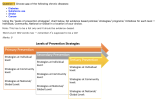 Question 1: Choose one of the following chronic diseases: Diabetes Substance use Stroke Cancer Using the 'levels of prevention strategies' chart below, list evidence based policies/ strategies/ programs/ initiatives for each level - Individual, Community, National or Global in a location of your choice. Note: This has to be a list only and it should be evidence-based. Word count: 600 words max -remember it's supposed to be a list! Marks: 9 Levels of Prevention Strategies Primary Prevention Secondary Prevention Strategies...
1) Compare and contrast communicable and noncommunicable diseases and give examples of each 2) Compare and...
 1) Compare and contrast communicable and noncommunicable diseases and give examples of each 2) Compare and contrast acute and chronic diseases and give examples of each 3) Describe the modes of communicable disease transmission and give examples of each. 4) Describe the Multicausation Model 5) Define primary, secondary, and tertiary prevention and give examples of each at both the individual and community levels
ASSESSMENT TASK 1: Poster Description This assessment task requires you to examine a health issue from the list below (National Health Priority Areas)
ASSESSMENT TASK 1: Poster Description This assessment task requires you to examine a health issue from the list below (National Health Priority Areas) This assessment task requires you to examine a community health issue and identify key points where changes can be made. An understanding of what is possible is required by any health care professional when approaching an issue if they are to plan for a genuine outcome.o Dementiao Arthritis and musculoskeletal conditionso Injury prevention and controlPart A Describe...
what are the possible question and answers for the following topic? Questions will be distributed approximately...
what are the possible question and answers for the following topic? Questions will be distributed approximately as follows: Substance Use Disorder and Cannabis - 10 Pain Management –20 Physiologic Stress and Pharmacologic Steroids- 20 Cumulative material – 2-3 questions from each of the preceding weeks. Exam questions come from class lectures, slides, readings and media resources. Approximately 2/3 of exam questions are knowledge base questions, and approximately 1/3 are application questions that ask you to apply what you have learned....
what discuss can you make about medicalization and chronic disease and illness? Adult Lealth Nursing Ethics...
 what discuss can you make about medicalization and chronic
disease and illness?
Adult Lealth Nursing Ethics mie B. Butts OBJECTIVES After reading this chapter, the reader should be able to do the following: 1. Explore the concept of medicalization as it relates to the societal shift away from physician predominance of the 1970s. 2. Differentiate among the following terms: compliance, noncompliance, adherence, nonadherence, and concordance. 3. Examine cultural views with regard to self-determination, decision making, and American healthcare professionals' values...
what discuss can you make about medicalization and chronic
disease and illness?
Adult Lealth Nursing Ethics mie B. Butts OBJECTIVES After reading this chapter, the reader should be able to do the following: 1. Explore the concept of medicalization as it relates to the societal shift away from physician predominance of the 1970s. 2. Differentiate among the following terms: compliance, noncompliance, adherence, nonadherence, and concordance. 3. Examine cultural views with regard to self-determination, decision making, and American healthcare professionals' values...
explaim the mechanisms amd toxological effects if type 1 diabetes in this article Exposure to arsenic...
 explaim the mechanisms amd toxological effects if type 1
diabetes in this article
Exposure to arsenic in drinking water is associated with increased prevalence of diabetes. We previously reported an association of diabetes and urinary concentration of dimethylarsinite (DMAS"), a toxic product of arsenic methylation by arsenic (+ 3 oxidation state) methyltransferase (AS3MT). Here we examine associations between AS3MT polymorphism, arsenic metabolism and diabetes. Fasting blood glucose, oral glucose tolerance and self-reported diagnoses were used to identify diabetic individuals. Inorganic...
explaim the mechanisms amd toxological effects if type 1
diabetes in this article
Exposure to arsenic in drinking water is associated with increased prevalence of diabetes. We previously reported an association of diabetes and urinary concentration of dimethylarsinite (DMAS"), a toxic product of arsenic methylation by arsenic (+ 3 oxidation state) methyltransferase (AS3MT). Here we examine associations between AS3MT polymorphism, arsenic metabolism and diabetes. Fasting blood glucose, oral glucose tolerance and self-reported diagnoses were used to identify diabetic individuals. Inorganic...
QUESTION 1 For the following question, select the component of the evidence-based public health approach to...
 QUESTION 1 For the following question, select the component of the evidence-based public health approach to the description: The Back-to-Sleep campaign directed information at parents and care-givers with the involvement of clinicians, crib manufacturers, and the media. The mortality from SIDS fell by approximately 50% within several years of the beginning of the Back-to-Sleep campaign Problem Description Recommendations Etiology o Implementation and Evaluation Question Completion Status: QUESTION 2 Short answer. In 3-4 sentences answer the following question What is public...
 Question 1: Choose one of the following chronic diseases: • Diabetes • Substance use • Stroke • Cancer Using the 'levels of prevention strategies' chart below, list evidence based policies/ strategies/ programs/ initiatives for each level - Individual, Community, National or Global in a location of your choice. Note: This has to be a list only and it should be evidence-based. Word count: 600 words max - remember it's supposed to be a list! Marks: 9 Levels of Prevention Strategies...
 Question 1: Choose one of the following chronic diseases: • Diabetes • Substance use • Stroke • Cancer Using the 'levels of prevention strategies' chart below, list evidence based policies/ strategies/ programs/ initiatives for each level - Individual, Community, National or Global in a location of your choice. Note: This has to be a list only and it should be evidence-based. Word count: 600 words max - remember it's supposed to be a list! Marks: 9 Levels of Prevention Strategies...
 Question 1: Choose one of the following chronic diseases: Diabetes Substance use Stroke Cancer Using the 'levels of prevention strategies' chart below, list evidence based policies/ strategies/ programs/ initiatives for each level - Individual, Community, National or Global in a location of your choice. Note: This has to be a list only and it should be evidence-based. Word count: 600 words max -remember it's supposed to be a list! Marks: 9 Levels of Prevention Strategies Primary Prevention Secondary Prevention Strategies...
 Question 1: Choose one of the following chronic diseases: Diabetes Substance use Stroke Cancer Using the 'levels of prevention strategies' chart below, list evidence based policies/ strategies/ programs/ initiatives for each level - Individual, Community, National or Global in a location of your choice. Note: This has to be a list only and it should be evidence-based. Word count: 600 words max -remember it's supposed to be a list! Marks: 9 Levels of Prevention Strategies Primary Prevention Secondary Prevention Strategies...
 1) Compare and contrast communicable and noncommunicable diseases and give examples of each 2) Compare and contrast acute and chronic diseases and give examples of each 3) Describe the modes of communicable disease transmission and give examples of each. 4) Describe the Multicausation Model 5) Define primary, secondary, and tertiary prevention and give examples of each at both the individual and community levels
 what discuss can you make about medicalization and chronic
disease and illness?
Adult Lealth Nursing Ethics mie B. Butts OBJECTIVES After reading this chapter, the reader should be able to do the following: 1. Explore the concept of medicalization as it relates to the societal shift away from physician predominance of the 1970s. 2. Differentiate among the following terms: compliance, noncompliance, adherence, nonadherence, and concordance. 3. Examine cultural views with regard to self-determination, decision making, and American healthcare professionals' values...
what discuss can you make about medicalization and chronic
disease and illness?
Adult Lealth Nursing Ethics mie B. Butts OBJECTIVES After reading this chapter, the reader should be able to do the following: 1. Explore the concept of medicalization as it relates to the societal shift away from physician predominance of the 1970s. 2. Differentiate among the following terms: compliance, noncompliance, adherence, nonadherence, and concordance. 3. Examine cultural views with regard to self-determination, decision making, and American healthcare professionals' values...
 explaim the mechanisms amd toxological effects if type 1
diabetes in this article
Exposure to arsenic in drinking water is associated with increased prevalence of diabetes. We previously reported an association of diabetes and urinary concentration of dimethylarsinite (DMAS"), a toxic product of arsenic methylation by arsenic (+ 3 oxidation state) methyltransferase (AS3MT). Here we examine associations between AS3MT polymorphism, arsenic metabolism and diabetes. Fasting blood glucose, oral glucose tolerance and self-reported diagnoses were used to identify diabetic individuals. Inorganic...
explaim the mechanisms amd toxological effects if type 1
diabetes in this article
Exposure to arsenic in drinking water is associated with increased prevalence of diabetes. We previously reported an association of diabetes and urinary concentration of dimethylarsinite (DMAS"), a toxic product of arsenic methylation by arsenic (+ 3 oxidation state) methyltransferase (AS3MT). Here we examine associations between AS3MT polymorphism, arsenic metabolism and diabetes. Fasting blood glucose, oral glucose tolerance and self-reported diagnoses were used to identify diabetic individuals. Inorganic...
 QUESTION 1 For the following question, select the component of the evidence-based public health approach to the description: The Back-to-Sleep campaign directed information at parents and care-givers with the involvement of clinicians, crib manufacturers, and the media. The mortality from SIDS fell by approximately 50% within several years of the beginning of the Back-to-Sleep campaign Problem Description Recommendations Etiology o Implementation and Evaluation Question Completion Status: QUESTION 2 Short answer. In 3-4 sentences answer the following question What is public...
Most questions answered within 3 hours.
-
Where is the error in this code sequence?
String s1 = "Hello";
String s2 = "ello";...
asked 11 months ago -
Financial data for Joel de Paris, Inc., for last year
follow:
Joel de Paris, Inc.
Balance...
asked 11 months ago -
Consider this reaction:
Al2(SO4)3 (aq)+ BaCl3
(aq) Al2Cl6 (aq)- +
3BaSO4(s) . What is the...
asked 11 months ago -
Suppose that Savneet is considering increasing her
recent random sample from 20 car rentals to 40...
asked 11 months ago -
Trucks arrive at an unloading terminal at an average rate of 120
per hour.
Trucks arrive...
asked 11 months ago -
Why are methanol and ethanol completely soluble in water while
octanol is not very little soluble....
asked 11 months ago -
A facilities manager at a university reads in a research report
that the mean amount of...
asked 11 months ago -
When the CuSO4 is rehydrated by adding water to the anhydrous
compound, is this an endothermic...
asked 11 months ago -
A ray of sunlight is passing from diamond into crown glass; the
angle of incidence is...
asked 11 months ago -
A block of mass 0.249 kg is placed on top of a light, vertical
spring of...
asked 11 months ago -
how do the kidneys compensate in the presences of acidosis
a) trigger hyperventilate
b) reserve acid...
asked 11 months ago -
Question 501 pts
The rental rate of capital to the firm increases. Which of the
following...
asked 11 months ago