our division is considering two investment projects, each of which requires an up-front expenditure of $17...
our division is considering two investment projects, each of which requires an up-front expenditure of $17 million. You estimate that the investments will produce the following net cash flows:
| Year | Project A | Project B | ||
| 1 | $ 5,000,000 | $20,000,000 | ||
| 2 | 10,000,000 | 10,000,000 | ||
| 3 | 20,000,000 | 7,000,000 | ||
-
What are the two projects' net present values, assuming the cost of capital is 5%? Do not round intermediate calculations. Round your answers to the nearest dollar.
Project A: $
Project B: $
What are the two projects' net present values, assuming the cost of capital is 10%? Do not round intermediate calculations. Round your answers to the nearest dollar.
Project A: $
Project B: $
What are the two projects' net present values, assuming the cost of capital is 15%? Do not round intermediate calculations. Round your answers to the nearest dollar.
Project A: $
Project B: $
-
What are the two projects' IRRs at these same costs of capital? Do not round intermediate calculations. Round your answers to two decimal places.
Project A: %
Project B: %
Homework Answers
NPV is given by:
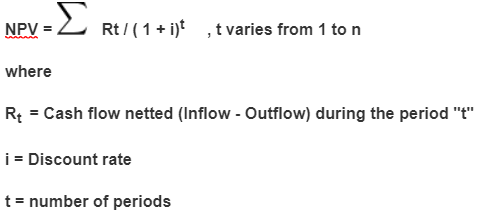
For Project A
Discount rate = 5%
NPV = [ 5,000,000 / (1 + 5%)^1 ] + [ 10,000,000 / (1 + 5%)^2 ] + [ 20,000,000 / (1 + 5%)^3 ] - Initial Investment
NPV = 4761904.76 + 9070294.78 + 17276751.97 - 17,000,000
NPV = $ 14,108,951.52
IRR
Discount rate at which NPV = 0 is known as IRR
NPV = 0 = [ 5,000,000 / (1 + r%)^1 ] + [ 10,000,000 / (1 + r%)^2 ] + [ 20,000,000 / (1 + r%)^3 ] - Initial Investment
0 = [ 5,000,000 / (1 + r%)^1 ] + [ 10,000,000 / (1 + r%)^2 ] + [ 20,000,000 / (1 + r%)^3 ] - 17,000,000
Solving for r
r = 36.12%
------------------
Discount rate = 10%
NPV = [ 5,000,000 / (1 + 10%)^1 ] + [ 10,000,000 / (1 + 10%)^2 ] + [ 20,000,000 / (1 + 10%)^3 ] - Initial Investment
NPV = 4545454.55 + 8264462.81 + 15026296.02 - 17,000,000
NPV = $ 10,836,213.37
IRR
Discount rate at which NPV = 0 is known as IRR
NPV = 0 = [ 5,000,000 / (1 + r%)^1 ] + [ 10,000,000 / (1 + r%)^2 ] + [ 20,000,000 / (1 + r%)^3 ] - Initial Investment
0 = [ 5,000,000 / (1 + r%)^1 ] + [ 10,000,000 / (1 + r%)^2 ] + [ 20,000,000 / (1 + r%)^3 ] - 17,000,000
Solving for r
r = 36.12%
----------------------
Discount rate = 15%
NPV = [ 5,000,000 / (1 + 15%)^1 ] + [ 10,000,000 / (1 + 15%)^2 ] + [ 20,000,000 / (1 + 15%)^3 ] - Initial Investment
NPV = 4347826.09 + 7561436.67 + 13150324.65 - 17,000,000
NPV = $ 8,059,587.41
IRR
Discount rate at which NPV = 0 is known as IRR
NPV = 0 = [ 5,000,000 / (1 + r%)^1 ] + [ 10,000,000 / (1 + r%)^2 ] + [ 20,000,000 / (1 + r%)^3 ] - Initial Investment
0 = [ 5,000,000 / (1 + r%)^1 ] + [ 10,000,000 / (1 + r%)^2 ] + [ 20,000,000 / (1 + r%)^3 ] - 17,000,000
Solving for r
r = 36.12%
-----------------------------------------------------------------------------------------------
For Project B
Discount rate = 5%
NPV = [ 20,000,000 / (1 + 5%)^1 ] + [ 10,000,000 / (1 + 5%)^2 ] + [ 7,000,000 / (1 + 5%)^3 ] - Initial Investment
NPV = 19047619.05 + 9070294.78 + 6046863.19 - 17,000,000
NPV = $ 17,164,777.02
IRR
Discount rate at which NPV = 0 is known as IRR
NPV = 0 = [ 20,000,000 / (1 + r%)^1 ] + [ 10,000,000 / (1 + r%)^2 ] + [ 7,000,000 / (1 + r%)^3 ] - Initial Investment
0 = [ 20,000,000 / (1 + r%)^1 ] + [ 10,000,000 / (1 + r%)^2 ] + [ 7,000,000 / (1 + r%)^3 ] - 17,000,000
Solving for r
r = 67.46%
-----------------------
Discount rate = 10%
NPV = [ 20,000,000 / (1 + 10%)^1 ] + [ 10,000,000 / (1 + 10%)^2 ] + [ 7,000,000 / (1 + 10%)^3 ] - Initial Investment
NPV = 18181818.18 + 8264462.81 + 5259203.61 - 17,000,000
NPV = $ 14,705,484.60
IRR
Discount rate at which NPV = 0 is known as IRR
NPV = 0 = [ 20,000,000 / (1 + r%)^1 ] + [ 10,000,000 / (1 + r%)^2 ] + [ 7,000,000 / (1 + r%)^3 ] - Initial Investment
0 = [ 20,000,000 / (1 + r%)^1 ] + [ 10,000,000 / (1 + r%)^2 ] + [ 7,000,000 / (1 + r%)^3 ] - 17,000,000
Solving for r
r = 67.46%
-----------------------
Discount rate = 15%
NPV = [ 20,000,000 / (1 + 15%)^1 ] + [ 10,000,000 / (1 + 15%)^2 ] + [ 7,000,000 / (1 + 15%)^3 ] - Initial Investment
NPV = 17391304.35 + 7561436.67 + 4602613.63 - 17,000,000
NPV = $ 12,555,354.65
IRR
Discount rate at which NPV = 0 is known as IRR
NPV = 0 = [ 20,000,000 / (1 + r%)^1 ] + [ 10,000,000 / (1 + r%)^2 ] + [ 7,000,000 / (1 + r%)^3 ] - Initial Investment
0 = [ 20,000,000 / (1 + r%)^1 ] + [ 10,000,000 / (1 + r%)^2 ] + [ 7,000,000 / (1 + r%)^3 ] - 17,000,000
Solving for r
r = 67.46%
-----------------------
SUMMARY
| Project A | Discount Rate | ||
| 5% | 10% | 15% | |
| NPV | 1,41,08,951.52 | 1,08,36,213.37 | 80,59,587.41 |
| IRR | 36.12% | 36.12% | 36.12% |
| Project B | Discount Rate | ||
| 5% | 10% | 15% | |
| NPV | 1,71,64,777.02 | 1,47,05,484.60 | 1,25,55,354.65 |
| IRR | 67.46% | 67.46% | 67.46% |
Add Answer to:
our division is
considering two investment projects, each of which requires an
up-front expenditure of $17...
NPV Your division is considering two investment projects, each of which requires an up-front expenditure of...
 NPV Your division is considering two investment projects, each of which requires an up-front expenditure of $17 million. You estimate that the investments will produce the following net cash flows: Year Project A Project B 1 $ 6,000,000 $20,000,000 2 10,000,000 10,000,000 3 20,000,000 7,000,000 a. What are the two projects' net present values, assuming the cost of capital is 5%? Do not round intermediate calculations. Round your answers to the nearest dollar. Project A: $ Project B: $ What...
NPV Your division is considering two investment projects, each of which requires an up-front expenditure of $17 million....
NPV Your division is considering two investment projects, each of which requires an up-front expenditure of $17 million. You estimate that the investments will produce the following net cash flows: Year Project A Project B 1 $ 5,000,000 $20,000,000 2 10,000,000 10,000,000 3 20,000,000 7,000,000 What are the two projects' net present values, assuming the cost of capital is 5%? Round your answers to the nearest dollar. Project A $ Project B $ What are the two projects' net present...
NPV Your division is considering two investment projects, each of which requires an up-front expenditure of...
 NPV Your division is considering two investment projects, each of which requires an up-front expenditure of $23 million. You estimate that the investments will produce the following net cash flows: Year Project A Project B 1 $5,000,000 $20,000,000 2 10,000,000 10,000,000 3 20,000,000 8,000,000 a. What are the two projects' net present values, assuming the cost of capital is 5%? Do not round Intermediate calculations, Round your answers to the nearest dollar. Project A: $ 71565713 Project B: $ 12028615...
NPV Your division is considering two investment projects, each of which requires an up-front expenditure of...
NPV Your division is considering two investment projects, each of which requires an up-front expenditure of $19 million. You estimate that the investments will produce the following net cash flows: Project A Project B Year 1 $ 5,000,000 $20,000,000 Year 2 10,000,000 10,000,000 Year 3 20,000,000 7,000,000 What are the two projects' net present values, assuming the cost of capital is 5%? Round your answers to the nearest dollar. Project A $ Project B $ What are...
NPV Your division is considering two investment projects, each of which requires an up-front expenditure of...
NPV Your division is considering two investment projects, each of which requires an up-front expenditure of $17 million. You estimate that the investments will produce the following net cash flows: Year Project A Project B 1 $ 4,000,000 $20,000,000 2 10,000,000 10,000,000 3 20,000,000 6,000,000 What are the two projects' net present values, assuming the cost of capital is 5%? Do not round intermediate calculations. Round your answers to the nearest dollar. Project A: $ Project B: $ What are the...
NPV Your division is considering two investment projects, each of which requires an up-front expenditure of...
NPV Your division is considering two investment projects, each of which requires an up-front expenditure of $19 million. You estimate that the investments will produce the following net cash flows: Year Project A Project B 1 $ 5,000,000 $20,000,000 2 10,000,000 10,000,000 3 20,000,000 6,000,000 What are the two projects' net present values, assuming the cost of capital is 5%? Round your answers to the nearest dollar. Project A $ Project B $ What are the two projects' net present values,...
Your division is considering two investment projects, each of which requires an up-front expenditure of $15...
Your division is considering two investment projects, each of which requires an up-front expenditure of $15 million. You estimate that the investments will produce the following net cash flows: Year Project A Project B 1 $ 5,000,000 $20,000,000 2 10,000,000 10,000,000 3 20,000,000 6,000,000 What are the two projects' net present values, assuming the cost of capital is 15%? Do not round intermediate calculations. Round your answers to the nearest dollar. Project A: $ Project B: $
Your company is considering two investment projects, each of which requires an up-front expenditure of $15...
Your company is considering two investment projects, each of which requires an up-front expenditure of $15 million. You estimate that the investments will produce the following net cash flow: Year: Project A Project B 1 $5,000,000 $20,000,000 2 10,000,000 10,000,000 3 20,000,000 6,000,000 What are the two projects’ net present values, assuming the cost of capital is 10%?
Your division is considering two investment projects, each of which requires an up-front expenditure of $15 million. Y...
Your division is considering two investment projects, each of which requires an up-front expenditure of $15 million. You estimate that the investments will produce the following net cash flows: Year Project A Project B 1 $5,000,000 $20,000,000 2 $10,000,000 $10,000,000 3 $20,000,000 $6,000,000 a. What are the two project’s net present values, assuming the cost of capital is 5%? 10%? 15% · 5%: · 10%: · 15% b. What are the two project’s IRR at these same costs of capital?
Your division is considering two investment projects, each of which requires an up-front expenditure of $20...
Your division is considering two investment projects, each of which requires an up-front expenditure of $20 million. You estimate that the investments will produce the following net cash flows: Year Project A Project B 1 $4,500,000 $20,000,000 2 10,000,000 10,000,000 3 20.000.000 6,500,000 What are the two project’s NPVs assuming the cost of capital is 3%, 12%, 17%? What are the two projects’ IRRs at those same costs of capital?
 NPV Your division is considering two investment projects, each of which requires an up-front expenditure of $17 million. You estimate that the investments will produce the following net cash flows: Year Project A Project B 1 $ 6,000,000 $20,000,000 2 10,000,000 10,000,000 3 20,000,000 7,000,000 a. What are the two projects' net present values, assuming the cost of capital is 5%? Do not round intermediate calculations. Round your answers to the nearest dollar. Project A: $ Project B: $ What...
 NPV Your division is considering two investment projects, each of which requires an up-front expenditure of $23 million. You estimate that the investments will produce the following net cash flows: Year Project A Project B 1 $5,000,000 $20,000,000 2 10,000,000 10,000,000 3 20,000,000 8,000,000 a. What are the two projects' net present values, assuming the cost of capital is 5%? Do not round Intermediate calculations, Round your answers to the nearest dollar. Project A: $ 71565713 Project B: $ 12028615...
Most questions answered within 3 hours.
-
Where is the error in this code sequence?
String s1 = "Hello";
String s2 = "ello";...
asked 10 months ago -
Financial data for Joel de Paris, Inc., for last year
follow:
Joel de Paris, Inc.
Balance...
asked 10 months ago -
Consider this reaction:
Al2(SO4)3 (aq)+ BaCl3
(aq) Al2Cl6 (aq)- +
3BaSO4(s) . What is the...
asked 10 months ago -
Suppose that Savneet is considering increasing her
recent random sample from 20 car rentals to 40...
asked 10 months ago -
Trucks arrive at an unloading terminal at an average rate of 120
per hour.
Trucks arrive...
asked 10 months ago -
Why are methanol and ethanol completely soluble in water while
octanol is not very little soluble....
asked 10 months ago -
A facilities manager at a university reads in a research report
that the mean amount of...
asked 10 months ago -
When the CuSO4 is rehydrated by adding water to the anhydrous
compound, is this an endothermic...
asked 10 months ago -
A ray of sunlight is passing from diamond into crown glass; the
angle of incidence is...
asked 10 months ago -
A block of mass 0.249 kg is placed on top of a light, vertical
spring of...
asked 10 months ago -
how do the kidneys compensate in the presences of acidosis
a) trigger hyperventilate
b) reserve acid...
asked 10 months ago -
Question 501 pts
The rental rate of capital to the firm increases. Which of the
following...
asked 10 months ago