
Homework Answers
a.)  b.) From the above graph, it is
evident that Qx (ATC1=ATC2) is 17.
b.) From the above graph, it is
evident that Qx (ATC1=ATC2) is 17.
c.) The minimum price Py would be $20000, which is the marginal cost for each unit of production.
The Marginal Cost for each unit of production using scale 1 is 20000 and 50000 using scale 2. And to minimize the price, we will go for minimum cost which is scale 1.
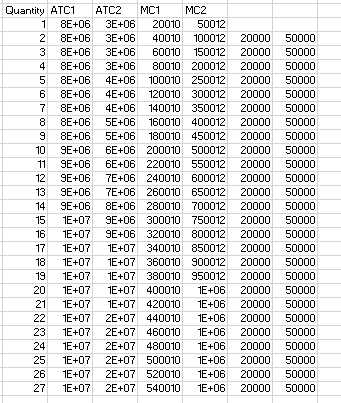
d.) Since this perfect competition and there are no super normal profits in this market structure
Add Answer to:
1. (60 points) Company X is in a perfectly competitive industry and is in long run....
1. (60 points) Company X is in a perfectly competitive industry and is in long run....
 1. (60 points) Company X is in a perfectly competitive industry and is in long run. That is, X has not picked its scale and fixed equipment yet. X has two scale options: Option I: TFC $7,500,000, TVC(Q) 100+ 10,000 Q, in $ Option ll: TFC $3,000,000, TVC(Q) 120+ 25,000 Q2, in $ a) (10 points) Plot ATC and MC for both options on the same graph with x-axis representing the quantity and y-axis representing MC and ATC. (You can...
1. (60 points) Company X is in a perfectly competitive industry and is in long run....
 1. (60 points) Company X is in a perfectly competitive industry and is in long run. That is, X has not picked its scale and fixed equipment yet. X has two scale options: Option I: TFC $7,500,000, TVC(a) 100+10,000 Q, in $. Option ll: TFC : $6,000,000, TVC(Q)-12Qt 25,000 Q. ¡n $. a) (10 points) Plot ATC and MC for both options on the same graph with x-axis representing the quantity and y-axis representing MC and ATC. (You can use...
1. (60 points) Company X is in a perfectly competitive industry and is in long run....
 1. (60 points) Company X is in a perfectly competitive industry and is in long run. That is, X has not picked its scale and fixed equipment yet. X has two scale options: Option I: TFC $7,500,000, TVC(a) 100+ 10,000 Q2, in $. Option Il: TFC $6,000,000, TVC(Q) 120+ 25,000 Q2, in $. a) (10 points) Plot ATC and MC for both options on the same graph with x-axis representing the quantity and y-axis representing MC and ATC. (You can...
1. (60 points) Company X is in a perfectly competitive industry and is in long run....
 1. (60 points) Company X is in a perfectly competitive industry and is in long run. That is, X has not picked its scale and fixed equipment yet. X has two scale options: Option I: TFC $7,500,000, TVC(a) 100+ 10,000 Q2, in $. Option Il: TFC $6,000,000, TVC(Q) 120+ 25,000 Q2, in $. a) (10 points) Plot ATC and MC for both options on the same graph with x-axis representing the quantity and y-axis representing MC and ATC. (You can...
1. (60 points) Company X is in a perfectly competitive industry and is in long run....
 1. (60 points) Company X is in a perfectly competitive industry and is in long run. That is, X has not picked its scale and fixed equipment yet. X has two scale options: Option I: TFC $7,500,000, TVC(a) 100+ 10,000 Q2, in $. Option Il: TFC $6,000,000, TVC(Q) 120+ 25,000 Q2, in $. a) (10 points) Plot ATC and MC for both options on the same graph with x-axis representing the quantity and y-axis representing MC and ATC. (You can...
10. Linda wants to open a T-shirt stand for Homecoming week. The school will license her...
 10. Linda wants to open a T-shirt stand for Homecoming week. The school will license her a booth for $100. Each T-shirt from the store will cost her $4. Linda's average cost function will be: A) $100+ $4X B) $100/X + $4 C) $104/X D) $100/X+S4/X 11. Which of the following formulas is NOT correct? a. MC = TC/Q b. TVC = AVC * Q c. TC=(AFC + AVC)*Q d. AFC = TFC/Q e. ATC = AVC + (TFC/Q) 12....
5. Deriving the short-run supply curve Aa Aa Consider the perfectly competitive market for halogen ceiling...
 5. Deriving the short-run supply curve Aa Aa Consider the perfectly competitive market for halogen ceiling lamps. The following graph shows the marginal cost (MC), average total cost (ATC), and average variable cost (AVC) curves for a typical firm in the industry. COSTS Dollars per lampl 100 MC 90 80 70 60 ATC AVC 50 40 30 20 10 0 4 8 12 16 20 24 28 32 36 40 QUANTITY OF OUTPUT (Thousands of lamps) For each price in...
2. (40 points) A monopolistically competitive company assembles and installs solar panels it imports at $10...
 2. (40 points) A monopolistically competitive company assembles and installs solar panels it imports at $10 per unit. All remaining costs of the company, denoted RC, is given by the following (as a function of per unit solar panel): RC(Q) = 1,000+5Q2 The demand faced by this company is given by Q-16.67-xP where P denotes the price, Q denotes the quantity and x is currently equal to 1/30. a) (10) points) What is the optimal production level, Q*, and what...
Question 2 (15 points) Continuing your analysis of the competitive US manufacturing industry from Question 1,...
 Question 2 (15 points) Continuing your analysis of the competitive US manufacturing industry from Question 1, with demand of Q = 200-P and supply of Q. = P-20, suppose a technological innovation causes the supply curve to shift down by $20 for every given quantity Q. • Depict the original supply, the new supply, and the original demand curves on the usual P, Q diagram. Label all intercepts. Clearly indicate and label the new market equilibrium. 2/8/2 compass 20 Mlinois.edu/bbcswebdavipid-4037356-dt-con020%20ECON528%20M6...
Question 2 (18) In scenario 1, Kobus specialises in the production of two products, namely apples...
 Question 2 (18) In scenario 1, Kobus specialises in the production of two products, namely apples and honey. With reference to Humming Honey, answer the following questions: 2.1 With reference to the (per box) production of Humming Honey, differentiate between marginal cost, marginal revenue and marginal production. (3) 2.2. In the short run, the farmer's costs in the production of Humming Honey consist of fixed costs and variable costs. Using your knowledge of cost formulas and calculations, redraw and complete...
 1. (60 points) Company X is in a perfectly competitive industry and is in long run. That is, X has not picked its scale and fixed equipment yet. X has two scale options: Option I: TFC $7,500,000, TVC(Q) 100+ 10,000 Q, in $ Option ll: TFC $3,000,000, TVC(Q) 120+ 25,000 Q2, in $ a) (10 points) Plot ATC and MC for both options on the same graph with x-axis representing the quantity and y-axis representing MC and ATC. (You can...
 1. (60 points) Company X is in a perfectly competitive industry and is in long run. That is, X has not picked its scale and fixed equipment yet. X has two scale options: Option I: TFC $7,500,000, TVC(a) 100+10,000 Q, in $. Option ll: TFC : $6,000,000, TVC(Q)-12Qt 25,000 Q. ¡n $. a) (10 points) Plot ATC and MC for both options on the same graph with x-axis representing the quantity and y-axis representing MC and ATC. (You can use...
 1. (60 points) Company X is in a perfectly competitive industry and is in long run. That is, X has not picked its scale and fixed equipment yet. X has two scale options: Option I: TFC $7,500,000, TVC(a) 100+ 10,000 Q2, in $. Option Il: TFC $6,000,000, TVC(Q) 120+ 25,000 Q2, in $. a) (10 points) Plot ATC and MC for both options on the same graph with x-axis representing the quantity and y-axis representing MC and ATC. (You can...
 1. (60 points) Company X is in a perfectly competitive industry and is in long run. That is, X has not picked its scale and fixed equipment yet. X has two scale options: Option I: TFC $7,500,000, TVC(a) 100+ 10,000 Q2, in $. Option Il: TFC $6,000,000, TVC(Q) 120+ 25,000 Q2, in $. a) (10 points) Plot ATC and MC for both options on the same graph with x-axis representing the quantity and y-axis representing MC and ATC. (You can...
 1. (60 points) Company X is in a perfectly competitive industry and is in long run. That is, X has not picked its scale and fixed equipment yet. X has two scale options: Option I: TFC $7,500,000, TVC(a) 100+ 10,000 Q2, in $. Option Il: TFC $6,000,000, TVC(Q) 120+ 25,000 Q2, in $. a) (10 points) Plot ATC and MC for both options on the same graph with x-axis representing the quantity and y-axis representing MC and ATC. (You can...
 10. Linda wants to open a T-shirt stand for Homecoming week. The school will license her a booth for $100. Each T-shirt from the store will cost her $4. Linda's average cost function will be: A) $100+ $4X B) $100/X + $4 C) $104/X D) $100/X+S4/X 11. Which of the following formulas is NOT correct? a. MC = TC/Q b. TVC = AVC * Q c. TC=(AFC + AVC)*Q d. AFC = TFC/Q e. ATC = AVC + (TFC/Q) 12....
 5. Deriving the short-run supply curve Aa Aa Consider the perfectly competitive market for halogen ceiling lamps. The following graph shows the marginal cost (MC), average total cost (ATC), and average variable cost (AVC) curves for a typical firm in the industry. COSTS Dollars per lampl 100 MC 90 80 70 60 ATC AVC 50 40 30 20 10 0 4 8 12 16 20 24 28 32 36 40 QUANTITY OF OUTPUT (Thousands of lamps) For each price in...
 2. (40 points) A monopolistically competitive company assembles and installs solar panels it imports at $10 per unit. All remaining costs of the company, denoted RC, is given by the following (as a function of per unit solar panel): RC(Q) = 1,000+5Q2 The demand faced by this company is given by Q-16.67-xP where P denotes the price, Q denotes the quantity and x is currently equal to 1/30. a) (10) points) What is the optimal production level, Q*, and what...
 Question 2 (15 points) Continuing your analysis of the competitive US manufacturing industry from Question 1, with demand of Q = 200-P and supply of Q. = P-20, suppose a technological innovation causes the supply curve to shift down by $20 for every given quantity Q. • Depict the original supply, the new supply, and the original demand curves on the usual P, Q diagram. Label all intercepts. Clearly indicate and label the new market equilibrium. 2/8/2 compass 20 Mlinois.edu/bbcswebdavipid-4037356-dt-con020%20ECON528%20M6...
 Question 2 (18) In scenario 1, Kobus specialises in the production of two products, namely apples and honey. With reference to Humming Honey, answer the following questions: 2.1 With reference to the (per box) production of Humming Honey, differentiate between marginal cost, marginal revenue and marginal production. (3) 2.2. In the short run, the farmer's costs in the production of Humming Honey consist of fixed costs and variable costs. Using your knowledge of cost formulas and calculations, redraw and complete...
Most questions answered within 3 hours.
-
Where is the error in this code sequence?
String s1 = "Hello";
String s2 = "ello";...
asked 10 months ago -
Financial data for Joel de Paris, Inc., for last year
follow:
Joel de Paris, Inc.
Balance...
asked 10 months ago -
Consider this reaction:
Al2(SO4)3 (aq)+ BaCl3
(aq) Al2Cl6 (aq)- +
3BaSO4(s) . What is the...
asked 10 months ago -
Suppose that Savneet is considering increasing her
recent random sample from 20 car rentals to 40...
asked 10 months ago -
Trucks arrive at an unloading terminal at an average rate of 120
per hour.
Trucks arrive...
asked 10 months ago -
Why are methanol and ethanol completely soluble in water while
octanol is not very little soluble....
asked 10 months ago -
A facilities manager at a university reads in a research report
that the mean amount of...
asked 10 months ago -
When the CuSO4 is rehydrated by adding water to the anhydrous
compound, is this an endothermic...
asked 10 months ago -
A ray of sunlight is passing from diamond into crown glass; the
angle of incidence is...
asked 10 months ago -
A block of mass 0.249 kg is placed on top of a light, vertical
spring of...
asked 10 months ago -
how do the kidneys compensate in the presences of acidosis
a) trigger hyperventilate
b) reserve acid...
asked 10 months ago -
Question 501 pts
The rental rate of capital to the firm increases. Which of the
following...
asked 10 months ago