

Homework Answers
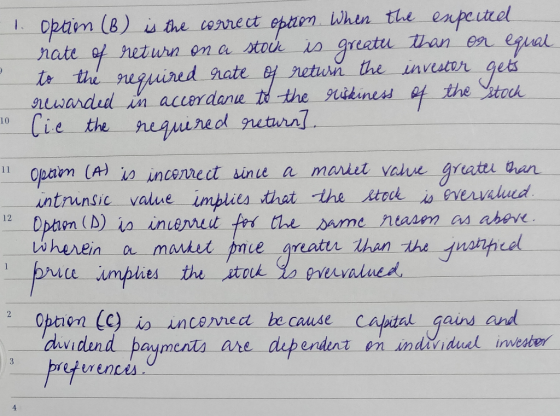
Add Answer to:
1) An investor should purchase a stock when A) the market price exceeds the intrinsic value...
6) Which of the following statements concerning the constant-growth dividend valuation model is (ar) correct 1....
 6) Which of the following statements concerning the constant-growth dividend valuation model is (ar) correct 1. One simple method of estimating the dividend growth rate is to analyze the historical paltem of dividends II. The expected total return equals the return from capital gains plus the return from dividends TIL. The model is applicable to growth firms with initially high growth rates. IV. The intrinsic value calculated using this method can change from one investor to another if their risk-return...
7) List the key variables that affect the P/E ratio and explain the relationship between each...
 7) List the key variables that affect the P/E ratio and explain the relationship between each variable and the P/E ratio. (a) growth rate in earnings; the higher the growth rate, the higher the P/E ratio (b) general state of the economy, the better the economic outlook, the higher the P/E (e) amount of debt in a company's capital structure; the lower the debt ratio, the higher the P/E (d) current and projected rate of inflation; the lower the inflation,...
For ABC Corp. paying a constant annual dividend, its stock price decreased. Which is expected for...
 For ABC Corp. paying a constant annual dividend, its stock price decreased. Which is expected for ABC Corp.: I. Its dividend yield to decrease II. Its dividend yield to increase III Its capital gains yield to decrease IV. Its capital gains yield to increase Select one: a. I only b. I and IlIl only c. Il and IV only d. Il only
The dividend growth model equates a stock’s intrinsic value (theoretical price) to the discounted sum of...
The dividend growth model equates a stock’s intrinsic value (theoretical price) to the discounted sum of the constant growth dividend stream. The relationship between the dividend growth rate (g) and the discount rate (r) is very important. Which statement accurately describes that relationship? Select one: a. I When g equals zero percent then the stocks intrinsic value is equal to div/r. b. II When g exceeds r then the stock’s intrinsic value is negative, meaning the stock is worthless c....
The dividend growth model: I. cannot be used to value zero-growth stocks. II. cannot be used to compute a stock pri...
 The dividend growth model: I. cannot be used to value zero-growth stocks. II. cannot be used to compute a stock price at any point in time. III. requires the required return to be higher than the growth rate. IV. assumes that dividends increase by a constant amount forever. V. none of the above is correct Multiple Choice 0 II, and IV only 0 V only 0 1, I, II, and IV only 0 Ill only 0 In order to estimate...
1. Mark owns a stock with a market price of $53 per share. This stock pays...
1. Mark owns a stock with a market price of $53 per share. This stock pays a constant annual dividend of $1.64 a share. If the price of the stock suddenly falls to $41 a share, you would expect the: I. dividend yield to increase. II. dividend yield to decrease. III. growth rate to increase. IV. growth rate to decrease. a) II only b) I and III only c) II and IV only d) III only e) I only 2....
Which of the following affect current stock price? 1. Dividend growth rate II. Required return III. Current dividend...
 Which of the following affect current stock price? 1. Dividend growth rate II. Required return III. Current dividend IV. Expected dividend next year Select one: a. I and III only b. ll and IV only c. 1, 11, III and IV d. I, II, and IV only
Which of the following would theoretically increase the intrinsic value of a company's stock price if...
 Which of the following would theoretically increase the intrinsic value of a company's stock price if you are valuing it using the dividend discount model? Higher interest rates b. Higher growth Higher Beta d Higher market risk premium
21. Problem 9.21 (Nonconstant Growth) еВook Assume that it is now January 1, 2019. Wayne-Martin Electric...
 21. Problem 9.21 (Nonconstant Growth) еВook Assume that it is now January 1, 2019. Wayne-Martin Electric Inc. (WME) has developed a solar panel capable of generating 200% more electricity than any other solar panel currently on the market. As a result, WME is expected to experience a 14% annual growth rate for the next 5 years. Other firms will have developed comparable technology by the end of 5 years, and WME's growth rate will slow to 5% per year indefinitely....
7. The annual annuity stream of payments with the same present va the project's_ - cost....
 7. The annual annuity stream of payments with the same present va the project's_ - cost. a. incremental C. d. opportunity equivalent annual 8. A cost that has already been paid, or the liability to pay has already been in a. salvage value expense. b. sunk cost. C. opportunity cost. Samarbrod or bloze d. erosion cost 9. A bond with semi-annual interest payments, all else equal, would be price with annual interest payments. A. higher B. lower C. the same...
 6) Which of the following statements concerning the constant-growth dividend valuation model is (ar) correct 1. One simple method of estimating the dividend growth rate is to analyze the historical paltem of dividends II. The expected total return equals the return from capital gains plus the return from dividends TIL. The model is applicable to growth firms with initially high growth rates. IV. The intrinsic value calculated using this method can change from one investor to another if their risk-return...
 7) List the key variables that affect the P/E ratio and explain the relationship between each variable and the P/E ratio. (a) growth rate in earnings; the higher the growth rate, the higher the P/E ratio (b) general state of the economy, the better the economic outlook, the higher the P/E (e) amount of debt in a company's capital structure; the lower the debt ratio, the higher the P/E (d) current and projected rate of inflation; the lower the inflation,...
 For ABC Corp. paying a constant annual dividend, its stock price decreased. Which is expected for ABC Corp.: I. Its dividend yield to decrease II. Its dividend yield to increase III Its capital gains yield to decrease IV. Its capital gains yield to increase Select one: a. I only b. I and IlIl only c. Il and IV only d. Il only
 The dividend growth model: I. cannot be used to value zero-growth stocks. II. cannot be used to compute a stock price at any point in time. III. requires the required return to be higher than the growth rate. IV. assumes that dividends increase by a constant amount forever. V. none of the above is correct Multiple Choice 0 II, and IV only 0 V only 0 1, I, II, and IV only 0 Ill only 0 In order to estimate...
 Which of the following affect current stock price? 1. Dividend growth rate II. Required return III. Current dividend IV. Expected dividend next year Select one: a. I and III only b. ll and IV only c. 1, 11, III and IV d. I, II, and IV only
 Which of the following would theoretically increase the intrinsic value of a company's stock price if you are valuing it using the dividend discount model? Higher interest rates b. Higher growth Higher Beta d Higher market risk premium
 21. Problem 9.21 (Nonconstant Growth) еВook Assume that it is now January 1, 2019. Wayne-Martin Electric Inc. (WME) has developed a solar panel capable of generating 200% more electricity than any other solar panel currently on the market. As a result, WME is expected to experience a 14% annual growth rate for the next 5 years. Other firms will have developed comparable technology by the end of 5 years, and WME's growth rate will slow to 5% per year indefinitely....
 7. The annual annuity stream of payments with the same present va the project's_ - cost. a. incremental C. d. opportunity equivalent annual 8. A cost that has already been paid, or the liability to pay has already been in a. salvage value expense. b. sunk cost. C. opportunity cost. Samarbrod or bloze d. erosion cost 9. A bond with semi-annual interest payments, all else equal, would be price with annual interest payments. A. higher B. lower C. the same...
Most questions answered within 3 hours.
-
Where is the error in this code sequence?
String s1 = "Hello";
String s2 = "ello";...
asked 11 months ago -
Financial data for Joel de Paris, Inc., for last year
follow:
Joel de Paris, Inc.
Balance...
asked 11 months ago -
Consider this reaction:
Al2(SO4)3 (aq)+ BaCl3
(aq) Al2Cl6 (aq)- +
3BaSO4(s) . What is the...
asked 11 months ago -
Suppose that Savneet is considering increasing her
recent random sample from 20 car rentals to 40...
asked 11 months ago -
Trucks arrive at an unloading terminal at an average rate of 120
per hour.
Trucks arrive...
asked 11 months ago -
Why are methanol and ethanol completely soluble in water while
octanol is not very little soluble....
asked 11 months ago -
A facilities manager at a university reads in a research report
that the mean amount of...
asked 11 months ago -
When the CuSO4 is rehydrated by adding water to the anhydrous
compound, is this an endothermic...
asked 11 months ago -
A ray of sunlight is passing from diamond into crown glass; the
angle of incidence is...
asked 11 months ago -
A block of mass 0.249 kg is placed on top of a light, vertical
spring of...
asked 11 months ago -
how do the kidneys compensate in the presences of acidosis
a) trigger hyperventilate
b) reserve acid...
asked 11 months ago -
Question 501 pts
The rental rate of capital to the firm increases. Which of the
following...
asked 11 months ago