
Homework Answers
Add Answer to:
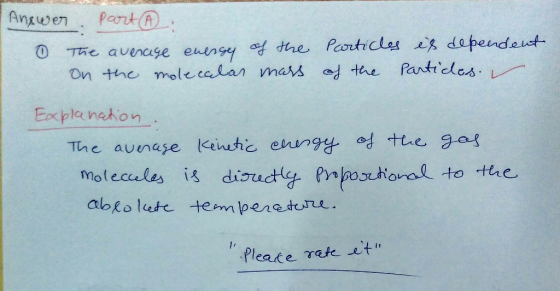
Part A Which of the following is NOT part of the Kinetic Molecular Theory? The average...
17. Which of the following is not apart of the kinetic molecular theory? A)The average energy...
17. Which of the following is not apart of the kinetic molecular theory? A)The average energy of the particles is dependent on the molecular mass of the particle? B) Gas particle do not repel each other C) There is a large distance between gas particles as compared to their relative size? D) The size of the actual gas particles is small compared tot the volume of the whole gas?
Question 33 Which statement is TRUE according to the kinetic molecular theory? The average kinetic energy...
 Question 33 Which statement is TRUE according to the kinetic molecular theory? The average kinetic energy of a particle is proportional to the temperature in Kelvin. The size of the particle is large compared to the volume. The collisions of particles with one another is not completely elastic. A single particle does not move in a straight line.
Which assumption is not part of the kinetic-molecular theory of gases? A. The kinetic energy of...
Which assumption is not part of the kinetic-molecular theory of gases? A. The kinetic energy of gas particles change with change in temperature. B. Because the space between gas particles is large, gas particles exert no attractive forces on each other. C. When gas particles collide with each other, they rebound and travel in new directions D. The size of gas particles is small compared to the space between the particles. E. Gas consists of particles that move randomly and...
Question 29 (Mandatory) (1 point) Which of the following is true about the kinetic molecular theory?...
 Question 29 (Mandatory) (1 point) Which of the following is true about the kinetic molecular theory? U a) The volume of a gas particle is considered to be small-about 0.10 mL. U b) Pressure is due to the collisions of the gas particles with the walls of the container, U C) Gas particles repel each other, but do not attract one another. u d Adding an ideal gas to a closed container will cause an increase in temperature. u e)...
According to the kinetic molecular theory, which of the following is NOT true this is the...
 According to the kinetic molecular theory, which of the following
is NOT true
this is the question options
n it any temperature the vapor pressure of acetic acid is lower than that of water. (O) Acetic acid is more volatile than water. ( Both A and B are correct. O Neither A nor B is correct. n Gas particles are in constant random motion and move in straight lines until they collide with another gas particle. The volume of gas...
According to the kinetic molecular theory, which of the following
is NOT true
this is the question options
n it any temperature the vapor pressure of acetic acid is lower than that of water. (O) Acetic acid is more volatile than water. ( Both A and B are correct. O Neither A nor B is correct. n Gas particles are in constant random motion and move in straight lines until they collide with another gas particle. The volume of gas...
279/as The Kinetic Molecular Theory ts Understand Postulates of the Kinetic Molecular Theory of Gases Question...
 279/as The Kinetic Molecular Theory ts Understand Postulates of the Kinetic Molecular Theory of Gases Question Which of the following is true regarding the size of gas molecules, according to the kinetic molecular theory? Select the correct answer below O The size of the molecules is small but Cannot be neglected O The size of the molecules is so small compared to the distance between them that the size is taken to be negligible The distance between molecules is small...
Which assumption is part of the kinetic molecular theory? A) the particles in a gas have...
Which assumption is part of the kinetic molecular theory? A) the particles in a gas have a distinct volume measured in mL B) the particles in a gas attract one another via intermolecular forces C) the particles in a gas collide and emit energy to the surroundings D) the speed of the particles in a gas is directly proportional to the Kelvin temperature E) the particles in a gas can be compressed
Which of the following statements about the kinetic molecular theory are not correct? O Attractive and...
 Which of the following statements about the kinetic molecular theory are not correct? O Attractive and repulsive forces between gas molecules are negligible The average kinetic energy of the molecules is not related to the absolute temperature Gases consist of molecules that are in continuous, random motion The combined volume of all the molecules of the gas is negligible relative to the total volume in which the gas is contained
8:15 Question 2 of 16 Submit According to the Kinetic Molecular Theory A) The volume of...
 8:15 Question 2 of 16 Submit According to the Kinetic Molecular Theory A) The volume of the gas particles will impact the volume available to the gas. B) Gas particles exert pressure by colliding with one another C) The gas particles are moving in circular motions throughout the container. D) The average kinetic energy is proportional to the temperature of the system.
QUESTION 16 Which of the following is NOT an assumption made by the kinetic molecular theory?...
 QUESTION 16 Which of the following is NOT an assumption made by the kinetic molecular theory? A gas is a collection of particles (molecules or atoms) in constant motion. This motion is straight-line motion The average kinetic energy (energy due to motion) of the gas particles is proportional to the temperature measured in kelvin. As temperature increases, the particles move faster and have more energy There is no attraction or repulsion between the gas particles, another wards, they not interact....
 Question 33 Which statement is TRUE according to the kinetic molecular theory? The average kinetic energy of a particle is proportional to the temperature in Kelvin. The size of the particle is large compared to the volume. The collisions of particles with one another is not completely elastic. A single particle does not move in a straight line.
 Question 29 (Mandatory) (1 point) Which of the following is true about the kinetic molecular theory? U a) The volume of a gas particle is considered to be small-about 0.10 mL. U b) Pressure is due to the collisions of the gas particles with the walls of the container, U C) Gas particles repel each other, but do not attract one another. u d Adding an ideal gas to a closed container will cause an increase in temperature. u e)...
 According to the kinetic molecular theory, which of the following
is NOT true
this is the question options
n it any temperature the vapor pressure of acetic acid is lower than that of water. (O) Acetic acid is more volatile than water. ( Both A and B are correct. O Neither A nor B is correct. n Gas particles are in constant random motion and move in straight lines until they collide with another gas particle. The volume of gas...
According to the kinetic molecular theory, which of the following
is NOT true
this is the question options
n it any temperature the vapor pressure of acetic acid is lower than that of water. (O) Acetic acid is more volatile than water. ( Both A and B are correct. O Neither A nor B is correct. n Gas particles are in constant random motion and move in straight lines until they collide with another gas particle. The volume of gas...
 279/as The Kinetic Molecular Theory ts Understand Postulates of the Kinetic Molecular Theory of Gases Question Which of the following is true regarding the size of gas molecules, according to the kinetic molecular theory? Select the correct answer below O The size of the molecules is small but Cannot be neglected O The size of the molecules is so small compared to the distance between them that the size is taken to be negligible The distance between molecules is small...
 Which of the following statements about the kinetic molecular theory are not correct? O Attractive and repulsive forces between gas molecules are negligible The average kinetic energy of the molecules is not related to the absolute temperature Gases consist of molecules that are in continuous, random motion The combined volume of all the molecules of the gas is negligible relative to the total volume in which the gas is contained
 8:15 Question 2 of 16 Submit According to the Kinetic Molecular Theory A) The volume of the gas particles will impact the volume available to the gas. B) Gas particles exert pressure by colliding with one another C) The gas particles are moving in circular motions throughout the container. D) The average kinetic energy is proportional to the temperature of the system.
 QUESTION 16 Which of the following is NOT an assumption made by the kinetic molecular theory? A gas is a collection of particles (molecules or atoms) in constant motion. This motion is straight-line motion The average kinetic energy (energy due to motion) of the gas particles is proportional to the temperature measured in kelvin. As temperature increases, the particles move faster and have more energy There is no attraction or repulsion between the gas particles, another wards, they not interact....
Most questions answered within 3 hours.
-
Where is the error in this code sequence?
String s1 = "Hello";
String s2 = "ello";...
asked 11 months ago -
Financial data for Joel de Paris, Inc., for last year
follow:
Joel de Paris, Inc.
Balance...
asked 11 months ago -
Consider this reaction:
Al2(SO4)3 (aq)+ BaCl3
(aq) Al2Cl6 (aq)- +
3BaSO4(s) . What is the...
asked 11 months ago -
Suppose that Savneet is considering increasing her
recent random sample from 20 car rentals to 40...
asked 11 months ago -
Trucks arrive at an unloading terminal at an average rate of 120
per hour.
Trucks arrive...
asked 11 months ago -
Why are methanol and ethanol completely soluble in water while
octanol is not very little soluble....
asked 11 months ago -
A facilities manager at a university reads in a research report
that the mean amount of...
asked 11 months ago -
When the CuSO4 is rehydrated by adding water to the anhydrous
compound, is this an endothermic...
asked 11 months ago -
A ray of sunlight is passing from diamond into crown glass; the
angle of incidence is...
asked 11 months ago -
A block of mass 0.249 kg is placed on top of a light, vertical
spring of...
asked 11 months ago -
how do the kidneys compensate in the presences of acidosis
a) trigger hyperventilate
b) reserve acid...
asked 11 months ago -
Question 501 pts
The rental rate of capital to the firm increases. Which of the
following...
asked 11 months ago