
Homework Answers
solution:
Given that:
consider the multiple regression model containing three independent variables such that the model is given by:
y=
+
+
+
+
also consider that =
+
(i) consider the four multiple-linear regression assumptions
1) the model of the population is such that the dependent
variable is expressed as the linear combination of explanatory
variables and the error term. this is what is exhibited by the
given population model. the expression is y=
+
+
+
+
2)the observations relating to dependent and explanatory variables are random observations.
this is assumed to hold as true in the given case
3)the explanatory variables are independent of each other such that no exact linear relationship among the independent variables holds. that means there is no problem of multi-collinearity
4)the expected value of the disturbance or error term in the
population model is zero. that means E(u
Given such assumptions , it could be ensured that
Since
That implies
This indicates that
is an unbiased estimator of
ii)
Since
That implies
Hence
and
Add Answer to:
Question 2 (0.5 mark) Consider the multiple regression model containing three independent variables, under Assumptions MLR.1...
Model Assumptions: Question: • Assumption MLR.1 (Linear in the Parameters): The model in the population can...
 Model Assumptions:
Question:
• Assumption MLR.1 (Linear in the Parameters): The model in the population can be written as y = Bo + B1X + ... + BkXk+u where Bo, B1, ..., Bk are the unknown parameters of interest and u unobserved random error. Assumption MLR.2 (Random Sampling): We have a random samp n observations, {(Xi1, X12, ..., Xik, Yi) : 1 = 1,2,...,n}, following the population model in Assumption MLR.1. Assumption MLR.3 (No Perfect Collinearity): In the sample, none...
Model Assumptions:
Question:
• Assumption MLR.1 (Linear in the Parameters): The model in the population can be written as y = Bo + B1X + ... + BkXk+u where Bo, B1, ..., Bk are the unknown parameters of interest and u unobserved random error. Assumption MLR.2 (Random Sampling): We have a random samp n observations, {(Xi1, X12, ..., Xik, Yi) : 1 = 1,2,...,n}, following the population model in Assumption MLR.1. Assumption MLR.3 (No Perfect Collinearity): In the sample, none...
It's 5 multiple-choice questions of applicated economic, can someone help me? Thank you so much! Assume...
 It's 5 multiple-choice questions of applicated economic, can
someone help me? Thank you so much!
Assume that the variable Y is actually determined by the following equation Y; = Bo + B1X1,i+ B2X2,i + Uj additionally assume that corr(X1, X2) = p. The usual assumptions for a linear model hold in this case. You are interested in estimating B1. To accomplish this you collect a sample of the variables Y and X1 and estimate the following model Y; = Yo...
It's 5 multiple-choice questions of applicated economic, can
someone help me? Thank you so much!
Assume that the variable Y is actually determined by the following equation Y; = Bo + B1X1,i+ B2X2,i + Uj additionally assume that corr(X1, X2) = p. The usual assumptions for a linear model hold in this case. You are interested in estimating B1. To accomplish this you collect a sample of the variables Y and X1 and estimate the following model Y; = Yo...
Consider the multiple regression with three independent variables under the classical linear model assumptions: y Bo+BBx,+B,x,...
 Consider the multiple regression with three independent variables under the classical linear model assumptions: y Bo+BBx,+B,x, +u 1. You would like to test the hypothesis: H0: B-3B, 1 What is the standard error of B-3B,? (i Write the t-statistic of B-3B ( Define 0,= B-3B.. Write a regression equation that allows you to directly obtain 0, and its standard error.
1. a. At any given combination of values , the assumptions for the multiple regression model...
1. a. At any given combination of values , the assumptions for the multiple regression model require that the population of potential error term values has? b. What is the point estimate for the constant variance? c.Which of the following is the sum of the squared differences between the predicted values of the dependent variable and the mean of the dependent variable, the explained variation? d.The null hypothesis for the overall F-test states that: At least one ββis not equal...
2. Consider a multiple linear regression model with two independent variables and no intercept. Assume n...
2. Consider a multiple linear regression model with two independent variables and no intercept. Assume n independent observations are available. (a). Write down the model in matrix form. Clearly indicate the content of every matrix used in this representation. (b). What is the Rank of X. for the above model? Explain why? (c). Compute the expressions for the least square estimators of B, and B2. Do not over-simplify the elements in your matrices.
1. In order to test whether the multiple linear regression model y bo +b,x1 + b2X2 is better than the average model (lazy model), which of the following null hypotheses is correct: a. Ho' b1...
 1. In order to test whether the multiple linear regression model y bo +b,x1 + b2X2 is better than the average model (lazy model), which of the following null hypotheses is correct: a. Ho' b1 = b2 = 0 Но: B1 B2-0 с. We have a dataset Company with three variables: Sales, employees and stores. To build a multiple linear regression model using Sales as dependent variable, number of stores and number of employees as independent variables, which of the...
3. Model assumptions Aa Aa E In a multiple regression model with p independent variables, that...
 3. Model assumptions Aa Aa E In a multiple regression model with p independent variables, that is, y-Po + β*1 + assumptions + ßpXp + t, you have the following Assumption 1: The error term ε is a random variable with a mean of zero, that is, E(E)-0 for all values of the independent variables x. Assumption 2: The variance of , denoted by ơ2, is the same for all values of the independent variables xi, X2, , Xp Assumption...
1. In a multiple regression model, changing the scale of one of the independent variables (a)...
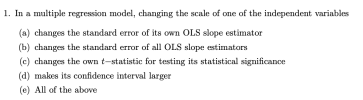 1. In a multiple regression model, changing the scale of one of the independent variables (a) changes the standard error of its own OLS slope estimator (b) changes the standard error of all OLS slope estimators (c) changes the own t-statistic for testing its statistical significance (d) makes its confidence interval larger (e) All of the above
QUESTION 2 In multiple linear regression analysis, the number of independent variables should be as large...
QUESTION 2 In multiple linear regression analysis, the number of independent variables should be as large as possible. more than 5. guided by economic theory. enough to guarantee that statistical significance is achieved. QUESTION 3 Omitted variable bias occurs when always occurs when performing simple linear regression analysis. independent variables that should be included in the analysis are not included and those independent variables are related to the variables in the regression model. independent variables that should not be included...
Consider the multiple regression model y = X3 + €, with E(€)=0 and var(€)=oʻI. Problem 1...
 Consider the multiple regression model y = X3 + €, with E(€)=0 and var(€)=oʻI. Problem 1 Gauss-Mrkov theorem (revisited). We already know that E = B and var() = '(X'X)". Consider now another unbiased estimator of 3, say b = AY. Since we are assuming that b is unbiased we reach the conclusion that AX = I (why?). The Gauss-Markov theorem claims that var(b) - var() is positive semi-definite which asks that we investigate q' var(b) - var() q. Show...
 Model Assumptions:
Question:
• Assumption MLR.1 (Linear in the Parameters): The model in the population can be written as y = Bo + B1X + ... + BkXk+u where Bo, B1, ..., Bk are the unknown parameters of interest and u unobserved random error. Assumption MLR.2 (Random Sampling): We have a random samp n observations, {(Xi1, X12, ..., Xik, Yi) : 1 = 1,2,...,n}, following the population model in Assumption MLR.1. Assumption MLR.3 (No Perfect Collinearity): In the sample, none...
Model Assumptions:
Question:
• Assumption MLR.1 (Linear in the Parameters): The model in the population can be written as y = Bo + B1X + ... + BkXk+u where Bo, B1, ..., Bk are the unknown parameters of interest and u unobserved random error. Assumption MLR.2 (Random Sampling): We have a random samp n observations, {(Xi1, X12, ..., Xik, Yi) : 1 = 1,2,...,n}, following the population model in Assumption MLR.1. Assumption MLR.3 (No Perfect Collinearity): In the sample, none...
 It's 5 multiple-choice questions of applicated economic, can
someone help me? Thank you so much!
Assume that the variable Y is actually determined by the following equation Y; = Bo + B1X1,i+ B2X2,i + Uj additionally assume that corr(X1, X2) = p. The usual assumptions for a linear model hold in this case. You are interested in estimating B1. To accomplish this you collect a sample of the variables Y and X1 and estimate the following model Y; = Yo...
It's 5 multiple-choice questions of applicated economic, can
someone help me? Thank you so much!
Assume that the variable Y is actually determined by the following equation Y; = Bo + B1X1,i+ B2X2,i + Uj additionally assume that corr(X1, X2) = p. The usual assumptions for a linear model hold in this case. You are interested in estimating B1. To accomplish this you collect a sample of the variables Y and X1 and estimate the following model Y; = Yo...
 Consider the multiple regression with three independent variables under the classical linear model assumptions: y Bo+BBx,+B,x, +u 1. You would like to test the hypothesis: H0: B-3B, 1 What is the standard error of B-3B,? (i Write the t-statistic of B-3B ( Define 0,= B-3B.. Write a regression equation that allows you to directly obtain 0, and its standard error.
 1. In order to test whether the multiple linear regression model y bo +b,x1 + b2X2 is better than the average model (lazy model), which of the following null hypotheses is correct: a. Ho' b1 = b2 = 0 Но: B1 B2-0 с. We have a dataset Company with three variables: Sales, employees and stores. To build a multiple linear regression model using Sales as dependent variable, number of stores and number of employees as independent variables, which of the...
 3. Model assumptions Aa Aa E In a multiple regression model with p independent variables, that is, y-Po + β*1 + assumptions + ßpXp + t, you have the following Assumption 1: The error term ε is a random variable with a mean of zero, that is, E(E)-0 for all values of the independent variables x. Assumption 2: The variance of , denoted by ơ2, is the same for all values of the independent variables xi, X2, , Xp Assumption...
 1. In a multiple regression model, changing the scale of one of the independent variables (a) changes the standard error of its own OLS slope estimator (b) changes the standard error of all OLS slope estimators (c) changes the own t-statistic for testing its statistical significance (d) makes its confidence interval larger (e) All of the above
 Consider the multiple regression model y = X3 + €, with E(€)=0 and var(€)=oʻI. Problem 1 Gauss-Mrkov theorem (revisited). We already know that E = B and var() = '(X'X)". Consider now another unbiased estimator of 3, say b = AY. Since we are assuming that b is unbiased we reach the conclusion that AX = I (why?). The Gauss-Markov theorem claims that var(b) - var() is positive semi-definite which asks that we investigate q' var(b) - var() q. Show...
Most questions answered within 3 hours.
-
Where is the error in this code sequence?
String s1 = "Hello";
String s2 = "ello";...
asked 11 months ago -
Financial data for Joel de Paris, Inc., for last year
follow:
Joel de Paris, Inc.
Balance...
asked 11 months ago -
Consider this reaction:
Al2(SO4)3 (aq)+ BaCl3
(aq) Al2Cl6 (aq)- +
3BaSO4(s) . What is the...
asked 11 months ago -
Suppose that Savneet is considering increasing her
recent random sample from 20 car rentals to 40...
asked 11 months ago -
Trucks arrive at an unloading terminal at an average rate of 120
per hour.
Trucks arrive...
asked 11 months ago -
Why are methanol and ethanol completely soluble in water while
octanol is not very little soluble....
asked 11 months ago -
A facilities manager at a university reads in a research report
that the mean amount of...
asked 11 months ago -
When the CuSO4 is rehydrated by adding water to the anhydrous
compound, is this an endothermic...
asked 11 months ago -
A ray of sunlight is passing from diamond into crown glass; the
angle of incidence is...
asked 11 months ago -
A block of mass 0.249 kg is placed on top of a light, vertical
spring of...
asked 11 months ago -
how do the kidneys compensate in the presences of acidosis
a) trigger hyperventilate
b) reserve acid...
asked 11 months ago -
Question 501 pts
The rental rate of capital to the firm increases. Which of the
following...
asked 11 months ago