
Homework Answers
Add Answer to:
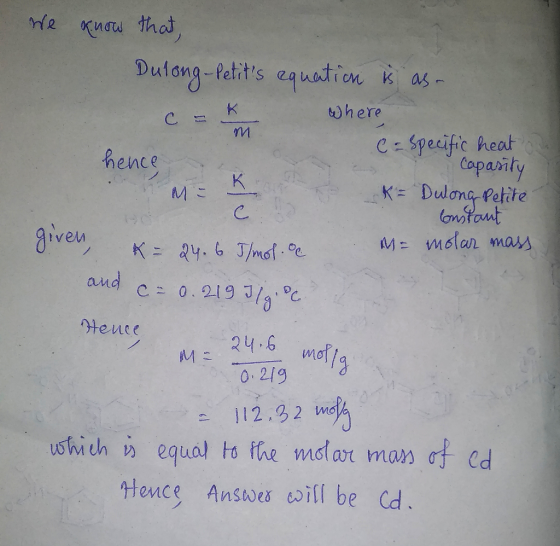
The specific heat of an unknown metal is 0.219 J/g.°C. Use Dulong and Petit's equation for...
If you look at the table of specific heat values for different metals, they are all...
If you look at the table of specific heat values for different metals, they are all so different from one another. The difference is mainly because specific heat is expressed as energy per unit mass. If specific heat were given as energy per mole, the values would be very similar. It is, in fact, this similarity of the molar specific heats of metals, which is the basis for the Law of Dulong and Petit. The law of Dulong and Petit...
Part 1.) Using the Law of Dulong and Petit and the given heat capacities determine the molar masses for the following me...
Part 1.) Using the Law of Dulong and Petit and the given heat capacities determine the molar masses for the following metals: Metal Specific heat J/ g⋅ oC Gold 0.1285 Silver 0.236 Magnesium 1.0419 Calculated Molar Mass of Silver in g/mol. (Put your answer in 4 significant figures) Part 2.) Using the Law of Dulong and Petit and the given heat capacities determine the molar masses for the following metals: Metal Specific heat J/ g⋅ oC Gold 0.129 Silver 0.2357...
200 g of an unknown metal powder at Thot = 72°C are dropped into a negligible...
200 g of an unknown metal powder at Thot = 72°C are dropped into a negligible heat capacity calorimeter containing 150 g of water at 16°C. The final equilibrium temperature is measured to be 36.6°C. 1. Calculate the specific heat of the metal powder c. c = J/kg-°C 2. Identify the metal from the list below. Water Beryllium Aluminum Silicon Iron Copper Silver Gold Lead 3. Using the data table, calculate the specific heat per mole Cmolar of each pure...
Identify an unknown metal by determining its specific heat capacity (Csp). It takes 26,347 J of...
 Identify an unknown metal by determining its specific heat capacity (Csp). It takes 26,347 J of heat to raise the temperature of 253.5 grams of the unknown metal from 31.4°C to 146.5°C. Determine the Csp and then use the adjacent table to identify the metal.de Date: city (Cs). of the then use the TABLE 6.4 Specific Heat Capacities of Some Common Substances Specific Heat Capacity, Cs Substance (J/g °C)* Elements 0.128 Lead 0.128 Gold Silver 0.235 0.385 sorto no 12...
3. If equivalent amounts of heat are absorbed by 1 mol of Metal A (molar mass...
 3. If equivalent amounts of heat are absorbed by 1 mol of Metal A (molar mass = 78 g/mol) and 1 mol of Metal B (molar mass = 100 g/mol), which shows the greatest rise in temperature? (Hint: Assume the metals obey Dulong and Petit's law.) Explain your reasoning.
An unknown metal sample of 54 g at 108°C is dropped into a calorimeter cup containing...
 An unknown metal sample of 54 g at 108°C is dropped into a calorimeter cup containing 190 g of 2. water at 20.3°c. After equilibrium is reached, the temperature of water is increased to 24.6°C. What is the specific heat of this metal? identify the metal by looking up the specific heat table. (Specific heat of water is 4186 J/kg.°C and heat capacity of the calorimeter is 125 J/oC)
if the specific heat of an unknown metal was 0.151 Cal/g•°C, what would be its approximate...
if the specific heat of an unknown metal was 0.151 Cal/g•°C, what would be its approximate molar mass?
Given the following information for an unknown chemical: Specific heat (c) of solid phase: 1.75 J/g°C Heat of fusion (ΔH...
Given the following information for an unknown chemical: Specific heat (c) of solid phase: 1.75 J/g°C Heat of fusion (ΔHfus): 32.0 kJ/mol Specific heat (c) of liquid phase: 4.50 J/g°C Heat of vaporization (ΔHvap): 400. kJ/mol Specific heat (c) of vapor phase: 1.50 J/g°C Molar mass: 72.5 g/mol Freezing point: -15.00°C Boiling point: 15.00°C 1.Calculate the total energy needed (in kJ) to convert 15.5g of this chemical from -21.5°C to room temperature (23.0°C).
3. A 32.520 g piece of unknown metal was heated in a hot water bath at 99.80°C. The hot metal was then transferred...
 3. A 32.520 g piece of unknown metal was heated in a hot water bath at 99.80°C. The hot metal was then transferred to a coffee-cup calorimeter containing 100.0 mL of water. Time-Temperature data was collected and plotted. From the plot, the initial and final tem- peratures for the water were determined to be T 23.76°C and T 26.18°C. and qse (Assume C 21.0 J°C.) a. Calculate cal b. Calculate qnetal Calculate cmetal d. Calculate the molar mass for the...
In 1819, Pierre Dulong and Alexis Petit reported that the product of the atomic mass of...
 In 1819, Pierre Dulong and Alexis Petit reported that the product of the atomic mass of a metal times its specific heat is approximately constant, an observation called the law of Dulong and Petit. Use the following data to answer the following questions. Mg/mol) Bismuth cs[J/(g.°c)] MX Cs 0.120 0.123 25.5 0.125 Lead Gold 207.2 197.0 195.1 118.7 Platinum Tin 65.4 0.215 0.233 0.388 0.397 0.433 0.460 Copper 63.5 Iron 55.8 32.1 Sulfur Average value: 0 (a) Complete the fourth...
 Identify an unknown metal by determining its specific heat capacity (Csp). It takes 26,347 J of heat to raise the temperature of 253.5 grams of the unknown metal from 31.4°C to 146.5°C. Determine the Csp and then use the adjacent table to identify the metal.de Date: city (Cs). of the then use the TABLE 6.4 Specific Heat Capacities of Some Common Substances Specific Heat Capacity, Cs Substance (J/g °C)* Elements 0.128 Lead 0.128 Gold Silver 0.235 0.385 sorto no 12...
 3. If equivalent amounts of heat are absorbed by 1 mol of Metal A (molar mass = 78 g/mol) and 1 mol of Metal B (molar mass = 100 g/mol), which shows the greatest rise in temperature? (Hint: Assume the metals obey Dulong and Petit's law.) Explain your reasoning.
 An unknown metal sample of 54 g at 108°C is dropped into a calorimeter cup containing 190 g of 2. water at 20.3°c. After equilibrium is reached, the temperature of water is increased to 24.6°C. What is the specific heat of this metal? identify the metal by looking up the specific heat table. (Specific heat of water is 4186 J/kg.°C and heat capacity of the calorimeter is 125 J/oC)
 3. A 32.520 g piece of unknown metal was heated in a hot water bath at 99.80°C. The hot metal was then transferred to a coffee-cup calorimeter containing 100.0 mL of water. Time-Temperature data was collected and plotted. From the plot, the initial and final tem- peratures for the water were determined to be T 23.76°C and T 26.18°C. and qse (Assume C 21.0 J°C.) a. Calculate cal b. Calculate qnetal Calculate cmetal d. Calculate the molar mass for the...
 In 1819, Pierre Dulong and Alexis Petit reported that the product of the atomic mass of a metal times its specific heat is approximately constant, an observation called the law of Dulong and Petit. Use the following data to answer the following questions. Mg/mol) Bismuth cs[J/(g.°c)] MX Cs 0.120 0.123 25.5 0.125 Lead Gold 207.2 197.0 195.1 118.7 Platinum Tin 65.4 0.215 0.233 0.388 0.397 0.433 0.460 Copper 63.5 Iron 55.8 32.1 Sulfur Average value: 0 (a) Complete the fourth...
Most questions answered within 3 hours.
-
Where is the error in this code sequence?
String s1 = "Hello";
String s2 = "ello";...
asked 11 months ago -
Financial data for Joel de Paris, Inc., for last year
follow:
Joel de Paris, Inc.
Balance...
asked 11 months ago -
Consider this reaction:
Al2(SO4)3 (aq)+ BaCl3
(aq) Al2Cl6 (aq)- +
3BaSO4(s) . What is the...
asked 11 months ago -
Suppose that Savneet is considering increasing her
recent random sample from 20 car rentals to 40...
asked 11 months ago -
Trucks arrive at an unloading terminal at an average rate of 120
per hour.
Trucks arrive...
asked 11 months ago -
Why are methanol and ethanol completely soluble in water while
octanol is not very little soluble....
asked 11 months ago -
A facilities manager at a university reads in a research report
that the mean amount of...
asked 11 months ago -
When the CuSO4 is rehydrated by adding water to the anhydrous
compound, is this an endothermic...
asked 11 months ago -
A ray of sunlight is passing from diamond into crown glass; the
angle of incidence is...
asked 11 months ago -
A block of mass 0.249 kg is placed on top of a light, vertical
spring of...
asked 11 months ago -
how do the kidneys compensate in the presences of acidosis
a) trigger hyperventilate
b) reserve acid...
asked 11 months ago -
Question 501 pts
The rental rate of capital to the firm increases. Which of the
following...
asked 11 months ago