
Homework Answers
Given
Density of metal = 5.92 g /ml
Initial temperature of metal = 191 0 C
Initial Volume of water = 25.0 ml
Volume of water after addition of metal = 34.3 ml
Initial temperature of water = 25 0 C
Final temperature of water= 40.8 0 C
Final temperature of metal = 40.8 0 C
First we have to calculate mass of metal.
From given information, volume of metal = Volume of water after addition of metal - Initial Volume of water
volume of
metal = 34.3 ml - 25.0 ml = 9.3 ml
We know that, density = Mass / volume
Mass of
metal = density
volume = 5.92 g
/ml
9.3 ml =
55.056 g
Similarly, Mass of water = 0.99707 g /ml 25.0 ml =
24.93 g ( density of water at 25 0 C =
0.99707 g/ml)
In this case, Heat lost by metal is absorbed by water.No heat is transferred to surrounding.
Hence, we can write q metal + q water = 0
Heat absorbed or emitted by any substance is given as q = m x C x (T final - T initial )
Where q is a heat absorbed or emitted, m is a mass of a body, C is a specific heat capacity of a body, T is a temperature of a body.
[ 55.056 g
C
(
40.8 0 C - 191 0 C)] metal + [
24.93 g
4.184 J / g
0 C
( 40.8
0 C - 25.0 0 C)] water = 0
[ 55.056 g C
(-
150.2 0 C )] metal + 1648.0 J =
0
[ 55.056 g C
(-
150.2 0 C )] metal = - 1648.0
J
C metal = - 1648.0 J / ( 55.056 g (-
150.2 0 C ) = 1648.0 J / 8269.4 g
0 C = 0.199 J / g 0 C
ANSWER : C metal = 0.199 J / g 0 C
Add Answer to:
An irregular lump of an unknown metal has a measured density of 5.92 g/mL. The metal...
An irregular lump of an unknown metal has a measured density of 3.87 g/mL. The metal...
An irregular lump of an unknown metal has a measured density of 3.87 g/mL. The metal is heated to a temperature of 175 °C and placed in a graduated cylinder filled with 25.0 mL of water at 25.0 °C. After the system has reached thermal equilibrium, the volume in the cylinder is read at 34.3 mL, and the temperature is recorded as 37.5 °C. What is the specific heat of the unknown metal sample? Assume no heat is lost to...
An irregular lump of an unknown metal has a measured density of 5.33 g/mL. The metal...
 An irregular lump of an unknown metal has a measured density of 5.33 g/mL. The metal is heated to a temperature of 157 °C and placed in a graduated cylinder filled with 25.0 mL of water at 25.0°C. After the system has reached thermal equilibrium, the volume in the cylinder is read at 33.7 mL, and the temperature is recorded as 37.8 °C. What is the specific heat of the unknown metal sample? Assume no heat is lost to the...
An irregular lump of an unknown metal has a measured density of 4.51 g/mL. The metal...
An irregular lump of an unknown metal has a measured density of 4.51 g/mL. The metal is heated to a temperature of 171 °C and placed in a graduated cylinder filled with 25.0 mL of water at 25.0 °C. After the system has reached thermal equilibrium, the volume in the cylinder is read at 30.2 mL, and the temperature is recorded as 47.7 °C. What is the specific heat of the unknown metal sample? Assume no heat is lost to...
An irregular lump of an unknown metal has a measured density of 3.05 g/mL. The metal...
An irregular lump of an unknown metal has a measured density of 3.05 g/mL. The metal is heated to a temperature of 175 °C and placed in a graduated cylinder filled with 25.0 mL of water at 25.0 °C. After the system has reached thermal equilibrium, the volume in the cylinder is read at 31.4 mL, and the temperature is recorded as 43.8 °C. What is the specific heat of the unknown metal sample? Assume no heat is lost to...
An irregular lump of an unknown metal has a measured density of 4.04 g/mL. The metal...
An irregular lump of an unknown metal has a measured density of 4.04 g/mL. The metal is heated to a temperature of 161 °C and placed in a graduated cylinder filled with 25.0 mL of water at 25.0 °C. After the system has reached thermal equilibrium, the volume in the cylinder is read at 34.1 mL, and the temperature is recorded as 45.2 °C. What is the specific heat of the unknown metal sample? Assume no heat is lost to...
An irregular lump of an unknown metal has a measured density of 5.39 g/mL. The metal...
An irregular lump of an unknown metal has a measured density of 5.39 g/mL. The metal is heated to a temperature of 159 °C and placed in a graduated cylinder filled with 25.0 mL of water at 25.0 °C. After the system has reached thermal equilibrium, the volume in the cylinder is read at 30.1 mL, and the temperature is recorded as 47.6 °C. What is the specific heat of the unknown metal sample? Assume no heat is lost to...
An irregular lump of an unknown metal has a measured density of 3.19 g/mL. The metal...
An irregular lump of an unknown metal has a measured density of 3.19 g/mL. The metal is heated to a temperature of 153°C and placed in a graduated cylinder filled with 25.0mL of water at 25.0°C. After the system has reached thermal equilibrium, the volume in the cylinder is read at 30.0mL, and the temperature is recorded as 37.1°C. What is the specific heat of the unknown metal sample? Assume no heat is lost to the surroundings. c=_____________J/g*C
An irregular lump of an unknown metal has a measured density of 5.19 g/mL. The metal is heated to a temperature of 179...
 An irregular lump of an unknown metal has a measured density of 5.19 g/mL. The metal is heated to a temperature of 179 °C and placed in a graduated cylinder filled with 25.0 mL of water at 25.0 °C. After the system has reached thermal equilibrium, the volume in the cylinder is read at 31.6 mL, and the temperature is recorded as 39.2 °C. What is the specific heat of the unknown metal sample? Assume no heat is lost to...
ion 6 of 11 > An irregular lump of an unknown metal has a measured density...
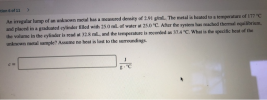 ion 6 of 11 > An irregular lump of an unknown metal has a measured density of 2.91 g/mL. The metal is heated to a temperature of 177 °C and placed in a graduated cylinder filled with 25.0 mL of water at 25.0 °C. After the system has reached thermal equilibrium, the volume in the cylinder is read at 32.8 mL, and the temperature is recorded as 37.4 °C. What is the specific heat of the unknown metal sample? Assume...
An irregular lump of an unknown metal has a measured density of 3.84 g/mL. The metal...
An irregular lump of an unknown metal has a measured density of 3.84 g/mL. The metal is heated to a temperature of 161 °C and placed in a graduated cylinder filled with 25.0 mL of water at 25.0 °C. After the system has reached thermal equilibrium, the volume in the cylinder is read at 33.7 mL, and the temperature is recorded as 37.4 °C. What is the specific heat of the unknown metal sample? Assume no heat is lost to...
 An irregular lump of an unknown metal has a measured density of 5.33 g/mL. The metal is heated to a temperature of 157 °C and placed in a graduated cylinder filled with 25.0 mL of water at 25.0°C. After the system has reached thermal equilibrium, the volume in the cylinder is read at 33.7 mL, and the temperature is recorded as 37.8 °C. What is the specific heat of the unknown metal sample? Assume no heat is lost to the...
 An irregular lump of an unknown metal has a measured density of 5.19 g/mL. The metal is heated to a temperature of 179 °C and placed in a graduated cylinder filled with 25.0 mL of water at 25.0 °C. After the system has reached thermal equilibrium, the volume in the cylinder is read at 31.6 mL, and the temperature is recorded as 39.2 °C. What is the specific heat of the unknown metal sample? Assume no heat is lost to...
 ion 6 of 11 > An irregular lump of an unknown metal has a measured density of 2.91 g/mL. The metal is heated to a temperature of 177 °C and placed in a graduated cylinder filled with 25.0 mL of water at 25.0 °C. After the system has reached thermal equilibrium, the volume in the cylinder is read at 32.8 mL, and the temperature is recorded as 37.4 °C. What is the specific heat of the unknown metal sample? Assume...
Most questions answered within 3 hours.
-
Where is the error in this code sequence?
String s1 = "Hello";
String s2 = "ello";...
asked 11 months ago -
Financial data for Joel de Paris, Inc., for last year
follow:
Joel de Paris, Inc.
Balance...
asked 11 months ago -
Consider this reaction:
Al2(SO4)3 (aq)+ BaCl3
(aq) Al2Cl6 (aq)- +
3BaSO4(s) . What is the...
asked 11 months ago -
Suppose that Savneet is considering increasing her
recent random sample from 20 car rentals to 40...
asked 11 months ago -
Trucks arrive at an unloading terminal at an average rate of 120
per hour.
Trucks arrive...
asked 11 months ago -
Why are methanol and ethanol completely soluble in water while
octanol is not very little soluble....
asked 11 months ago -
A facilities manager at a university reads in a research report
that the mean amount of...
asked 11 months ago -
When the CuSO4 is rehydrated by adding water to the anhydrous
compound, is this an endothermic...
asked 11 months ago -
A ray of sunlight is passing from diamond into crown glass; the
angle of incidence is...
asked 11 months ago -
A block of mass 0.249 kg is placed on top of a light, vertical
spring of...
asked 11 months ago -
how do the kidneys compensate in the presences of acidosis
a) trigger hyperventilate
b) reserve acid...
asked 11 months ago -
Question 501 pts
The rental rate of capital to the firm increases. Which of the
following...
asked 11 months ago