
Homework Answers


Add Answer to:
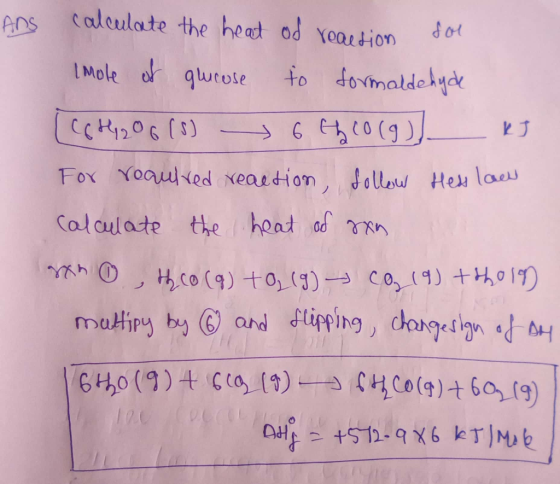
Calculate the heat of reaction for the conversion of 1 mole of glucose into formaldehyde, given...
Calculate the heat of reaction for the conversion of 1 mole of glucose into formaldehyde, given the following therm...
 Calculate the heat of reaction for the conversion of 1 mole of glucose into formaldehyde, given the following thermochemical data: H2CO(g)+0,(8)Co,(g) + H,0(g) AH Comb-572.9 kJ/mol 6C(s)+6H,(g)+30,(g)CH1206(s) AHP-1274.4 kJ/mol [c)+0,()Co,] AHP-393.5 kJ/mol H, (g)+0,) AH-285.8 kJ/mol H,0(s) What is the AHn for the reaction below? CH120)6H.CO(g) SUBMIT ANS
Calculate the heat of reaction for the conversion of 1 mole of glucose into formaldehyde, given...
 Calculate the heat of reaction for the conversion of 1 mole of glucose into formaldehyde, given the following thermochemical data: H.COg) +0,8) – CO,g) +H, (e) AH comb - -572.9 kJ/mol 6C(s) + 6H, (s) +302(8) AH--1274.4 kJ/mol CH2() 0,()] [C(s) +0,(s) - AH--393.5 kJ/mol H_(8) +0(8) -H,0 (8) AH = -285.8 kJ/mol What is the AHan for the reaction below? nyugust AH, --1274.4 kJ/mol 26 mplasci [C(s) +0,68) - 002(8)] AH,- -393.5 kJ/mol H,() + 02(8) AH, --285.8 kJ/mol...
a Using the heats of formation below, calculate the heat of reaction for the following reaction:...
 a Using the heats of formation below, calculate the heat of reaction for the following reaction: C2H2(g) + 5/202(2)→ 2C02() +H20() AH® (kJ/mol) C2H2(g) 226.7 O2(g) 0 CO2(g) -393.5 H20(-285.8 kJ Submit b Using the heats of formation below. calculate the heat of reaction for the following reaction: PC13(2) + Cl2(2)→ PC15(e) AH(kJ/mol) PC13(g) -306.4 Cl2(E) 0 PC1s() -398.9
6. Given the following thermochemical reactions 2NO N,+O 2NO+O,2NO AH=-180 kJ AH=-112 kJ Calculate the enthalpy...
 6. Given the following thermochemical reactions 2NO N,+O 2NO+O,2NO AH=-180 kJ AH=-112 kJ Calculate the enthalpy change of the reaction of nitrogen with oxygen to produce nitrogen dioxide. N,+20,2NO, AH r? Lo Given the following standard enthalpy of formations: AHor [C2H$OH(I) =-277.7 kJ/mol]; AHOr [CHCO2H) =-484.5 kJ/mol]; AHr [H2O) = -285.8 kJ/mol]; AHn[O2(g) = 0 kJ/mol]. Calculate the AHn for the reaction. C,H.OH()+O,(g) ->CH,CO,H() + H2O(1)
Please show all steps: Calculate the enthalpy for this reaction: Given the following thermochemical equations: c:H2(g)...
 Please show all steps:
Calculate the enthalpy for this reaction: Given the following thermochemical equations: c:H2(g) + (5/2)?2(g) > 2CO2(g) + H20(1) C(s) +02(g) -> CO2(g) ??? =-1299.5 kJ ??? -393.5 kJ ??? 285.8 kJ -> H2
Please show all steps:
Calculate the enthalpy for this reaction: Given the following thermochemical equations: c:H2(g) + (5/2)?2(g) > 2CO2(g) + H20(1) C(s) +02(g) -> CO2(g) ??? =-1299.5 kJ ??? -393.5 kJ ??? 285.8 kJ -> H2
1) Find the AH of the following reaction: C(s) + O2(g) à CO2(g) Given the following...
 1) Find the AH of the following reaction: C(s) + O2(g) à CO2(g) Given the following data: Sro(s) + CO2(g) à SrCO3(s) 2Sro(s) à 2Sr(s) +0,(8) AH = -234 kJ AH = +1184 kJ 2SCO,(s) à 25r(s) + 2C(s) + 302(g) AH = +2440 kJ 2) Find the AH of the following reaction: 3NO,(g) + H2O(l) à 2HNO,(aq) + NO(g) Given the following data: 2NO(g) + O2(g) à 2NO(g) AH=-116 kJ 2N2(g) + 502(g) + 2H2O(l) à 4HNO3(aq) AH =...
4. Use Hess' Law to calculate the enthalpy change (AHºr) for this reaction: (12 pts.) 6C(s)...
 4. Use Hess' Law to calculate the enthalpy change (AHºr) for this reaction: (12 pts.) 6C(s) + 6H2(g) + 302(g) → C6H12O6(s) using the following equations: A. C(s) + O2(g) → CO2(g) B. H2(g) + 1/2O2(g) → H2O(g) C. C6H12O6(s) + 6O2(g) → 6CO2(g) + 6H2O)- D. H20m) → H2O(g) AH°= -393.5 kJ AH°= -241.8kJ AH°= -2803.0 kJ AH°= +40.7 kJ C 6111260) At = AHT (66 tn 4) AH3= DH, + A M₂ A4 = A Hz - H₂...
1. Calculate AH for the reaction C2H4 (8) + H2() → C2H6), from the following data....
 1. Calculate AH for the reaction C2H4 (8) + H2() → C2H6), from the following data. C2H4 (g) + 3 02 (®) → 2 CO2 (s) + 2 H20 (1) C2H6 (g) + 7/2 02(g) → 2 CO2(g) + 3 H20 (1) H2 + 1/2O2() → H20 (1) AH = -1411. kJ/mole AH = -1560. kJ/mole AH = -285.8 kJ/mole 2. Calculate AH for the reaction 4 NH3(g) +502 (g) → 4 NO(g) + 6 H20 (g), from the following...
*ATTACHED THE PICTURE BELOW TO HAVE A BETTER UNDERTSTANDING* *Also please showwork on how tou solve...
 *ATTACHED THE PICTURE BELOW TO HAVE A BETTER
UNDERTSTANDING*
*Also please showwork on how tou solve the problem to
umderstand it* TY
4. Use Hess' Law to calculate the enthalpy change (∆H°f) for
this reaction:
6C(s) + 6H2(g) + 3O2(g)C6H12O6(s)
using the following equations:
A. C(s) + O2(g)CO2(g)
B. H2(g) + 1/2O2(g)H2O(g)
C. C6H12O6(s) + 6O2(g) 6CO2(g) + 6H2O(l)
D. H2O(l)H2O(g)
∆H°= -393.5 kJ
∆H°= -241.8kJ
∆H°= -2803.0 kJ
∆H°= +40.7 kJ
Why is this change in enthalpy given...
*ATTACHED THE PICTURE BELOW TO HAVE A BETTER
UNDERTSTANDING*
*Also please showwork on how tou solve the problem to
umderstand it* TY
4. Use Hess' Law to calculate the enthalpy change (∆H°f) for
this reaction:
6C(s) + 6H2(g) + 3O2(g)C6H12O6(s)
using the following equations:
A. C(s) + O2(g)CO2(g)
B. H2(g) + 1/2O2(g)H2O(g)
C. C6H12O6(s) + 6O2(g) 6CO2(g) + 6H2O(l)
D. H2O(l)H2O(g)
∆H°= -393.5 kJ
∆H°= -241.8kJ
∆H°= -2803.0 kJ
∆H°= +40.7 kJ
Why is this change in enthalpy given...
6. Hess's Law. Use the data in Table 1 to calculate AH for the reaction below:...
 6. Hess's Law. Use the data in Table 1 to calculate AH for the reaction below: Table 1. Change in Enthalpy for Reactions Reactions Change in Enthalpy (AH) AH = -393.5 kJ/mol (1) C() (2) Hz((g) + + O2(g) O2(g) → CO2(8) → H2O(l) AH2 = -285.8 kJ/mol (3) 2CH.(g) + 702(g) → 4 CO2(g)+ 6H2O(1) AH = -283.0 kJ/mol Calculate the enthalpy change for the reaction: 2 C(s) + 3H2(g) → CzH6(g) AH = kJ/mol
 Calculate the heat of reaction for the conversion of 1 mole of glucose into formaldehyde, given the following thermochemical data: H2CO(g)+0,(8)Co,(g) + H,0(g) AH Comb-572.9 kJ/mol 6C(s)+6H,(g)+30,(g)CH1206(s) AHP-1274.4 kJ/mol [c)+0,()Co,] AHP-393.5 kJ/mol H, (g)+0,) AH-285.8 kJ/mol H,0(s) What is the AHn for the reaction below? CH120)6H.CO(g) SUBMIT ANS
 Calculate the heat of reaction for the conversion of 1 mole of glucose into formaldehyde, given the following thermochemical data: H.COg) +0,8) – CO,g) +H, (e) AH comb - -572.9 kJ/mol 6C(s) + 6H, (s) +302(8) AH--1274.4 kJ/mol CH2() 0,()] [C(s) +0,(s) - AH--393.5 kJ/mol H_(8) +0(8) -H,0 (8) AH = -285.8 kJ/mol What is the AHan for the reaction below? nyugust AH, --1274.4 kJ/mol 26 mplasci [C(s) +0,68) - 002(8)] AH,- -393.5 kJ/mol H,() + 02(8) AH, --285.8 kJ/mol...
 a Using the heats of formation below, calculate the heat of reaction for the following reaction: C2H2(g) + 5/202(2)→ 2C02() +H20() AH® (kJ/mol) C2H2(g) 226.7 O2(g) 0 CO2(g) -393.5 H20(-285.8 kJ Submit b Using the heats of formation below. calculate the heat of reaction for the following reaction: PC13(2) + Cl2(2)→ PC15(e) AH(kJ/mol) PC13(g) -306.4 Cl2(E) 0 PC1s() -398.9
 6. Given the following thermochemical reactions 2NO N,+O 2NO+O,2NO AH=-180 kJ AH=-112 kJ Calculate the enthalpy change of the reaction of nitrogen with oxygen to produce nitrogen dioxide. N,+20,2NO, AH r? Lo Given the following standard enthalpy of formations: AHor [C2H$OH(I) =-277.7 kJ/mol]; AHOr [CHCO2H) =-484.5 kJ/mol]; AHr [H2O) = -285.8 kJ/mol]; AHn[O2(g) = 0 kJ/mol]. Calculate the AHn for the reaction. C,H.OH()+O,(g) ->CH,CO,H() + H2O(1)
 Please show all steps:
Calculate the enthalpy for this reaction: Given the following thermochemical equations: c:H2(g) + (5/2)?2(g) > 2CO2(g) + H20(1) C(s) +02(g) -> CO2(g) ??? =-1299.5 kJ ??? -393.5 kJ ??? 285.8 kJ -> H2
Please show all steps:
Calculate the enthalpy for this reaction: Given the following thermochemical equations: c:H2(g) + (5/2)?2(g) > 2CO2(g) + H20(1) C(s) +02(g) -> CO2(g) ??? =-1299.5 kJ ??? -393.5 kJ ??? 285.8 kJ -> H2
 1) Find the AH of the following reaction: C(s) + O2(g) à CO2(g) Given the following data: Sro(s) + CO2(g) à SrCO3(s) 2Sro(s) à 2Sr(s) +0,(8) AH = -234 kJ AH = +1184 kJ 2SCO,(s) à 25r(s) + 2C(s) + 302(g) AH = +2440 kJ 2) Find the AH of the following reaction: 3NO,(g) + H2O(l) à 2HNO,(aq) + NO(g) Given the following data: 2NO(g) + O2(g) à 2NO(g) AH=-116 kJ 2N2(g) + 502(g) + 2H2O(l) à 4HNO3(aq) AH =...
 4. Use Hess' Law to calculate the enthalpy change (AHºr) for this reaction: (12 pts.) 6C(s) + 6H2(g) + 302(g) → C6H12O6(s) using the following equations: A. C(s) + O2(g) → CO2(g) B. H2(g) + 1/2O2(g) → H2O(g) C. C6H12O6(s) + 6O2(g) → 6CO2(g) + 6H2O)- D. H20m) → H2O(g) AH°= -393.5 kJ AH°= -241.8kJ AH°= -2803.0 kJ AH°= +40.7 kJ C 6111260) At = AHT (66 tn 4) AH3= DH, + A M₂ A4 = A Hz - H₂...
 1. Calculate AH for the reaction C2H4 (8) + H2() → C2H6), from the following data. C2H4 (g) + 3 02 (®) → 2 CO2 (s) + 2 H20 (1) C2H6 (g) + 7/2 02(g) → 2 CO2(g) + 3 H20 (1) H2 + 1/2O2() → H20 (1) AH = -1411. kJ/mole AH = -1560. kJ/mole AH = -285.8 kJ/mole 2. Calculate AH for the reaction 4 NH3(g) +502 (g) → 4 NO(g) + 6 H20 (g), from the following...
 *ATTACHED THE PICTURE BELOW TO HAVE A BETTER
UNDERTSTANDING*
*Also please showwork on how tou solve the problem to
umderstand it* TY
4. Use Hess' Law to calculate the enthalpy change (∆H°f) for
this reaction:
6C(s) + 6H2(g) + 3O2(g)C6H12O6(s)
using the following equations:
A. C(s) + O2(g)CO2(g)
B. H2(g) + 1/2O2(g)H2O(g)
C. C6H12O6(s) + 6O2(g) 6CO2(g) + 6H2O(l)
D. H2O(l)H2O(g)
∆H°= -393.5 kJ
∆H°= -241.8kJ
∆H°= -2803.0 kJ
∆H°= +40.7 kJ
Why is this change in enthalpy given...
*ATTACHED THE PICTURE BELOW TO HAVE A BETTER
UNDERTSTANDING*
*Also please showwork on how tou solve the problem to
umderstand it* TY
4. Use Hess' Law to calculate the enthalpy change (∆H°f) for
this reaction:
6C(s) + 6H2(g) + 3O2(g)C6H12O6(s)
using the following equations:
A. C(s) + O2(g)CO2(g)
B. H2(g) + 1/2O2(g)H2O(g)
C. C6H12O6(s) + 6O2(g) 6CO2(g) + 6H2O(l)
D. H2O(l)H2O(g)
∆H°= -393.5 kJ
∆H°= -241.8kJ
∆H°= -2803.0 kJ
∆H°= +40.7 kJ
Why is this change in enthalpy given...
 6. Hess's Law. Use the data in Table 1 to calculate AH for the reaction below: Table 1. Change in Enthalpy for Reactions Reactions Change in Enthalpy (AH) AH = -393.5 kJ/mol (1) C() (2) Hz((g) + + O2(g) O2(g) → CO2(8) → H2O(l) AH2 = -285.8 kJ/mol (3) 2CH.(g) + 702(g) → 4 CO2(g)+ 6H2O(1) AH = -283.0 kJ/mol Calculate the enthalpy change for the reaction: 2 C(s) + 3H2(g) → CzH6(g) AH = kJ/mol
Most questions answered within 3 hours.
-
Where is the error in this code sequence?
String s1 = "Hello";
String s2 = "ello";...
asked 11 months ago -
Financial data for Joel de Paris, Inc., for last year
follow:
Joel de Paris, Inc.
Balance...
asked 11 months ago -
Consider this reaction:
Al2(SO4)3 (aq)+ BaCl3
(aq) Al2Cl6 (aq)- +
3BaSO4(s) . What is the...
asked 11 months ago -
Suppose that Savneet is considering increasing her
recent random sample from 20 car rentals to 40...
asked 11 months ago -
Trucks arrive at an unloading terminal at an average rate of 120
per hour.
Trucks arrive...
asked 11 months ago -
Why are methanol and ethanol completely soluble in water while
octanol is not very little soluble....
asked 11 months ago -
A facilities manager at a university reads in a research report
that the mean amount of...
asked 11 months ago -
When the CuSO4 is rehydrated by adding water to the anhydrous
compound, is this an endothermic...
asked 11 months ago -
A ray of sunlight is passing from diamond into crown glass; the
angle of incidence is...
asked 11 months ago -
A block of mass 0.249 kg is placed on top of a light, vertical
spring of...
asked 11 months ago -
how do the kidneys compensate in the presences of acidosis
a) trigger hyperventilate
b) reserve acid...
asked 11 months ago -
Question 501 pts
The rental rate of capital to the firm increases. Which of the
following...
asked 11 months ago