
Homework Answers
b) To separate the two metals difference between their non expanded diameter must be equal to the change in expanded diameters for a given temperature difference i.e.,

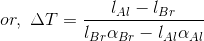
l denotes the length and  denotes the coefficient of linear expansion
Putting the values,

So, the temperature they must be cooled to is

Add Answer to:
A brass ring of diameter 10.00 cm at 22.0°C is heated and slipped over an aluminum...
OAsk Your Teacher 2. +1/3 polnts | Previous Answers SF6 10.P.015 My Notes A brass ring of diameter 10 cm at 18.0°C is heated and slipped over an aluminum rod with a diameter of 10.01 cm at 18.0°C. As...
 OAsk Your Teacher 2. +1/3 polnts | Previous Answers SF6 10.P.015 My Notes A brass ring of diameter 10 cm at 18.0°C is heated and slipped over an aluminum rod with a diameter of 10.01 cm at 18.0°C. Assume that the average coefficients of linear expansion are constant (a) To what temperature must this combination be cooled to separate them? PC Is this temperature attainable? yes no (b) If the aluminum rod were 10.03 cm in diameter, what would be...
At 28.5°C, an aluminum ring has an inner diameter of 6.000 0 cm and a brass...
 At 28.5°C, an aluminum ring has an inner diameter of 6.000 0 cm and a brass rod has a diameter of 6.070 0 cm. (Note, if needed, Table 1 is available for use in solving this problem.) (a) If only the ring is warmed, what temperature must it reach so that it will just slip over the rod? 486.11 This is the required temperature change of the ring. The problem asks for the final temperature. °C (b) If both the...
A steel rod is 3.418 cm in diameter at 26.00°C. A brass ring has an interior...
A steel rod is 3.418 cm in diameter at 26.00°C. A brass ring has an interior diameter of 3.410 cm at 26.00°C. At what common temperature will the ring just slide onto the rod? The linear expansion coefficient of steel is 11.00 × 10⁻⁶ 1/C°. The linear expansion coefficient of brass is 19.00 × 10⁻⁶ 1/C°.
A steel rod is 2.855 cm in diameter at 20.00°C. A brass ring has an interior...
A steel rod is 2.855 cm in diameter at 20.00°C. A brass ring has an interior diameter of 2.852 cm at 20.00°C. At what common temperature will the ring just slide onto the rod? The linear expansion coefficient of steel is 11.00 × 10⁻⁶ 1/C°. The linear expansion coefficient of brass is 19.00 × 10⁻⁶ 1/C°.
A steel rod is 3.311 cm in diameter at 27.00°C. A brass ring has an interior...
A steel rod is 3.311 cm in diameter at 27.00°C. A brass ring has an interior diameter of 3.307 cm at 27.00°C. At what common temperature will the ring just slide onto the rod? The linear expansion coefficient of steel is 11.00 × 10⁻⁶ 1/C°. The linear expansion coefficient of brass is 19.00 × 10⁻⁶ 1/C°.
At 20∘C, the hole in an aluminum ring is 2.700 cm in diameter. You need to...
At 20∘C, the hole in an aluminum ring is 2.700 cm in diameter. You need to slip this ring over a steel shaft that has a room-temperature diameter of 2.707 cm . To what common temperature should the ring and the shaft be heated so that the ring will just fit onto the shaft? Coefficients of linear thermal expansion of steel and aluminum are 12×10−6 K−1 and 23×10−6 K−1 respectively.
At 20∘C, the hole in an aluminum ring is 2.300 cm in diameter. You need to...
At 20∘C, the hole in an aluminum ring is 2.300 cm in diameter. You need to slip this ring over a steel shaft that has a room-temperature diameter of 2.306 cm .To what common temperature should the ring and the shaft be heated so that the ring will just fit onto the shaft? Coefficients of linear thermal expansion of steel and aluminum are 12×10−6 K−1 and 23×10−6 K−1 respectively.
Original Temp = 22 degrees C 3. An aluminum ring has an inner diameter slightly smaller...
 Original Temp = 22 degrees
C
3. An aluminum ring has an inner diameter slightly smaller than the diameter of a steel rod. The aluminum ring is heated so that it expands sufficiently to fit over the steel rod and cooled so that it makes a tight fit. Because aluminum expands and contracts at a greater rate than steel, the system should be heated. The diameter of steel rod is 4.040 cm and the diameter of the aluminum ring is...
Original Temp = 22 degrees
C
3. An aluminum ring has an inner diameter slightly smaller than the diameter of a steel rod. The aluminum ring is heated so that it expands sufficiently to fit over the steel rod and cooled so that it makes a tight fit. Because aluminum expands and contracts at a greater rate than steel, the system should be heated. The diameter of steel rod is 4.040 cm and the diameter of the aluminum ring is...
A steel rod is 3.000 cm in diameter at 25°C. A brass ring has an interior...
A steel rod is 3.000 cm in diameter at 25°C. A brass ring has an interior diameter of 2.992 cm at 25°C. At what common temperature will the ring just slide onto the rod?
A hollow aluminum cylinder 15.0 cm deep has an internal capacity of 2.000 L at 22.0°C....
A hollow aluminum cylinder 15.0 cm deep has an internal capacity of 2.000 L at 22.0°C. It is completely filled with turpentine at 22.0°C. The turpentine and the aluminum cylinder are then slowly warmed together to 92.0°C. (The average linear expansion coefficient for aluminum is 24 ? 10?6°C?1, and the average volume expansion coefficient for turpentine is 9.0 ? 10?4°C?1.) (a) How much turpentine overflows? cm3 (b) What is the volume of turpentine remaining in the cylinder at 92.0°C? (Give...
 OAsk Your Teacher 2. +1/3 polnts | Previous Answers SF6 10.P.015 My Notes A brass ring of diameter 10 cm at 18.0°C is heated and slipped over an aluminum rod with a diameter of 10.01 cm at 18.0°C. Assume that the average coefficients of linear expansion are constant (a) To what temperature must this combination be cooled to separate them? PC Is this temperature attainable? yes no (b) If the aluminum rod were 10.03 cm in diameter, what would be...
 At 28.5°C, an aluminum ring has an inner diameter of 6.000 0 cm and a brass rod has a diameter of 6.070 0 cm. (Note, if needed, Table 1 is available for use in solving this problem.) (a) If only the ring is warmed, what temperature must it reach so that it will just slip over the rod? 486.11 This is the required temperature change of the ring. The problem asks for the final temperature. °C (b) If both the...
 Original Temp = 22 degrees
C
3. An aluminum ring has an inner diameter slightly smaller than the diameter of a steel rod. The aluminum ring is heated so that it expands sufficiently to fit over the steel rod and cooled so that it makes a tight fit. Because aluminum expands and contracts at a greater rate than steel, the system should be heated. The diameter of steel rod is 4.040 cm and the diameter of the aluminum ring is...
Original Temp = 22 degrees
C
3. An aluminum ring has an inner diameter slightly smaller than the diameter of a steel rod. The aluminum ring is heated so that it expands sufficiently to fit over the steel rod and cooled so that it makes a tight fit. Because aluminum expands and contracts at a greater rate than steel, the system should be heated. The diameter of steel rod is 4.040 cm and the diameter of the aluminum ring is...
Most questions answered within 3 hours.
-
Where is the error in this code sequence?
String s1 = "Hello";
String s2 = "ello";...
asked 11 months ago -
Financial data for Joel de Paris, Inc., for last year
follow:
Joel de Paris, Inc.
Balance...
asked 11 months ago -
Consider this reaction:
Al2(SO4)3 (aq)+ BaCl3
(aq) Al2Cl6 (aq)- +
3BaSO4(s) . What is the...
asked 11 months ago -
Suppose that Savneet is considering increasing her
recent random sample from 20 car rentals to 40...
asked 11 months ago -
Trucks arrive at an unloading terminal at an average rate of 120
per hour.
Trucks arrive...
asked 11 months ago -
Why are methanol and ethanol completely soluble in water while
octanol is not very little soluble....
asked 11 months ago -
A facilities manager at a university reads in a research report
that the mean amount of...
asked 11 months ago -
When the CuSO4 is rehydrated by adding water to the anhydrous
compound, is this an endothermic...
asked 11 months ago -
A ray of sunlight is passing from diamond into crown glass; the
angle of incidence is...
asked 11 months ago -
A block of mass 0.249 kg is placed on top of a light, vertical
spring of...
asked 11 months ago -
how do the kidneys compensate in the presences of acidosis
a) trigger hyperventilate
b) reserve acid...
asked 11 months ago -
Question 501 pts
The rental rate of capital to the firm increases. Which of the
following...
asked 11 months ago