
Homework Answers
Add Answer to:
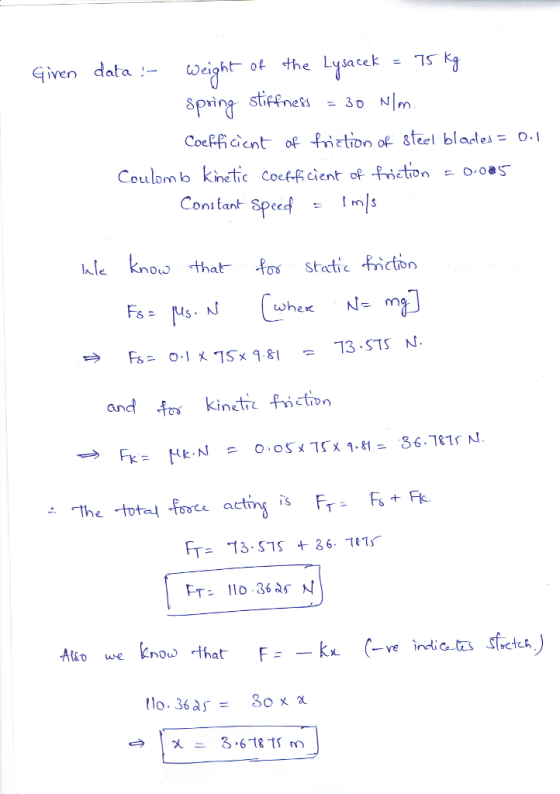
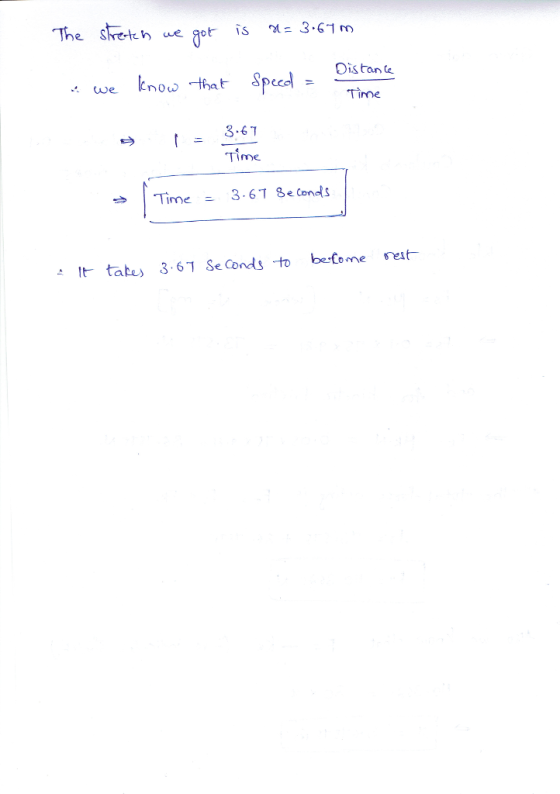
Problem 3. Evan Lysacek and Elvis Stojko, two of the best ice skaters, are challenging each...
In Figure 11-48, two skaters, each of mass 40 kg, approach each other along parallel paths...
Two skaters, each of mass 40 kg, approach each other along parallel paths separated by 4.0 m. They have opposite velocities of 2.1 m/s each. One skater carries one endof a long pole with negligible mass, and the second skater grabs the other end of it as she passes. The skaters then rotate around the center of the pole. Assume thatthe friction between skates and ice is negligible.(a) What is the radius of the circle they now skate in?2 meters(b)...
Two friends, Al and Jo, have a combined mass of 168 kg. At an ice skating...
Two friends, Al and Jo, have a combined mass of 168 kg. At an ice skating rink they stand close together on skates, at rest and facing each other, with a compressed spring between them. The spring is kept from pushing them apart because they are holding each other. When they release their arms, Al moves off in one direction at a speed of 0.75 m/s, while Jo moves off in the opposite direction at a speed of 1.5 m/s....
#4-7 Two ice skaters stand facing each other at rest on a frozen pond. They push...
 #4-7
Two ice skaters stand facing each other at rest on a frozen pond. They push off against one another and the 48 kg skater acquires a speed of 0.69 m/s If the other skater acquires a speed of 0.81 m/s, what is her mass in kilograms? kg My Notes Ask Your Teacher -/2 points HAFColPhys1 8.2WA019. O5 Submissiens Used A man holding a rock sits on a sled that is sliding across a frozen lake (negligible friction) with a...
#4-7
Two ice skaters stand facing each other at rest on a frozen pond. They push off against one another and the 48 kg skater acquires a speed of 0.69 m/s If the other skater acquires a speed of 0.81 m/s, what is her mass in kilograms? kg My Notes Ask Your Teacher -/2 points HAFColPhys1 8.2WA019. O5 Submissiens Used A man holding a rock sits on a sled that is sliding across a frozen lake (negligible friction) with a...
Question 6.3 6.3 Consider a double mass-spring system with two masses of M and m on...
 Question 6.3
6.3 Consider a double mass-spring system with two masses of M and m on a frictionless surface, as shown in Figure 6.30. Mass m is connected to M by a spring of constant k and rest length lo. Mass M is connected to a fixed wall by a spring of constant k and rest length lo and a damper with constant b. Find the equations of motion of each mass. (HINT: See Tutorial 2.1.) risto M wa ww...
Question 6.3
6.3 Consider a double mass-spring system with two masses of M and m on a frictionless surface, as shown in Figure 6.30. Mass m is connected to M by a spring of constant k and rest length lo. Mass M is connected to a fixed wall by a spring of constant k and rest length lo and a damper with constant b. Find the equations of motion of each mass. (HINT: See Tutorial 2.1.) risto M wa ww...
3. 1072 4 m/s 26 A 80 kg Prof. Sukanek wearing ice skates stands motionless on...
 3. 1072 4 m/s 26 A 80 kg Prof. Sukanek wearing ice skates stands motionless on the ice when he throws a 8 kg block with a velocity as shown in the figure. Assume he keeps his legs rigid during the throw and neglect friction and the motion of his arms. Use right and up as the positive directions. NOTES IMAGES DISCUSS UNITS STATS HELP PREFERENCES Part Description Answer Chk History A. 6.82 pts. 75% Assume he completes the throw...
Consider the system shown in the figure right, where two blocks m1=5 kg, and m2=10 kg are connected to each other
 Consider the system shown in the figure right, where two blocks m1=5 kg, and m2=10 kg are connected to each other by a string that passes through a massless pulley. The stiffness constant of the spring attached to m1 and the wall is k=120N/m and the coefficient of kinetic friction between m1 and the surface is given to be μk=0.2. If the system is released from rest when the spring is at its equilibrium length and m2 is at a...
Version 3 Part B (Mechanical Encrgy and Conservation of Energy) Problem B1: Two blocks with masses...
 Version 3 Part B (Mechanical Encrgy and Conservation of Energy) Problem B1: Two blocks with masses m,-Skg and mz= 10kg hang on either side of a pulley as shown in figure below. Block m, is on an incline 0 30° and is attached to a spring whose constant is k 40N/m. The system is released from rest with the spring at is natural length. m2 Use the conservation of mechanical energy to find: 1) The maximum extension of the spring....
3, A block of mass m = 2.00 kg is attached to a spring of force...
 3, A block of mass m = 2.00 kg is attached to a spring of force constant k = 520 N/m as shown in the figure low. The block is pulled to a position ax, -5.15 em to the right of equilibrium and released from rest. x=0 x=x o Find the sped he lodk has as it passes through equililbrium if the horizontal surface is frctionless (b) Find the speed the block has as it passes through equilibrium (for the...
Problem 3 (70 pts): Consider the mechanical system in Figure , the so-called "cart pendulum" system....
 Problem 3 (70 pts): Consider the mechanical system in Figure , the so-called "cart pendulum" system. The cart has a moving mass M, and is connected to a linear motor via a flexible coupling with stiffness K and damping B. An inverted pendulum of length1, negligible inertia and mass m is attached to the cart via a rotary actuator. If the pendulum damping coefficient is b, the linear actuator force is F and the rotary actuator torque is t 1)...
PLEASE EXPLAIN ALL ANSWERS 3 kg vertically cing is 10 kg g is used to frictionless...
 PLEASE EXPLAIN ALL ANSWERS
3 kg vertically cing is 10 kg g is used to frictionless maximum these ag is most 11. Three blocks, A, B, and C. of masses 1, 2, and 3 kg, respectively, are initially at rest on a frictionless surface as indicated in the figure above. What force has to be applied on block C 5= 200 mis? to accelerate the three blocks at 2 m/s? (A) 0.33 N (2) +22) 4362) 16 V=20mis (B) 1.5...
PLEASE EXPLAIN ALL ANSWERS
3 kg vertically cing is 10 kg g is used to frictionless maximum these ag is most 11. Three blocks, A, B, and C. of masses 1, 2, and 3 kg, respectively, are initially at rest on a frictionless surface as indicated in the figure above. What force has to be applied on block C 5= 200 mis? to accelerate the three blocks at 2 m/s? (A) 0.33 N (2) +22) 4362) 16 V=20mis (B) 1.5...
 #4-7
Two ice skaters stand facing each other at rest on a frozen pond. They push off against one another and the 48 kg skater acquires a speed of 0.69 m/s If the other skater acquires a speed of 0.81 m/s, what is her mass in kilograms? kg My Notes Ask Your Teacher -/2 points HAFColPhys1 8.2WA019. O5 Submissiens Used A man holding a rock sits on a sled that is sliding across a frozen lake (negligible friction) with a...
#4-7
Two ice skaters stand facing each other at rest on a frozen pond. They push off against one another and the 48 kg skater acquires a speed of 0.69 m/s If the other skater acquires a speed of 0.81 m/s, what is her mass in kilograms? kg My Notes Ask Your Teacher -/2 points HAFColPhys1 8.2WA019. O5 Submissiens Used A man holding a rock sits on a sled that is sliding across a frozen lake (negligible friction) with a...
 Question 6.3
6.3 Consider a double mass-spring system with two masses of M and m on a frictionless surface, as shown in Figure 6.30. Mass m is connected to M by a spring of constant k and rest length lo. Mass M is connected to a fixed wall by a spring of constant k and rest length lo and a damper with constant b. Find the equations of motion of each mass. (HINT: See Tutorial 2.1.) risto M wa ww...
Question 6.3
6.3 Consider a double mass-spring system with two masses of M and m on a frictionless surface, as shown in Figure 6.30. Mass m is connected to M by a spring of constant k and rest length lo. Mass M is connected to a fixed wall by a spring of constant k and rest length lo and a damper with constant b. Find the equations of motion of each mass. (HINT: See Tutorial 2.1.) risto M wa ww...
 3. 1072 4 m/s 26 A 80 kg Prof. Sukanek wearing ice skates stands motionless on the ice when he throws a 8 kg block with a velocity as shown in the figure. Assume he keeps his legs rigid during the throw and neglect friction and the motion of his arms. Use right and up as the positive directions. NOTES IMAGES DISCUSS UNITS STATS HELP PREFERENCES Part Description Answer Chk History A. 6.82 pts. 75% Assume he completes the throw...
 Version 3 Part B (Mechanical Encrgy and Conservation of Energy) Problem B1: Two blocks with masses m,-Skg and mz= 10kg hang on either side of a pulley as shown in figure below. Block m, is on an incline 0 30° and is attached to a spring whose constant is k 40N/m. The system is released from rest with the spring at is natural length. m2 Use the conservation of mechanical energy to find: 1) The maximum extension of the spring....
 3, A block of mass m = 2.00 kg is attached to a spring of force constant k = 520 N/m as shown in the figure low. The block is pulled to a position ax, -5.15 em to the right of equilibrium and released from rest. x=0 x=x o Find the sped he lodk has as it passes through equililbrium if the horizontal surface is frctionless (b) Find the speed the block has as it passes through equilibrium (for the...
 Problem 3 (70 pts): Consider the mechanical system in Figure , the so-called "cart pendulum" system. The cart has a moving mass M, and is connected to a linear motor via a flexible coupling with stiffness K and damping B. An inverted pendulum of length1, negligible inertia and mass m is attached to the cart via a rotary actuator. If the pendulum damping coefficient is b, the linear actuator force is F and the rotary actuator torque is t 1)...
 PLEASE EXPLAIN ALL ANSWERS
3 kg vertically cing is 10 kg g is used to frictionless maximum these ag is most 11. Three blocks, A, B, and C. of masses 1, 2, and 3 kg, respectively, are initially at rest on a frictionless surface as indicated in the figure above. What force has to be applied on block C 5= 200 mis? to accelerate the three blocks at 2 m/s? (A) 0.33 N (2) +22) 4362) 16 V=20mis (B) 1.5...
PLEASE EXPLAIN ALL ANSWERS
3 kg vertically cing is 10 kg g is used to frictionless maximum these ag is most 11. Three blocks, A, B, and C. of masses 1, 2, and 3 kg, respectively, are initially at rest on a frictionless surface as indicated in the figure above. What force has to be applied on block C 5= 200 mis? to accelerate the three blocks at 2 m/s? (A) 0.33 N (2) +22) 4362) 16 V=20mis (B) 1.5...
Most questions answered within 3 hours.
-
Where is the error in this code sequence?
String s1 = "Hello";
String s2 = "ello";...
asked 10 months ago -
Financial data for Joel de Paris, Inc., for last year
follow:
Joel de Paris, Inc.
Balance...
asked 10 months ago -
Consider this reaction:
Al2(SO4)3 (aq)+ BaCl3
(aq) Al2Cl6 (aq)- +
3BaSO4(s) . What is the...
asked 10 months ago -
Suppose that Savneet is considering increasing her
recent random sample from 20 car rentals to 40...
asked 10 months ago -
Trucks arrive at an unloading terminal at an average rate of 120
per hour.
Trucks arrive...
asked 10 months ago -
Why are methanol and ethanol completely soluble in water while
octanol is not very little soluble....
asked 10 months ago -
A facilities manager at a university reads in a research report
that the mean amount of...
asked 10 months ago -
When the CuSO4 is rehydrated by adding water to the anhydrous
compound, is this an endothermic...
asked 10 months ago -
A ray of sunlight is passing from diamond into crown glass; the
angle of incidence is...
asked 10 months ago -
A block of mass 0.249 kg is placed on top of a light, vertical
spring of...
asked 10 months ago -
how do the kidneys compensate in the presences of acidosis
a) trigger hyperventilate
b) reserve acid...
asked 10 months ago -
Question 501 pts
The rental rate of capital to the firm increases. Which of the
following...
asked 10 months ago