How do you calculate the sample mean excess return of the risk free rate ? (possibly...
How do you calculate the sample mean excess return of the risk free rate ? (possibly with excel)
Homework Answers
Step :- 1
First of all enter the data of the rerunron the security over the years in column.

Step :- 2
Then in next column enter the risk free interest rate data.
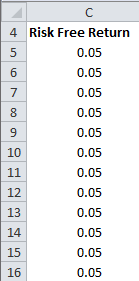
Step :- 3
Then in the next column, subtract the risk free returns from the returns on our security. This will called Excess Return.
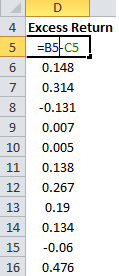
Step :- 4
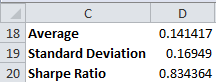
- Now let's calculat the excess return. In the above sheet it will be calculate by the =AVERAGE (D15:D16).
- calculate the standard deviations of the Excess Return. For above example it will be =STDEV(D5:D16)
- Finally calculate the sharpe's ratio by the dividing the average excess return by the standard deviations of the same. In our example the formula will be =D18/D19
Thanks for posting.....
i hope my efforts will be fruitful to you...?
Add Answer to:
How do you calculate the sample mean excess return of the risk
free rate ? (possibly...
CAPM: The risk-free rate is 2%, Beta=1.6 and return to the market is 5% Calculate excess...
CAPM: The risk-free rate is 2%, Beta=1.6 and return to the market is 5% Calculate excess return to the market Calculate the required return on equity What does a lower number mean vs a higher return on equity? No spreadsheet, worked out
Suppose that the average excess return on stocks is 12.00% and that the risk-free interest rate...
 Suppose that the average excess return on stocks is 12.00% and that the risk-free interest rate is 3.00%. Compute expected returns to stocks with each of the following beta coefficients using the capital asset pricing model (CAPM): Hint: Do not forget to enter the minus sign if the value of the return to stock is negative.) Return to Stocks (%) 0.7 0.2 1.0 2.0 Based on the CAPM and your calculations for the return to stocks, what does it mean...
The risk-free rate is 3% and you believe that the S&P 500's excess return will be...
The risk-free rate is 3% and you believe that the S&P 500's excess return will be 10.6% over the next year. If you invest in a stock with a beta of 1.1 (and a standard deviation of 30%), what is your best guess as to its expected excess return over the next year? The expected excess return over the next year is? (Round to two decimal places.)
A corporate bond has an expected, total (not excess) return of 5%. The risk-free rate is...
A corporate bond has an expected, total (not excess) return of 5%. The risk-free rate is 2% and the expected market return (total, not excess) is 10%. Which of the following is closest to the beta of the corporate bond?
The risk free rate is 7%, the return in the market is 10%, and the beta...
The risk free rate is 7%, the return in the market is 10%, and the beta is 1.30. What return must you receive to be satisfied that you are being fairly ]for the risk of the firm? Using excel to solve
Consider the two (excess return) index-model regression results for stocks A and B. The risk-free rate...
 Consider the two (excess return) index-model regression results
for stocks A and B. The risk-free rate over the
period was 7%, and the market’s average return was 14%. Performance
is measured using an index model regression on excess returns.
Consider the two excess return) index-model regression results for stocks A and B. The risk-free rate over the period was 7%, and the market's average return was 14%. Performance is measured using an index model regression on excess returns Stock A...
Consider the two (excess return) index-model regression results
for stocks A and B. The risk-free rate over the
period was 7%, and the market’s average return was 14%. Performance
is measured using an index model regression on excess returns.
Consider the two excess return) index-model regression results for stocks A and B. The risk-free rate over the period was 7%, and the market's average return was 14%. Performance is measured using an index model regression on excess returns Stock A...
Given that the risk-free rate is 5%, the expected return on the market portfolio is 20%,...
Given that the risk-free rate is 5%, the expected return on the market portfolio is 20%, and the standard deviation of returns to the market portfolio is 20%, answer the following questions: c. Now suppose that you want to have a portfolio, which pays 25% expected return. What is the weight in the risk free asset and in the market portfolio? d. What do these weights mean: What are you doing with the risk free asset and what are you...
TOISRULIUSS. Expected Return = Risk free Rate + beta (expected market return - risk free rate)...
 TOISRULIUSS. Expected Return = Risk free Rate + beta (expected market return - risk free rate) .04 +0.80.09 - .04) = .08 = 8.0% 3. Suppose the MiniCD Corporation's common stock has a return of 12%. Assume the risk- free rate is 4%, the expected market return is 9%, and no unsystematic influence affected Mini's return. The beta for MiniCD is:
Consider the two (excess return) index-model regression results for stocks A and B. The risk-free rate...
Consider the two (excess return) index-model regression results for stocks A and B. The risk-free rate over the period was 7%, and the market’s average return was 14%. Performance is measured using an index model regression on excess returns. Stock A Stock B Index model regression estimates 1% + 1.2(rM − rf) 2% + 0.8(rM − rf) R-square 0.635 0.466 Residual standard deviation, σ(e) 11.3% 20.1% Standard deviation of excess returns 22.6% 26.9% a. Calculate the following statistics for each...
Consider the two (excess return) index-model regression results for stocks A and B. The risk-free rate...
Consider the two (excess return) index-model regression results for stocks A and B. The risk-free rate over the period was 5%, and the market’s average return was 12%. Performance is measured using an index model regression on excess returns. Stock A Stock B Index model regression estimates 1% + 1.2(rM − rf) 2% + 0.8(rM − rf) R-square 0.599 0.448 Residual standard deviation, σ(e) 10.7% 19.5% Standard deviation of excess returns 22% 25.7% a. Calculate the following statistics for each...
 Suppose that the average excess return on stocks is 12.00% and that the risk-free interest rate is 3.00%. Compute expected returns to stocks with each of the following beta coefficients using the capital asset pricing model (CAPM): Hint: Do not forget to enter the minus sign if the value of the return to stock is negative.) Return to Stocks (%) 0.7 0.2 1.0 2.0 Based on the CAPM and your calculations for the return to stocks, what does it mean...
 Consider the two (excess return) index-model regression results
for stocks A and B. The risk-free rate over the
period was 7%, and the market’s average return was 14%. Performance
is measured using an index model regression on excess returns.
Consider the two excess return) index-model regression results for stocks A and B. The risk-free rate over the period was 7%, and the market's average return was 14%. Performance is measured using an index model regression on excess returns Stock A...
Consider the two (excess return) index-model regression results
for stocks A and B. The risk-free rate over the
period was 7%, and the market’s average return was 14%. Performance
is measured using an index model regression on excess returns.
Consider the two excess return) index-model regression results for stocks A and B. The risk-free rate over the period was 7%, and the market's average return was 14%. Performance is measured using an index model regression on excess returns Stock A...
 TOISRULIUSS. Expected Return = Risk free Rate + beta (expected market return - risk free rate) .04 +0.80.09 - .04) = .08 = 8.0% 3. Suppose the MiniCD Corporation's common stock has a return of 12%. Assume the risk- free rate is 4%, the expected market return is 9%, and no unsystematic influence affected Mini's return. The beta for MiniCD is:
Most questions answered within 3 hours.
-
Where is the error in this code sequence?
String s1 = "Hello";
String s2 = "ello";...
asked 10 months ago -
Financial data for Joel de Paris, Inc., for last year
follow:
Joel de Paris, Inc.
Balance...
asked 10 months ago -
Consider this reaction:
Al2(SO4)3 (aq)+ BaCl3
(aq) Al2Cl6 (aq)- +
3BaSO4(s) . What is the...
asked 10 months ago -
Suppose that Savneet is considering increasing her
recent random sample from 20 car rentals to 40...
asked 10 months ago -
Trucks arrive at an unloading terminal at an average rate of 120
per hour.
Trucks arrive...
asked 10 months ago -
Why are methanol and ethanol completely soluble in water while
octanol is not very little soluble....
asked 10 months ago -
A facilities manager at a university reads in a research report
that the mean amount of...
asked 10 months ago -
When the CuSO4 is rehydrated by adding water to the anhydrous
compound, is this an endothermic...
asked 10 months ago -
A ray of sunlight is passing from diamond into crown glass; the
angle of incidence is...
asked 10 months ago -
A block of mass 0.249 kg is placed on top of a light, vertical
spring of...
asked 10 months ago -
how do the kidneys compensate in the presences of acidosis
a) trigger hyperventilate
b) reserve acid...
asked 10 months ago -
Question 501 pts
The rental rate of capital to the firm increases. Which of the
following...
asked 10 months ago