
Homework Answers
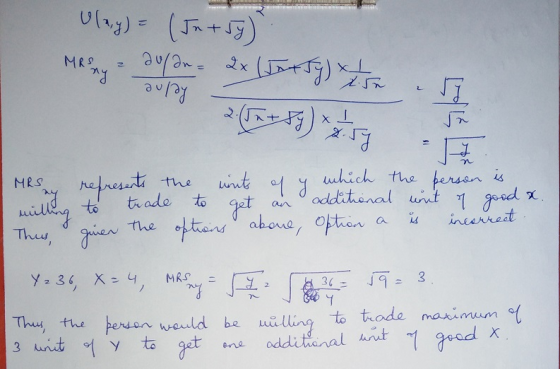
The Marginal Rate of Substitution represents the rate of exchange between good X and good Y. It shows the amount of Y which the person is willing to trade to get an additional unit of good X. The answer to the above question is option a which can be answered in the following manner:
Add Answer to:
4. An individual has preferences represented by the utility function U(x,y)=(x12+yızg Which of the following statements...
3. Originally, the price of X is $150 and the price of Y is S50. If the price of X increases by $20 and the price o...
 3. Originally, the price of X is $150 and the price of Y is S50. If the price of X increases by $20 and the price of Y increases by S10, the new budget line will a. move outward and be parallel to the old budget line b. move outward and become steeper c. move inward and become steeper d. move outward and become flatter e. move inward and become flatter x"2 + 1n0) 4. An individual's preferences are represented...
2. An individual's preferences over food (F) and clothing (C) are represented by the utility function...
 2. An individual's preferences over food (F) and clothing (C) are represented by the utility function U(F, C)FiC. She currently has 9 units of food and 8 units of clothing According to her MRS, she would be willing to give up a maximum of 4/3 units of food to obtain one more piece of clothing. a. True b. False
7. An individual's preferences are represented by the utility function Ua, y) 4xy x. Which of...
 7. An individual's preferences are represented by the utility function Ua, y) 4xy x. Which of the following statements is false? a. The marginal utility of x increases as x increases, holding y constant. b. Preferences are monotonic in both goods. c. The indifference curves slope downward at a decreasing rate. d. The marginal rate of substitution ofx for y increases as y increases, holding x constarnt e. The consumer is willing to give up decreasing amounts of good y...
3. Suppose an individual has perfect-complements preferences that can be represented by the utility function U(x,y)=...
 3. Suppose an individual has perfect-complements preferences that can be represented by the utility function U(x,y)= min[3x,2y]. Furthermore, suppose that she faces a standard linear budget constraint, with income denoted by m and prices denoted by px and p,, respectively. a) Derive the demand functions for x and y. b) How does demand for the two goods depend on the prices, p, and p, ? Explain.
Suppose utility is given by the following function: u(x, y) = xy3 Use this utility function...
Suppose utility is given by the following function: u(x, y) = xy3 Use this utility function to answer the following questions: (d) What is the marginal rate of substitution implied by this utility function? What does this mean in words? (e) How much of each good would this individual need to have to be willing to trade 1 unit of good x for 1 unit of good y (i.e. for the MRS to be equal to 1)? (f) Suppose we...
5. Assume an individual has preferences represented by the utility function U(x, y) = x1/2y1/3 Which...
 5. Assume an individual has preferences represented by the utility function U(x, y) = x1/2y1/3 Which of the following statements is necessarily TRUE? Assume prices and income are positive. a. The price consumption curve as the price of x changes) slopes downward. b. The income consumption curve slopes downward. c. Cross-price elasticity of demand for good x with respect to the price of y is negative. d. Price elasticity of demand for good y is negative. (See Besanko 5.6 and...
Suppose the preferences of an individual are represented by a quasilinear utility function: U (x, y)...
Suppose the preferences of an individual are represented by a quasilinear utility function: U (x, y) = ln(x) + y (a)Suppose px =1, py =5 and I = 20. The price of x increases to 2 (px = 2). Calculate the changes in the demand for x. What can you say about the substitution and income effects for small changes in the price of x? What happens to the demand for y? Is y a gross substitute? (b)Now suppose px...
Sally the Sleek’s preferences can be described by the utility function U(x, y) = x^2y^3/1000. Prices...
Sally the Sleek’s preferences can be described by the utility function U(x, y) = x^2y^3/1000. Prices are px = 4 and py = 3; she has an income of $80 to spend. (a) If Sally initially consumed 5 units of x and 20 units of y, how much additional utility does she get from spending one (small fraction of a) dollar more on good x? How much additional utility does she get from spending one (small fraction of a) dollar...
8. An individual's preferences are represented by the utility function Ulx, y) . Which of the...
 8. An individual's preferences are represented by the utility function Ulx, y) . Which of the following statements is true? a. The marginal utility of x decreases as x increases, holding y constant. b. The marginal rate of substitution of x for y increases as the consumer substitutes x for y (i.e. more x and less y) along an indifference curve. c. The consumer needs to be compensated with (i.e. gain) increasing amounts of good x in order to be...
4. An individual has preferences over two goods (x and y) that are represented by function...
 4. An individual has preferences over two goods (x and y) that are represented by function U = min{x,y}. The individual has income $60, the price of x is $4 and the price of good y is $2. (a) What kind of goods are these to the individual? (i.e. what "special case” is this?) (b) What is this individual's budget constraint? (c) What is this individual's optimal bundle of x and y? [HINT: You can't take the derivative of this...
 3. Originally, the price of X is $150 and the price of Y is S50. If the price of X increases by $20 and the price of Y increases by S10, the new budget line will a. move outward and be parallel to the old budget line b. move outward and become steeper c. move inward and become steeper d. move outward and become flatter e. move inward and become flatter x"2 + 1n0) 4. An individual's preferences are represented...
 2. An individual's preferences over food (F) and clothing (C) are represented by the utility function U(F, C)FiC. She currently has 9 units of food and 8 units of clothing According to her MRS, she would be willing to give up a maximum of 4/3 units of food to obtain one more piece of clothing. a. True b. False
 7. An individual's preferences are represented by the utility function Ua, y) 4xy x. Which of the following statements is false? a. The marginal utility of x increases as x increases, holding y constant. b. Preferences are monotonic in both goods. c. The indifference curves slope downward at a decreasing rate. d. The marginal rate of substitution ofx for y increases as y increases, holding x constarnt e. The consumer is willing to give up decreasing amounts of good y...
 3. Suppose an individual has perfect-complements preferences that can be represented by the utility function U(x,y)= min[3x,2y]. Furthermore, suppose that she faces a standard linear budget constraint, with income denoted by m and prices denoted by px and p,, respectively. a) Derive the demand functions for x and y. b) How does demand for the two goods depend on the prices, p, and p, ? Explain.
 5. Assume an individual has preferences represented by the utility function U(x, y) = x1/2y1/3 Which of the following statements is necessarily TRUE? Assume prices and income are positive. a. The price consumption curve as the price of x changes) slopes downward. b. The income consumption curve slopes downward. c. Cross-price elasticity of demand for good x with respect to the price of y is negative. d. Price elasticity of demand for good y is negative. (See Besanko 5.6 and...
 8. An individual's preferences are represented by the utility function Ulx, y) . Which of the following statements is true? a. The marginal utility of x decreases as x increases, holding y constant. b. The marginal rate of substitution of x for y increases as the consumer substitutes x for y (i.e. more x and less y) along an indifference curve. c. The consumer needs to be compensated with (i.e. gain) increasing amounts of good x in order to be...
 4. An individual has preferences over two goods (x and y) that are represented by function U = min{x,y}. The individual has income $60, the price of x is $4 and the price of good y is $2. (a) What kind of goods are these to the individual? (i.e. what "special case” is this?) (b) What is this individual's budget constraint? (c) What is this individual's optimal bundle of x and y? [HINT: You can't take the derivative of this...
Most questions answered within 3 hours.
-
Where is the error in this code sequence?
String s1 = "Hello";
String s2 = "ello";...
asked 10 months ago -
Financial data for Joel de Paris, Inc., for last year
follow:
Joel de Paris, Inc.
Balance...
asked 10 months ago -
Consider this reaction:
Al2(SO4)3 (aq)+ BaCl3
(aq) Al2Cl6 (aq)- +
3BaSO4(s) . What is the...
asked 10 months ago -
Suppose that Savneet is considering increasing her
recent random sample from 20 car rentals to 40...
asked 10 months ago -
Trucks arrive at an unloading terminal at an average rate of 120
per hour.
Trucks arrive...
asked 10 months ago -
Why are methanol and ethanol completely soluble in water while
octanol is not very little soluble....
asked 10 months ago -
A facilities manager at a university reads in a research report
that the mean amount of...
asked 10 months ago -
When the CuSO4 is rehydrated by adding water to the anhydrous
compound, is this an endothermic...
asked 10 months ago -
A ray of sunlight is passing from diamond into crown glass; the
angle of incidence is...
asked 10 months ago -
A block of mass 0.249 kg is placed on top of a light, vertical
spring of...
asked 10 months ago -
how do the kidneys compensate in the presences of acidosis
a) trigger hyperventilate
b) reserve acid...
asked 10 months ago -
Question 501 pts
The rental rate of capital to the firm increases. Which of the
following...
asked 10 months ago