
Homework Answers
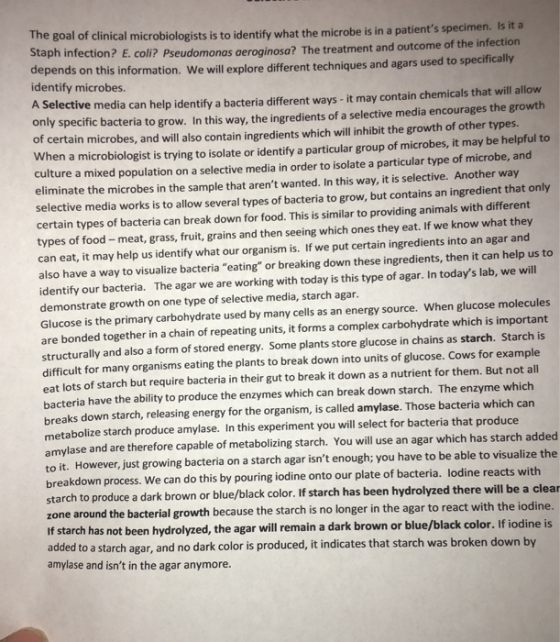
1. Why did we use cow manure for this lab?
Solution:-It’s because cow's have a fecal composition contains a low amount of protein and a high amount of starch because of their highly fibrous diet which is a source of a starch degrading bacteria
2. What was the component in the agar which selected for starch degrading bacteria?
Solution:- . Amylase was the component in the agar which selected for starch degrading bacteria
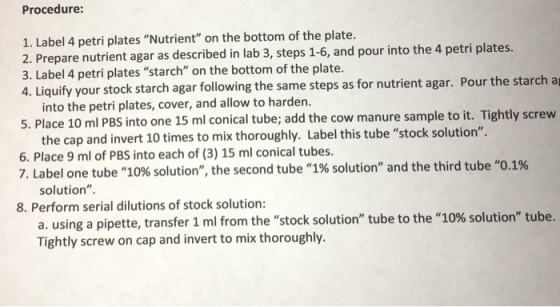
3. What is the purpose of serial dilution?
Solution:- The Purpose of sequential weakening is to decide the quantity of microscopic organisms per unit volume in the original culture, determination of the culture density in cells per ml
4. What is the purpose of using a selective media?
Solution: - Selective media is used to allow the growth of certain type of organisms while hindering the development of different life forms
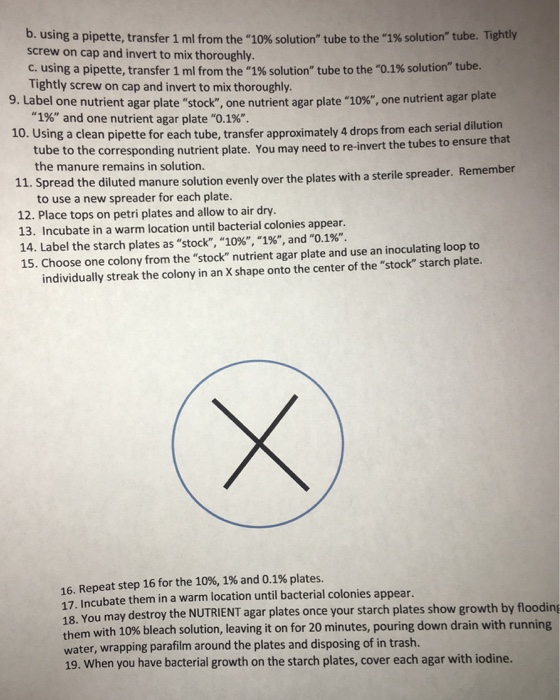
5. What was the purpose for the nutrient agar in this lab
Solution: - Nutrient Agar is used for general purpose it is utilized for the development of microorganisms supporting development of an extensive variety of non-particular living beings.
Add Answer to:
Questions
Lab background/procedure
1. Why did we use cow manure for this lab? 2. What was...
Q’s Lab Background/Procedures Post-lab questions: 1. Why did we use cow manure for this lab? 2....
 Q’s
Lab Background/Procedures
Post-lab questions: 1. Why did we use cow manure for this lab? 2. What was the component in the agar which selected for starch degrading bacteria? 3. What is the purpose of serial dilution? 4. What is the purpose of using a selective media? 5. What was the purpose for the nutrient agar in this lab?
Q’s
Lab Background/Procedures
Post-lab questions: 1. Why did we use cow manure for this lab? 2. What was the component in the agar which selected for starch degrading bacteria? 3. What is the purpose of serial dilution? 4. What is the purpose of using a selective media? 5. What was the purpose for the nutrient agar in this lab?
Lab Report-Carbohydrates 1. Purpose 2. Special Media for Isolating Bacteria (Lab #12) a. Why are dyes...
 Lab Report-Carbohydrates 1. Purpose 2. Special Media for Isolating Bacteria (Lab #12) a. Why are dyes such as phenol red, eosin or methylene blue added to the media? b. How does the bacterium change the media (i.e color of agar or colonies) after incubation? C. In this experiment, which media are selective, and which are differential? d. How did the results observe on the mannitol salt agar and EMB agar correlate to the Gram reaction of the bacteria? e. What...
Ubiquity of Microorganisms and Quadrant Streaking POST LAB DATE: SECTION: NAME: INSTRUCTOR: OULU Questions 1. in...
 Ubiquity of Microorganisms and Quadrant Streaking POST LAB DATE: SECTION: NAME: INSTRUCTOR: OULU Questions 1. in microbiology lab, what is the function of an incubatore 2. Define: A. pure culture B. mixed culture C. Chromogenesis D. Enriched media E. Selective media F. Reducing media 3. What is the purpose of quadront streaking 4. Why should nutrient medium always be sterile before it is inoculated with a microbial specimen for culture and isolation 5. Why can't all microorganisms grow on a...
Multiple Choice. Highlight the single correct answer choice. 1. Streak plates are useful in microbiology to...
Multiple Choice. Highlight the single correct answer choice. 1. Streak plates are useful in microbiology to __________. quantify the number of bacteria measure turbidity identify bacteria determine cell shape 2. In the streak-plate technique, the intent is to isolate bacteria by dilution in theory by __________. dilution on a solid surface separating cells within the solid surface using a pipette dilution in water blanks 3. A pure culture consists of which of the following? one genus of microbe one species...
PLEASE READ THE QUESTIONS AND DIRECTION CAREFULLY BEFORE ANSWERING. (MICROBIOLOGY LAB) THANK YOU! Why do we...
PLEASE READ THE QUESTIONS AND DIRECTION CAREFULLY BEFORE ANSWERING. (MICROBIOLOGY LAB) THANK YOU! Why do we use sugar as a component when performing triple Sugar Iron Agar tests? How do we know that the bacteria produced gasses as a result of metabolizing sugar? What is meant by a non-fermenter? Why can some organisms live with or without oxygen Why is a non-metallic instrument used in the Oxidase and O-F Glucose Tests experiment?
LAB REPORT 2- Selected questions from Exercise 3-7 (Acid-fast stain) Note: This is turned in after...
 LAB REPORT 2- Selected questions from Exercise 3-7 (Acid-fast stain) Note: This is turned in after you have viewed your acid fast stain slides. Bacteria for this exercise are: Mycobacterium smegmatis (or M. phlei) and S. aureus. Q1. Acid fast bacteria are have some significant differences as compared to non-acid fast bacteria. What are the major chemical (structural) differences among these different bacteria that might explain the acid-fast stain? Hint: This structural difference also affects the way the bacteria grow...
1) List 2 advantages of having a capsule. What is one environment where you would find...
 1) List 2 advantages of having a capsule. What is one environment where you would find a capsule containing organism? (1.5) 2) List 2 advantages of an endospore. What is one environment where you would find a spore- forming bacteria? (1.5) 3) In Exercise 12, what difference did you observe between the heat treated and non-heat treated soil plating results? (0.5) 1ml 1ml. ImL 1ml iml. Undiluted sample A B C D Colonies on PCA plate 4) A 10-fold serial...
To be included in the formal lab report, this list is not inclusive of all the...
 To be included in the formal lab report, this list is not inclusive of all the questions that should be answered in your formal lab report, but is rather to be used as a starting point. 1. State the clinical manifestations of infection by Salmonella enteric serovars? 2. With respect to the following media, briefly describe (1) their intended application, and (2) the biochemical principles of their use. a. Bismuth Sulfite agar b. Brilliant Green Sulfa agar c. Hektoen Enteric...
Background Background continued... Questions Experiment 2: TSI The triple sugar iron agar (TSI) can identify gram...
 Background
 continued...
Questions
Experiment 2: TSI The triple sugar iron agar (TSI) can identify gram negative bacteria based on how they metabolize carbohydrates. It contains three carbohydrates-glucose, lactose and sucrose, in addition to sodium thiosulfate which some bacteria use in the production of hydrogen sulfide (H2S). It also contains iron in the ferrous form and phenol red as a pH indicator. TSI is poured into a tube when heated to a liquid form, and the tube is slanted as...
Background
Background continued...
Questions
Experiment 2: TSI The triple sugar iron agar (TSI) can identify gram negative bacteria based on how they metabolize carbohydrates. It contains three carbohydrates-glucose, lactose and sucrose, in addition to sodium thiosulfate which some bacteria use in the production of hydrogen sulfide (H2S). It also contains iron in the ferrous form and phenol red as a pH indicator. TSI is poured into a tube when heated to a liquid form, and the tube is slanted as...
Micrebes in the Environment QUESTIONS What in the advantage of using Petri plate rather thon tet...
 Micrebes in the Environment QUESTIONS What in the advantage of using Petri plate rather thon tet t in mieriogy? 2What are bacteria uaing for nutrienta in satrient agsr What is the perpoe of the agar? CRITICAL THINKING Did all the organiems living in or on the environmente aompled gw on your nutrient agar Briefly explain. 1. 2 How could you determine whether the turbidity in your nutrient broth tube was from a mixture of diferent microbes or from the growth...
 Q’s
Lab Background/Procedures
Post-lab questions: 1. Why did we use cow manure for this lab? 2. What was the component in the agar which selected for starch degrading bacteria? 3. What is the purpose of serial dilution? 4. What is the purpose of using a selective media? 5. What was the purpose for the nutrient agar in this lab?
Q’s
Lab Background/Procedures
Post-lab questions: 1. Why did we use cow manure for this lab? 2. What was the component in the agar which selected for starch degrading bacteria? 3. What is the purpose of serial dilution? 4. What is the purpose of using a selective media? 5. What was the purpose for the nutrient agar in this lab?
 Lab Report-Carbohydrates 1. Purpose 2. Special Media for Isolating Bacteria (Lab #12) a. Why are dyes such as phenol red, eosin or methylene blue added to the media? b. How does the bacterium change the media (i.e color of agar or colonies) after incubation? C. In this experiment, which media are selective, and which are differential? d. How did the results observe on the mannitol salt agar and EMB agar correlate to the Gram reaction of the bacteria? e. What...
 Ubiquity of Microorganisms and Quadrant Streaking POST LAB DATE: SECTION: NAME: INSTRUCTOR: OULU Questions 1. in microbiology lab, what is the function of an incubatore 2. Define: A. pure culture B. mixed culture C. Chromogenesis D. Enriched media E. Selective media F. Reducing media 3. What is the purpose of quadront streaking 4. Why should nutrient medium always be sterile before it is inoculated with a microbial specimen for culture and isolation 5. Why can't all microorganisms grow on a...
 LAB REPORT 2- Selected questions from Exercise 3-7 (Acid-fast stain) Note: This is turned in after you have viewed your acid fast stain slides. Bacteria for this exercise are: Mycobacterium smegmatis (or M. phlei) and S. aureus. Q1. Acid fast bacteria are have some significant differences as compared to non-acid fast bacteria. What are the major chemical (structural) differences among these different bacteria that might explain the acid-fast stain? Hint: This structural difference also affects the way the bacteria grow...
 1) List 2 advantages of having a capsule. What is one environment where you would find a capsule containing organism? (1.5) 2) List 2 advantages of an endospore. What is one environment where you would find a spore- forming bacteria? (1.5) 3) In Exercise 12, what difference did you observe between the heat treated and non-heat treated soil plating results? (0.5) 1ml 1ml. ImL 1ml iml. Undiluted sample A B C D Colonies on PCA plate 4) A 10-fold serial...
 To be included in the formal lab report, this list is not inclusive of all the questions that should be answered in your formal lab report, but is rather to be used as a starting point. 1. State the clinical manifestations of infection by Salmonella enteric serovars? 2. With respect to the following media, briefly describe (1) their intended application, and (2) the biochemical principles of their use. a. Bismuth Sulfite agar b. Brilliant Green Sulfa agar c. Hektoen Enteric...
 Background
 continued...
Questions
Experiment 2: TSI The triple sugar iron agar (TSI) can identify gram negative bacteria based on how they metabolize carbohydrates. It contains three carbohydrates-glucose, lactose and sucrose, in addition to sodium thiosulfate which some bacteria use in the production of hydrogen sulfide (H2S). It also contains iron in the ferrous form and phenol red as a pH indicator. TSI is poured into a tube when heated to a liquid form, and the tube is slanted as...
Background
Background continued...
Questions
Experiment 2: TSI The triple sugar iron agar (TSI) can identify gram negative bacteria based on how they metabolize carbohydrates. It contains three carbohydrates-glucose, lactose and sucrose, in addition to sodium thiosulfate which some bacteria use in the production of hydrogen sulfide (H2S). It also contains iron in the ferrous form and phenol red as a pH indicator. TSI is poured into a tube when heated to a liquid form, and the tube is slanted as...
 Micrebes in the Environment QUESTIONS What in the advantage of using Petri plate rather thon tet t in mieriogy? 2What are bacteria uaing for nutrienta in satrient agsr What is the perpoe of the agar? CRITICAL THINKING Did all the organiems living in or on the environmente aompled gw on your nutrient agar Briefly explain. 1. 2 How could you determine whether the turbidity in your nutrient broth tube was from a mixture of diferent microbes or from the growth...
Most questions answered within 3 hours.
-
Where is the error in this code sequence?
String s1 = "Hello";
String s2 = "ello";...
asked 10 months ago -
Financial data for Joel de Paris, Inc., for last year
follow:
Joel de Paris, Inc.
Balance...
asked 10 months ago -
Consider this reaction:
Al2(SO4)3 (aq)+ BaCl3
(aq) Al2Cl6 (aq)- +
3BaSO4(s) . What is the...
asked 10 months ago -
Suppose that Savneet is considering increasing her
recent random sample from 20 car rentals to 40...
asked 10 months ago -
Trucks arrive at an unloading terminal at an average rate of 120
per hour.
Trucks arrive...
asked 10 months ago -
Why are methanol and ethanol completely soluble in water while
octanol is not very little soluble....
asked 10 months ago -
A facilities manager at a university reads in a research report
that the mean amount of...
asked 10 months ago -
When the CuSO4 is rehydrated by adding water to the anhydrous
compound, is this an endothermic...
asked 10 months ago -
A ray of sunlight is passing from diamond into crown glass; the
angle of incidence is...
asked 10 months ago -
A block of mass 0.249 kg is placed on top of a light, vertical
spring of...
asked 10 months ago -
how do the kidneys compensate in the presences of acidosis
a) trigger hyperventilate
b) reserve acid...
asked 10 months ago -
Question 501 pts
The rental rate of capital to the firm increases. Which of the
following...
asked 10 months ago