A parallel plate capacitor is formed with two plates separated by 5.00 mm as shown in...
Homework Answers

Add Answer to:
A parallel plate capacitor is formed with two plates separated
by 5.00 mm as shown in...
A parallel plate capacitor is formed with two plates separated by 5.00 mm as shown in...
 A parallel plate capacitor is formed with two plates separated
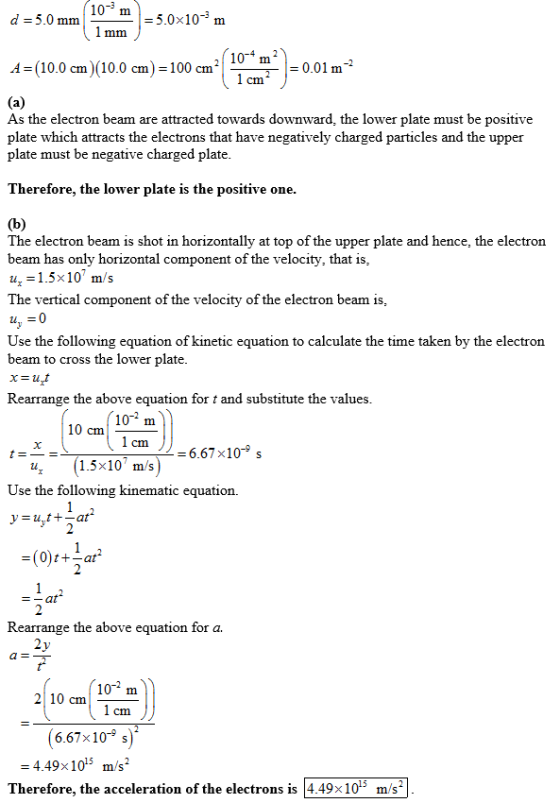
by 5.00 mm as shown in Figure 1. Each plate is a 10.0 cm X 10.0 cm
square. We do not know the charge on the plates. An electron beam
is shot in from one edge of the capacitor. It enters the capacitor
very close (call it 0 mm) from the top plate and travelling
parallel to the plates. The electrons in the beam are moving at
1.50 × 10⁷...
A parallel plate capacitor is formed with two plates separated
by 5.00 mm as shown in Figure 1. Each plate is a 10.0 cm X 10.0 cm
square. We do not know the charge on the plates. An electron beam
is shot in from one edge of the capacitor. It enters the capacitor
very close (call it 0 mm) from the top plate and travelling
parallel to the plates. The electrons in the beam are moving at
1.50 × 10⁷...
2. A parallel plate capacitor is formed with two plates separated by 5.00 mm as shown...
 2. A parallel plate capacitor is formed with two plates separated by 5.00 mm as shown in Figure 1.Each plate is a 10.0 cm X 10.0 cm square. We do not know the charge on the plates. An electron beam isshot in from one edge of the capacitor. It enters the capacitor very close (call it 0 mm) from the top plateand travelling parallel to the plates. The electrons in the beam are moving at 1.50x 10⁷ m/s as they...
A parallel‑plate capacitor has plates of 4.50 cm by 5.00 cm . The plates are separated...
A parallel‑plate capacitor has plates of 4.50 cm by 5.00 cm . The plates are separated by a 0.500 -mm ‑thick piece of paper. What is the capacitance C of this capacitor? The dielectric constant for paper is 2.5.
The circular plates of a parallel-plate capacitor are 6.00 cm in diameter and are spaced 5.00...
 The circular plates of a parallel-plate capacitor are 6.00 cm in diameter and are spaced 5.00 mm apart. They are charged by transferring 1.00 x 10" electrons from one plate to the other. What is the electric potential difference between the plates? (A) (B) 2,540 V 2,970 V 3,200 V 3,880 V 4,350 V (D) (E)
A parallel-plate capacitor has 2.00 cm2 plates that are separated by 5.00 mm with air between...
A parallel-plate capacitor has 2.00 cm2 plates that are separated by 5.00 mm with air between them. If a 12.0 V battery is connected to this capacitor, how much energy does it store?
A parallel plate capacitor is formed from two circular plates, each of radius 3.10 cm, separated...
 A parallel plate capacitor is formed from two circular plates, each of radius 3.10 cm, separated by 3.20 mm. The plates are charged to 11.5 n. A proton is shot from the negative plate to the positive. What launch speed must the proton have to just barely reach the positive plate? O 1.32x10 m/s O 2.64x10⁷ m/s O 3.63x 10⁵ m/s O 5.14x10 m/s
A parallel‑plate capacitor has plates of 5.00 cm 5.00 cm by 4.60 cm. 4.60 cm. The...
A parallel‑plate capacitor has plates of 5.00 cm 5.00 cm by 4.60 cm. 4.60 cm. The plates are separated by a 0.350-mm 0.350-mm ‑thick piece of paper. What is the capacitance ? C of this capacitor? The dielectric constant for paper is 2.5. 2.5.
A parallel‑plate capacitor has plates of 5.00 cm 5.00 cm by 4.60 cm. 4.60 cm. The...
A parallel‑plate capacitor has plates of 5.00 cm 5.00 cm by 4.60 cm. 4.60 cm. The plates are separated by a 0.350-mm 0.350-mm ‑thick piece of paper. What is the capacitance ? C of this capacitor? The dielectric constant for paper is 2.5. 2.5.
A parallel plate capacitor has metal plates, each of area 1.50 m2, separated by 1.40 mm....
A parallel plate capacitor has metal plates, each of area 1.50 m2, separated by 1.40 mm. What charge (in µC) is stored in this capacitor if a voltage of 2.70 ✕ 103 V is applied to it? _______µC
Two 2.3-cm-diameter-disks spaced 1.9 mm apart form a parallel-plate capacitor. The plates have charge ± 6.0nC. a)...
Two 2.3-cm-diameter-disks spaced 1.9 mm apart form a parallel-plate capacitor. The plates have charge ± 6.0nC. a) What is the voltage across the capacitor? b) An electron is launched from the negative plate. It strikes the positive plate at a speed of 7.0×10⁷ m/s . What was the electron's speed as it left the negative plate?
 A parallel plate capacitor is formed with two plates separated
by 5.00 mm as shown in Figure 1. Each plate is a 10.0 cm X 10.0 cm
square. We do not know the charge on the plates. An electron beam
is shot in from one edge of the capacitor. It enters the capacitor
very close (call it 0 mm) from the top plate and travelling
parallel to the plates. The electrons in the beam are moving at
1.50 × 10⁷...
A parallel plate capacitor is formed with two plates separated
by 5.00 mm as shown in Figure 1. Each plate is a 10.0 cm X 10.0 cm
square. We do not know the charge on the plates. An electron beam
is shot in from one edge of the capacitor. It enters the capacitor
very close (call it 0 mm) from the top plate and travelling
parallel to the plates. The electrons in the beam are moving at
1.50 × 10⁷...
 2. A parallel plate capacitor is formed with two plates separated by 5.00 mm as shown in Figure 1.Each plate is a 10.0 cm X 10.0 cm square. We do not know the charge on the plates. An electron beam isshot in from one edge of the capacitor. It enters the capacitor very close (call it 0 mm) from the top plateand travelling parallel to the plates. The electrons in the beam are moving at 1.50x 10⁷ m/s as they...
 The circular plates of a parallel-plate capacitor are 6.00 cm in diameter and are spaced 5.00 mm apart. They are charged by transferring 1.00 x 10" electrons from one plate to the other. What is the electric potential difference between the plates? (A) (B) 2,540 V 2,970 V 3,200 V 3,880 V 4,350 V (D) (E)
 A parallel plate capacitor is formed from two circular plates, each of radius 3.10 cm, separated by 3.20 mm. The plates are charged to 11.5 n. A proton is shot from the negative plate to the positive. What launch speed must the proton have to just barely reach the positive plate? O 1.32x10 m/s O 2.64x10⁷ m/s O 3.63x 10⁵ m/s O 5.14x10 m/s
Most questions answered within 3 hours.
-
Where is the error in this code sequence?
String s1 = "Hello";
String s2 = "ello";...
asked 10 months ago -
Financial data for Joel de Paris, Inc., for last year
follow:
Joel de Paris, Inc.
Balance...
asked 10 months ago -
Consider this reaction:
Al2(SO4)3 (aq)+ BaCl3
(aq) Al2Cl6 (aq)- +
3BaSO4(s) . What is the...
asked 10 months ago -
Suppose that Savneet is considering increasing her
recent random sample from 20 car rentals to 40...
asked 10 months ago -
Trucks arrive at an unloading terminal at an average rate of 120
per hour.
Trucks arrive...
asked 10 months ago -
Why are methanol and ethanol completely soluble in water while
octanol is not very little soluble....
asked 10 months ago -
A facilities manager at a university reads in a research report
that the mean amount of...
asked 10 months ago -
When the CuSO4 is rehydrated by adding water to the anhydrous
compound, is this an endothermic...
asked 10 months ago -
A ray of sunlight is passing from diamond into crown glass; the
angle of incidence is...
asked 10 months ago -
A block of mass 0.249 kg is placed on top of a light, vertical
spring of...
asked 10 months ago -
how do the kidneys compensate in the presences of acidosis
a) trigger hyperventilate
b) reserve acid...
asked 10 months ago -
Question 501 pts
The rental rate of capital to the firm increases. Which of the
following...
asked 10 months ago