
Homework Answers
Add Answer to:
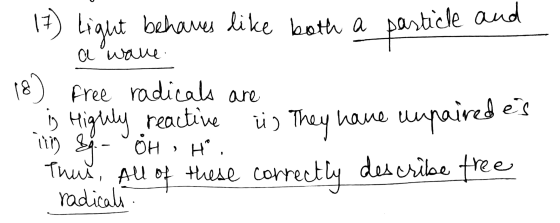
QUESTIUN IT Light behaves like a particle. a wave. both a particle and a wave. neither...
What will take the most energy? (Constants: Heat of fusion of water: 334 J/g Heat of...
What will take the most energy? (Constants: Heat of fusion of water: 334 J/g Heat of vaporization of water: 2260 J/g Specific heat capacity of copper: 0.385 J/g*C Specific heat capacity of gold: 0.129 J/g*C Specific heat capacity of water: 4.18 J/g*C) a. Increase the temperature of 10 grams of solid gold by 15 degrees b. Increase the temperature of 10 grams of solid water (ice) by 12 degrees c. Evaporate 10 grams of water d. Increase the temperature of...
Only asking for accuracy. I'll make sure to leave a like :) 1. According to Planck's...
 Only asking for accuracy. I'll make sure to leave a like :)
1. According to Planck's hypothesis, a. the energy of an incandescent body is quantized. b. the variable n can have any real number value. c. the frequency of vibration is inversely proportional to the energy. d. atoms constantly radiate electromagnetic waves when they vibrate. 6. Which of the following best describes the nature of light? a. Light has wave properties only. b. Light has particle properties only. c....
Only asking for accuracy. I'll make sure to leave a like :)
1. According to Planck's hypothesis, a. the energy of an incandescent body is quantized. b. the variable n can have any real number value. c. the frequency of vibration is inversely proportional to the energy. d. atoms constantly radiate electromagnetic waves when they vibrate. 6. Which of the following best describes the nature of light? a. Light has wave properties only. b. Light has particle properties only. c....
Question # 1: Find the unit of energy in the energy expression of a free particle...
 Question # 1: Find the unit of energy in the energy expression of a free particle in 1-D box: Question # 2: A proton in a box is in a state n = 5 falls to a state n = 4 and loose energy with a wavelength of 2000 nm, what is the length of the box? (answer: 4 x 10 m) Question # 3: a. Consider an electron confined to move in an atom in one dimension over a...
pleas help 5,6,7,8,9,10 III IV 5. The product of free-radical halogenation reactions is an alkyl halide....
 pleas help 5,6,7,8,9,10
III IV 5. The product of free-radical halogenation reactions is an alkyl halide. The major amount of this halide forms during the second step of propagation. However, you should be aware that one possible termination step also forms alkyl halides. Why does the majority of the alkyl halide product come from the propagation step and not the termination step? A. At any given time during the reaction, the concentration of both the alkyl radical and the halide...
pleas help 5,6,7,8,9,10
III IV 5. The product of free-radical halogenation reactions is an alkyl halide. The major amount of this halide forms during the second step of propagation. However, you should be aware that one possible termination step also forms alkyl halides. Why does the majority of the alkyl halide product come from the propagation step and not the termination step? A. At any given time during the reaction, the concentration of both the alkyl radical and the halide...
I'd like to ask the answers for all of the uestions Question 1. A reaction in...
 I'd
like to ask the answers for all of the uestions
Question 1. A reaction in an anabolic pathway in a cell has a AG of +2.5 kcal/mol. Which of the following is true regarding this reaction? A. It will occur spontaneously. B. The product of the reaction has a lower free energy than the reactants. C. It can occur if it is coupled to ATP hydrolysis. D. It is an exergonic reaction. E. It is breaking a polymer into...
I'd
like to ask the answers for all of the uestions
Question 1. A reaction in an anabolic pathway in a cell has a AG of +2.5 kcal/mol. Which of the following is true regarding this reaction? A. It will occur spontaneously. B. The product of the reaction has a lower free energy than the reactants. C. It can occur if it is coupled to ATP hydrolysis. D. It is an exergonic reaction. E. It is breaking a polymer into...
use the notes provided to help answer the question above. will rate well The second step...
 use the notes provided to help answer the question
above. will rate well
The second step of the synthesis transformation of the chlorosulfonyl functional group into a sulfonamide) is an example of a a. Nucleophilic displacement (substitution) b Elimination C. Electrophilic aromatic substitution d. Acid hydrolysis Esterification e. THE SULFONIC ACID GROUP AND ITS DERIVATIVES Sulfonic acids are organic analogs of sulfuric acid, a very strong acid. They are highly corrosive, react vigorously with water, and can cause skin bums....
use the notes provided to help answer the question
above. will rate well
The second step of the synthesis transformation of the chlorosulfonyl functional group into a sulfonamide) is an example of a a. Nucleophilic displacement (substitution) b Elimination C. Electrophilic aromatic substitution d. Acid hydrolysis Esterification e. THE SULFONIC ACID GROUP AND ITS DERIVATIVES Sulfonic acids are organic analogs of sulfuric acid, a very strong acid. They are highly corrosive, react vigorously with water, and can cause skin bums....
mestion Completion Status: Why did I suggest that the secret to life is electrons and protons?...
 mestion Completion Status: Why did I suggest that the secret to life is electrons and protons? A. Because redox reactions are necessary for all of the reactions in live cells and these redox reactions require both H+ and electrons B. Because electrons carry a negative charge and protons have a positive charge C. Because most (not all) cells need electron transport and H+ gradients to make ATP D. Because electrons are necessary for the electrical responses of the cell (like...
all please Lecture exercise 1 & laboratory exercises (1 pt. cach, 40 pts. total) 31. What...
 all please
Lecture exercise 1 & laboratory exercises (1 pt. cach, 40 pts. total) 31. What was the question that Fleming asked in the case study? a. Why were there clear areas around the mold? c. Can bacteria grow rapidly on agar plates? b. Do molds produce a chemical tha us produce a chemical that kills bacteria? De hacteria produce a chemical that kills molds? e not having a control, Fleming was able to support his hypothesis because of which...
all please
Lecture exercise 1 & laboratory exercises (1 pt. cach, 40 pts. total) 31. What was the question that Fleming asked in the case study? a. Why were there clear areas around the mold? c. Can bacteria grow rapidly on agar plates? b. Do molds produce a chemical tha us produce a chemical that kills bacteria? De hacteria produce a chemical that kills molds? e not having a control, Fleming was able to support his hypothesis because of which...
please and please choose the right answer and please make it clear for my understanding 1-Which...
please and please choose the right answer and please make it clear for my understanding 1-Which of the following statements are false? Oxidation and reduction half-reactions occur at electrodes in electrochemical cells All electrochemical reactions involve the transfer of electrons Oxidation occurs at the anode All voltaic (galvanic) cells involve the use of electricity to initiate nonspontaneous chemical reactions Reduction occurs at the cathode 2-During the electrolysis of aqueous KCl solution using inert electrodes, gaseous hydrogen is evolved at one...
Immunology Question May you check my answers for 2a and 2b and see if: the information...
 Immunology Question
May you check my answers for 2a and 2b and see if: the
information is being accurately presented, there is no unneeded
information, and most importantly it is answering the question? I
added more information to strengthen my answer so hopefully, it is
better this time around. Thank you in advance!
2) Candida albicans is an opportunistic fungal pathogen in humans, and can cause a few irritating, but non- life threatening, infections in healthy individuals. However, in immunocompromised...
Immunology Question
May you check my answers for 2a and 2b and see if: the
information is being accurately presented, there is no unneeded
information, and most importantly it is answering the question? I
added more information to strengthen my answer so hopefully, it is
better this time around. Thank you in advance!
2) Candida albicans is an opportunistic fungal pathogen in humans, and can cause a few irritating, but non- life threatening, infections in healthy individuals. However, in immunocompromised...
 Only asking for accuracy. I'll make sure to leave a like :)
1. According to Planck's hypothesis, a. the energy of an incandescent body is quantized. b. the variable n can have any real number value. c. the frequency of vibration is inversely proportional to the energy. d. atoms constantly radiate electromagnetic waves when they vibrate. 6. Which of the following best describes the nature of light? a. Light has wave properties only. b. Light has particle properties only. c....
Only asking for accuracy. I'll make sure to leave a like :)
1. According to Planck's hypothesis, a. the energy of an incandescent body is quantized. b. the variable n can have any real number value. c. the frequency of vibration is inversely proportional to the energy. d. atoms constantly radiate electromagnetic waves when they vibrate. 6. Which of the following best describes the nature of light? a. Light has wave properties only. b. Light has particle properties only. c....
 Question # 1: Find the unit of energy in the energy expression of a free particle in 1-D box: Question # 2: A proton in a box is in a state n = 5 falls to a state n = 4 and loose energy with a wavelength of 2000 nm, what is the length of the box? (answer: 4 x 10 m) Question # 3: a. Consider an electron confined to move in an atom in one dimension over a...
 pleas help 5,6,7,8,9,10
III IV 5. The product of free-radical halogenation reactions is an alkyl halide. The major amount of this halide forms during the second step of propagation. However, you should be aware that one possible termination step also forms alkyl halides. Why does the majority of the alkyl halide product come from the propagation step and not the termination step? A. At any given time during the reaction, the concentration of both the alkyl radical and the halide...
pleas help 5,6,7,8,9,10
III IV 5. The product of free-radical halogenation reactions is an alkyl halide. The major amount of this halide forms during the second step of propagation. However, you should be aware that one possible termination step also forms alkyl halides. Why does the majority of the alkyl halide product come from the propagation step and not the termination step? A. At any given time during the reaction, the concentration of both the alkyl radical and the halide...
 I'd
like to ask the answers for all of the uestions
Question 1. A reaction in an anabolic pathway in a cell has a AG of +2.5 kcal/mol. Which of the following is true regarding this reaction? A. It will occur spontaneously. B. The product of the reaction has a lower free energy than the reactants. C. It can occur if it is coupled to ATP hydrolysis. D. It is an exergonic reaction. E. It is breaking a polymer into...
I'd
like to ask the answers for all of the uestions
Question 1. A reaction in an anabolic pathway in a cell has a AG of +2.5 kcal/mol. Which of the following is true regarding this reaction? A. It will occur spontaneously. B. The product of the reaction has a lower free energy than the reactants. C. It can occur if it is coupled to ATP hydrolysis. D. It is an exergonic reaction. E. It is breaking a polymer into...
 use the notes provided to help answer the question
above. will rate well
The second step of the synthesis transformation of the chlorosulfonyl functional group into a sulfonamide) is an example of a a. Nucleophilic displacement (substitution) b Elimination C. Electrophilic aromatic substitution d. Acid hydrolysis Esterification e. THE SULFONIC ACID GROUP AND ITS DERIVATIVES Sulfonic acids are organic analogs of sulfuric acid, a very strong acid. They are highly corrosive, react vigorously with water, and can cause skin bums....
use the notes provided to help answer the question
above. will rate well
The second step of the synthesis transformation of the chlorosulfonyl functional group into a sulfonamide) is an example of a a. Nucleophilic displacement (substitution) b Elimination C. Electrophilic aromatic substitution d. Acid hydrolysis Esterification e. THE SULFONIC ACID GROUP AND ITS DERIVATIVES Sulfonic acids are organic analogs of sulfuric acid, a very strong acid. They are highly corrosive, react vigorously with water, and can cause skin bums....
 mestion Completion Status: Why did I suggest that the secret to life is electrons and protons? A. Because redox reactions are necessary for all of the reactions in live cells and these redox reactions require both H+ and electrons B. Because electrons carry a negative charge and protons have a positive charge C. Because most (not all) cells need electron transport and H+ gradients to make ATP D. Because electrons are necessary for the electrical responses of the cell (like...
 all please
Lecture exercise 1 & laboratory exercises (1 pt. cach, 40 pts. total) 31. What was the question that Fleming asked in the case study? a. Why were there clear areas around the mold? c. Can bacteria grow rapidly on agar plates? b. Do molds produce a chemical tha us produce a chemical that kills bacteria? De hacteria produce a chemical that kills molds? e not having a control, Fleming was able to support his hypothesis because of which...
all please
Lecture exercise 1 & laboratory exercises (1 pt. cach, 40 pts. total) 31. What was the question that Fleming asked in the case study? a. Why were there clear areas around the mold? c. Can bacteria grow rapidly on agar plates? b. Do molds produce a chemical tha us produce a chemical that kills bacteria? De hacteria produce a chemical that kills molds? e not having a control, Fleming was able to support his hypothesis because of which...
 Immunology Question
May you check my answers for 2a and 2b and see if: the
information is being accurately presented, there is no unneeded
information, and most importantly it is answering the question? I
added more information to strengthen my answer so hopefully, it is
better this time around. Thank you in advance!
2) Candida albicans is an opportunistic fungal pathogen in humans, and can cause a few irritating, but non- life threatening, infections in healthy individuals. However, in immunocompromised...
Immunology Question
May you check my answers for 2a and 2b and see if: the
information is being accurately presented, there is no unneeded
information, and most importantly it is answering the question? I
added more information to strengthen my answer so hopefully, it is
better this time around. Thank you in advance!
2) Candida albicans is an opportunistic fungal pathogen in humans, and can cause a few irritating, but non- life threatening, infections in healthy individuals. However, in immunocompromised...
Most questions answered within 3 hours.
-
Where is the error in this code sequence?
String s1 = "Hello";
String s2 = "ello";...
asked 10 months ago -
Financial data for Joel de Paris, Inc., for last year
follow:
Joel de Paris, Inc.
Balance...
asked 10 months ago -
Consider this reaction:
Al2(SO4)3 (aq)+ BaCl3
(aq) Al2Cl6 (aq)- +
3BaSO4(s) . What is the...
asked 10 months ago -
Suppose that Savneet is considering increasing her
recent random sample from 20 car rentals to 40...
asked 10 months ago -
Trucks arrive at an unloading terminal at an average rate of 120
per hour.
Trucks arrive...
asked 10 months ago -
Why are methanol and ethanol completely soluble in water while
octanol is not very little soluble....
asked 10 months ago -
A facilities manager at a university reads in a research report
that the mean amount of...
asked 10 months ago -
When the CuSO4 is rehydrated by adding water to the anhydrous
compound, is this an endothermic...
asked 10 months ago -
A ray of sunlight is passing from diamond into crown glass; the
angle of incidence is...
asked 10 months ago -
A block of mass 0.249 kg is placed on top of a light, vertical
spring of...
asked 10 months ago -
how do the kidneys compensate in the presences of acidosis
a) trigger hyperventilate
b) reserve acid...
asked 10 months ago -
Question 501 pts
The rental rate of capital to the firm increases. Which of the
following...
asked 10 months ago