
Homework Answers
Add Answer to:
gned Exercises A pressurized tank of helium gas initially at 12.5 bar and 31 C is...
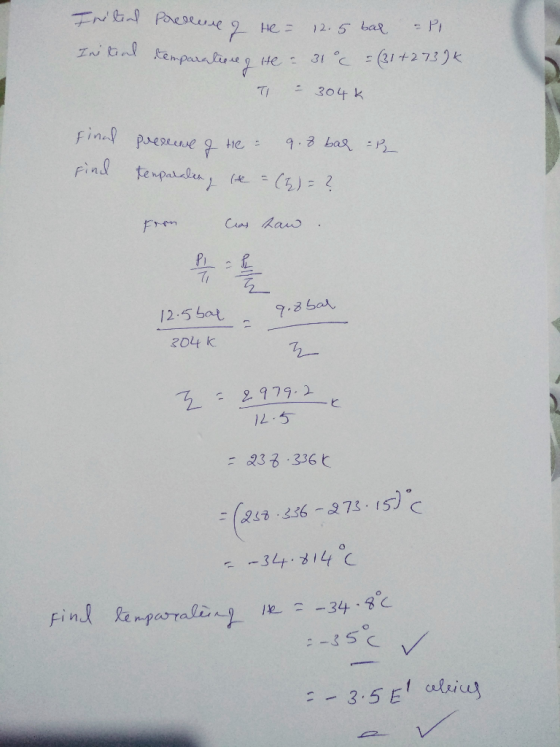
A pressurized tank of helium gas initially at 12.5 bar and 31c is cooled until the...
A pressurized tank of helium gas initially at 12.5 bar and 31c is cooled until the pressure reaches 9.8 bar. what is the final temperature of the gas?
4. Typically, scuba tanks are immersed in water to cool them as they are filled with...
 4. Typically, scuba tanks are immersed in water to cool them as they are filled with compressed air. If a tank is initially charged to 1500.0 psi at 34 Cand subsequently allowed to cool to 21 C, what is the final pressure in the tank? Enter the correct numerical value to 2.0% precision Express scientific notation like 4.29E-15 psi Grade This Exercise
3. A chunk of dry ice, CO2(s), weighing 7.4 g is sealed inside a 2 L...
 3. A chunk of dry ice, CO2(s), weighing 7.4 g is sealed inside a 2 L soda bottle initially containing 1 bar of air. What is the total pressure in the bottle after the dry ice sublimes and comes to 298.15 K? Enter the correct numerical value to 2.0% precision. Express scientific notation like 4.29E-15 bar
3. A chunk of dry ice, CO2(s), weighing 7.4 g is sealed inside a 2 L...
 3. A chunk of dry ice, CO2(s), weighing 7.4 g is sealed inside a 2 L soda bottle initially containing 1 bar of air. What is the total pressure in the bottle after the dry ice sublimes and comes to 298.15 K? Enter the correct numerical value to 2.0% precision. Express scientific notation like 4.29E-15 bar
3. A chunk of dry ice, CO2(s), weighing 7.4 g is sealed inside a 2 L...
 3. A chunk of dry ice, CO2(s), weighing 7.4 g is sealed inside a 2 L soda bottle initially containing 1 bar of air. What is the total pressure in the bottle after the dry ice sublimes and comes to 298.15 K? Enter the correct numerical value to 2.0% precision. Express scientific notation like 4.29E-15 bar
4 (30 points). A rigid tank that is initially evacuated is connected through a valve toa...
 4 (30 points). A rigid tank that is initially evacuated is connected through a valve toa supply line that carries helium at 1 MPa and 300 K. Now the valve is opened, and helium is allowed to flow slowly intothe tank until the pressure reaches IMPa P2). The final temperature and mass of the helium gas in the tank are: T2 300 K and m2 1 kg. Determine the direction (Is heat transferred to or from the tank?) and amount...
1.Argon contained in a closed, rigid tank, initially at 62.3°C, 3.9 bar, and a volume of...
1.Argon contained in a closed, rigid tank, initially at 62.3°C, 3.9 bar, and a volume of 4.2 m3, is heated to a final pressure of 9.4 bar. Assuming the ideal gas model with k = 1.6 for the argon, determine the heat transfer, in kJ. 2.Water vapor contained in a piston–cylinder assembly undergoes an isothermal expansion at 223°C from a pressure of 5.4 bar to a pressure of 1.9 bar. Evaluate the work, in kJ/kg. 3.A mass of 4 kilograms...
3.- [Four marks] One mol of ideal gas initially at a pressure of 2.0 bar and...
 3.- [Four marks] One mol of ideal gas initially at a pressure of 2.0 bar and temperature of 273 K is taken to a final pressure of 4.0 bar using a reversible path defined by P V = constant. Find AU, w and q. Take Üy to be equal to 12.5 J mol-1K-1 and R 0.083145 bar dm mol-'K-1 8.3145 J mol-' K-1 -
3.32. One mole of an ideal gas, initially at 30°C and 1 bar, is changed to 130°C and 10 bar by three different mechanic...
 3.32. One mole of an ideal gas, initially at 30°C and 1 bar, is changed to 130°C and 10 bar by three different mechanically reversible processes: The gas is first heated at constant volume until its temperature is 130°C; then it is compressed isothermally until its pressure is 10 bar The gas is first heated at constant pressure until its temperature is 130°C; then it is compressed isothermally to 10 bar The gas is first compressed isothermally to 10 bar;...
1. A) Argon contained in a closed, rigid tank, initially at 32.7°C, 1.5 bar, and a...
1. A) Argon contained in a closed, rigid tank, initially at 32.7°C, 1.5 bar, and a volume of 0.9 m3, is heated to a final pressure of 9.2 bar. Assuming the ideal gas model with k = 1.53 for the argon, determine the heat transfer, in kJ. B) Nitrogen (N2) contained in a piston–cylinder arrangement, initially at 8.6 bar and 422 K, undergoes an expansion to a final temperature of 300 K, during which the pressure–volume relationship is pV1.4 =...
 4. Typically, scuba tanks are immersed in water to cool them as they are filled with compressed air. If a tank is initially charged to 1500.0 psi at 34 Cand subsequently allowed to cool to 21 C, what is the final pressure in the tank? Enter the correct numerical value to 2.0% precision Express scientific notation like 4.29E-15 psi Grade This Exercise
 3. A chunk of dry ice, CO2(s), weighing 7.4 g is sealed inside a 2 L soda bottle initially containing 1 bar of air. What is the total pressure in the bottle after the dry ice sublimes and comes to 298.15 K? Enter the correct numerical value to 2.0% precision. Express scientific notation like 4.29E-15 bar
 3. A chunk of dry ice, CO2(s), weighing 7.4 g is sealed inside a 2 L soda bottle initially containing 1 bar of air. What is the total pressure in the bottle after the dry ice sublimes and comes to 298.15 K? Enter the correct numerical value to 2.0% precision. Express scientific notation like 4.29E-15 bar
 3. A chunk of dry ice, CO2(s), weighing 7.4 g is sealed inside a 2 L soda bottle initially containing 1 bar of air. What is the total pressure in the bottle after the dry ice sublimes and comes to 298.15 K? Enter the correct numerical value to 2.0% precision. Express scientific notation like 4.29E-15 bar
 4 (30 points). A rigid tank that is initially evacuated is connected through a valve toa supply line that carries helium at 1 MPa and 300 K. Now the valve is opened, and helium is allowed to flow slowly intothe tank until the pressure reaches IMPa P2). The final temperature and mass of the helium gas in the tank are: T2 300 K and m2 1 kg. Determine the direction (Is heat transferred to or from the tank?) and amount...
 3.- [Four marks] One mol of ideal gas initially at a pressure of 2.0 bar and temperature of 273 K is taken to a final pressure of 4.0 bar using a reversible path defined by P V = constant. Find AU, w and q. Take Üy to be equal to 12.5 J mol-1K-1 and R 0.083145 bar dm mol-'K-1 8.3145 J mol-' K-1 -
 3.32. One mole of an ideal gas, initially at 30°C and 1 bar, is changed to 130°C and 10 bar by three different mechanically reversible processes: The gas is first heated at constant volume until its temperature is 130°C; then it is compressed isothermally until its pressure is 10 bar The gas is first heated at constant pressure until its temperature is 130°C; then it is compressed isothermally to 10 bar The gas is first compressed isothermally to 10 bar;...
Most questions answered within 3 hours.
-
Where is the error in this code sequence?
String s1 = "Hello";
String s2 = "ello";...
asked 11 months ago -
Financial data for Joel de Paris, Inc., for last year
follow:
Joel de Paris, Inc.
Balance...
asked 11 months ago -
Consider this reaction:
Al2(SO4)3 (aq)+ BaCl3
(aq) Al2Cl6 (aq)- +
3BaSO4(s) . What is the...
asked 11 months ago -
Suppose that Savneet is considering increasing her
recent random sample from 20 car rentals to 40...
asked 11 months ago -
Trucks arrive at an unloading terminal at an average rate of 120
per hour.
Trucks arrive...
asked 11 months ago -
Why are methanol and ethanol completely soluble in water while
octanol is not very little soluble....
asked 11 months ago -
A facilities manager at a university reads in a research report
that the mean amount of...
asked 11 months ago -
When the CuSO4 is rehydrated by adding water to the anhydrous
compound, is this an endothermic...
asked 11 months ago -
A ray of sunlight is passing from diamond into crown glass; the
angle of incidence is...
asked 11 months ago -
A block of mass 0.249 kg is placed on top of a light, vertical
spring of...
asked 11 months ago -
how do the kidneys compensate in the presences of acidosis
a) trigger hyperventilate
b) reserve acid...
asked 11 months ago -
Question 501 pts
The rental rate of capital to the firm increases. Which of the
following...
asked 11 months ago