
Homework Answers
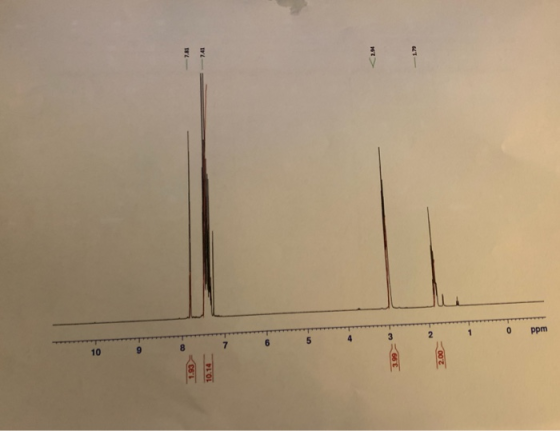
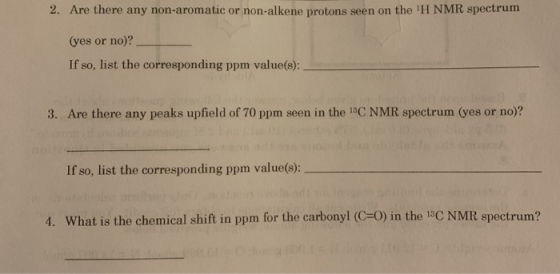
2. Yes, there are total 6 non-aromatic/non-alkene protons.
2 protons at 1.79 ppm which corresponds to e and 4 protons which corresponds to d
3. Yes, there are two peaks upfield of 70 ppm seen in 13C NMR spectrum at 22.9 ppm and 28.4 ppm indicating the aliphatic carbons e & d respectively. Peak at 77 ppm is a solvent peak of CDCl3.
4. Peak for carbonyl group seen far downfield at 190.3ppm.

Add Answer to:
Please answer questions 2,3, and 4 that correspond to the nmr
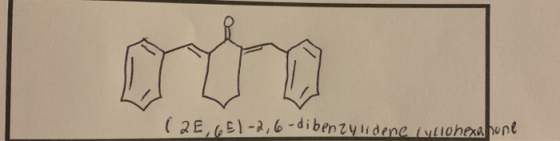
spectra of (2E,6E)-2,6-dibenzylidenecyclohexanone.
Product:
ppm...
CRUDE PRODUCT COMPOSITION: (as determined by NMR) Show Calculations for % 9-fluorenol and % unreacted 9-fluorenone: A0...
 CRUDE PRODUCT COMPOSITION: (as determined by NMR) Show
Calculations for % 9-fluorenol and % unreacted 9-fluorenone:
A05-1.1.fid 2800 2600 2400 2200 2000 1800 1600 1400 1200 -1000 -800 -600 400 200 0 -200 -2 -3 5 4 1 1 8 7 10 11 14 13 12 16 15 f1 (ppm) You will notice that the main difference in the spectra are the presence of non-aromatic absorbances around 5.5 and 2.0 ppm in the NMR of the product alcohol. These of...
CRUDE PRODUCT COMPOSITION: (as determined by NMR) Show
Calculations for % 9-fluorenol and % unreacted 9-fluorenone:
A05-1.1.fid 2800 2600 2400 2200 2000 1800 1600 1400 1200 -1000 -800 -600 400 200 0 -200 -2 -3 5 4 1 1 8 7 10 11 14 13 12 16 15 f1 (ppm) You will notice that the main difference in the spectra are the presence of non-aromatic absorbances around 5.5 and 2.0 ppm in the NMR of the product alcohol. These of...
Explain # 7 compound name P-Chlorophenol elaborate on What 7. NMR-both C13 and HI -Please include...
 Explain # 7 compound name P-Chlorophenol
elaborate on What 7. NMR-both C13 and HI -Please include the spectra-Please each peak Why is it a singlet? Why is it downfield or upfield? What peak corresponds to what signal etc... Nuclear Magnetic Resonance (list all peaks) Protons Chemical Shift(ppm) Aromatic Multiplicity-1 Integration 6.9 3.5 NHz Conclusion Please show the name and the chemical structure (Lewis Structure) of the compound. Show how (chemical equation) it is synthesized and the mechanism (chemical equations with...
Explain # 7 compound name P-Chlorophenol
elaborate on What 7. NMR-both C13 and HI -Please include the spectra-Please each peak Why is it a singlet? Why is it downfield or upfield? What peak corresponds to what signal etc... Nuclear Magnetic Resonance (list all peaks) Protons Chemical Shift(ppm) Aromatic Multiplicity-1 Integration 6.9 3.5 NHz Conclusion Please show the name and the chemical structure (Lewis Structure) of the compound. Show how (chemical equation) it is synthesized and the mechanism (chemical equations with...
please help me answer the IR, H NMR and 13C NMR questions based on the pictures...
 please help me answer the IR, H NMR and 13C NMR questions based
on the pictures below.
IR List the important peaks seen in the IR of the product and label with the associated stretches and bends (eg. C-H stretch, etc). 13C NMR List all the peaks in the 13C NMR and give them each a number. Write the structure of the product and label the carbons with the associated number for the peak. (The peaks from 21-25 can be...
please help me answer the IR, H NMR and 13C NMR questions based
on the pictures below.
IR List the important peaks seen in the IR of the product and label with the associated stretches and bends (eg. C-H stretch, etc). 13C NMR List all the peaks in the 13C NMR and give them each a number. Write the structure of the product and label the carbons with the associated number for the peak. (The peaks from 21-25 can be...
NMR IR CAN YOU PLEASE ANSWER AS SOON AS POSSIBLE THANK YOU PLEASE EXPLAIN IT IN DETAIL THANK YOU Experimental Data Only report the IR absorptions that provide diagnosis...
 NMR
IR
CAN YOU PLEASE ANSWER AS SOON AS POSSIBLE THANK
YOU
PLEASE EXPLAIN IT IN DETAIL THANK YOU
Experimental Data Only report the IR absorptions that provide diagnosis for the major functional groups. Copies of your spectra will be included in your lab report with this information written on the spectra. However, the information should also be included in the body of the report in a text format similar to the example given below IR cm1: 1735 (C-o); MS:...
NMR
IR
CAN YOU PLEASE ANSWER AS SOON AS POSSIBLE THANK
YOU
PLEASE EXPLAIN IT IN DETAIL THANK YOU
Experimental Data Only report the IR absorptions that provide diagnosis for the major functional groups. Copies of your spectra will be included in your lab report with this information written on the spectra. However, the information should also be included in the body of the report in a text format similar to the example given below IR cm1: 1735 (C-o); MS:...
The IR/spectrum shows the value, 1st photo shows the instructions. Attached are 2 sets of spectra....
 The IR/spectrum shows the value, 1st photo shows the
instructions.
Attached are 2 sets of spectra. Each set is worth 25 points. Not all sets have a Mass Spectrum, but do have information that was obtained from MS and some sets do not have a "C-NMR and don't really need one. Look at each spectrum individually and clearly list and comment on the structural Characteristics you can determine from that spectrum. (Chemical shifts, splitting patterns, coupling constants, fragmentation patterns, absorption...
The IR/spectrum shows the value, 1st photo shows the
instructions.
Attached are 2 sets of spectra. Each set is worth 25 points. Not all sets have a Mass Spectrum, but do have information that was obtained from MS and some sets do not have a "C-NMR and don't really need one. Look at each spectrum individually and clearly list and comment on the structural Characteristics you can determine from that spectrum. (Chemical shifts, splitting patterns, coupling constants, fragmentation patterns, absorption...
Only need help with 5,6,7 and mechanism FTIR and NMR Spectra After completing a reaction and...
 Only need help with 5,6,7
and mechanism
FTIR and NMR Spectra After completing a reaction and working up the products, it is still necessary to confirm that the correct product was formed. The most common tools used for this analysis are Fourier Transform Infrared (FTIR) and Nuclear Magnetic Resonance (NMR) spectroscopy. In the virtual laboratory, 'H and C NMR spectra are available. Details on interpreting FTIR and NMR spectra are found in your textbook. Your instructor may or may not...
Only need help with 5,6,7
and mechanism
FTIR and NMR Spectra After completing a reaction and working up the products, it is still necessary to confirm that the correct product was formed. The most common tools used for this analysis are Fourier Transform Infrared (FTIR) and Nuclear Magnetic Resonance (NMR) spectroscopy. In the virtual laboratory, 'H and C NMR spectra are available. Details on interpreting FTIR and NMR spectra are found in your textbook. Your instructor may or may not...
Product was formed successfully based on the exp. below (about 85% yield), please interpret/discuss HNMR/IR in...
 Product was formed successfully based on the exp. below (about
85% yield), please interpret/discuss HNMR/IR in as much detail as
possible and assign peaks on HNMR (which peak represents which
protons of which group, etc). Note: I already know how you
determine the formation of the product so you can skip that part of
part b).
Based on this exp:
Discuss the IR spectrum and what is the peak in IR that you can see for a specific functional group...
Product was formed successfully based on the exp. below (about
85% yield), please interpret/discuss HNMR/IR in as much detail as
possible and assign peaks on HNMR (which peak represents which
protons of which group, etc). Note: I already know how you
determine the formation of the product so you can skip that part of
part b).
Based on this exp:
Discuss the IR spectrum and what is the peak in IR that you can see for a specific functional group...
 CRUDE PRODUCT COMPOSITION: (as determined by NMR) Show
Calculations for % 9-fluorenol and % unreacted 9-fluorenone:
A05-1.1.fid 2800 2600 2400 2200 2000 1800 1600 1400 1200 -1000 -800 -600 400 200 0 -200 -2 -3 5 4 1 1 8 7 10 11 14 13 12 16 15 f1 (ppm) You will notice that the main difference in the spectra are the presence of non-aromatic absorbances around 5.5 and 2.0 ppm in the NMR of the product alcohol. These of...
CRUDE PRODUCT COMPOSITION: (as determined by NMR) Show
Calculations for % 9-fluorenol and % unreacted 9-fluorenone:
A05-1.1.fid 2800 2600 2400 2200 2000 1800 1600 1400 1200 -1000 -800 -600 400 200 0 -200 -2 -3 5 4 1 1 8 7 10 11 14 13 12 16 15 f1 (ppm) You will notice that the main difference in the spectra are the presence of non-aromatic absorbances around 5.5 and 2.0 ppm in the NMR of the product alcohol. These of...
 Explain # 7 compound name P-Chlorophenol
elaborate on What 7. NMR-both C13 and HI -Please include the spectra-Please each peak Why is it a singlet? Why is it downfield or upfield? What peak corresponds to what signal etc... Nuclear Magnetic Resonance (list all peaks) Protons Chemical Shift(ppm) Aromatic Multiplicity-1 Integration 6.9 3.5 NHz Conclusion Please show the name and the chemical structure (Lewis Structure) of the compound. Show how (chemical equation) it is synthesized and the mechanism (chemical equations with...
Explain # 7 compound name P-Chlorophenol
elaborate on What 7. NMR-both C13 and HI -Please include the spectra-Please each peak Why is it a singlet? Why is it downfield or upfield? What peak corresponds to what signal etc... Nuclear Magnetic Resonance (list all peaks) Protons Chemical Shift(ppm) Aromatic Multiplicity-1 Integration 6.9 3.5 NHz Conclusion Please show the name and the chemical structure (Lewis Structure) of the compound. Show how (chemical equation) it is synthesized and the mechanism (chemical equations with...
 please help me answer the IR, H NMR and 13C NMR questions based
on the pictures below.
IR List the important peaks seen in the IR of the product and label with the associated stretches and bends (eg. C-H stretch, etc). 13C NMR List all the peaks in the 13C NMR and give them each a number. Write the structure of the product and label the carbons with the associated number for the peak. (The peaks from 21-25 can be...
please help me answer the IR, H NMR and 13C NMR questions based
on the pictures below.
IR List the important peaks seen in the IR of the product and label with the associated stretches and bends (eg. C-H stretch, etc). 13C NMR List all the peaks in the 13C NMR and give them each a number. Write the structure of the product and label the carbons with the associated number for the peak. (The peaks from 21-25 can be...
 NMR
IR
CAN YOU PLEASE ANSWER AS SOON AS POSSIBLE THANK
YOU
PLEASE EXPLAIN IT IN DETAIL THANK YOU
Experimental Data Only report the IR absorptions that provide diagnosis for the major functional groups. Copies of your spectra will be included in your lab report with this information written on the spectra. However, the information should also be included in the body of the report in a text format similar to the example given below IR cm1: 1735 (C-o); MS:...
NMR
IR
CAN YOU PLEASE ANSWER AS SOON AS POSSIBLE THANK
YOU
PLEASE EXPLAIN IT IN DETAIL THANK YOU
Experimental Data Only report the IR absorptions that provide diagnosis for the major functional groups. Copies of your spectra will be included in your lab report with this information written on the spectra. However, the information should also be included in the body of the report in a text format similar to the example given below IR cm1: 1735 (C-o); MS:...
 The IR/spectrum shows the value, 1st photo shows the
instructions.
Attached are 2 sets of spectra. Each set is worth 25 points. Not all sets have a Mass Spectrum, but do have information that was obtained from MS and some sets do not have a "C-NMR and don't really need one. Look at each spectrum individually and clearly list and comment on the structural Characteristics you can determine from that spectrum. (Chemical shifts, splitting patterns, coupling constants, fragmentation patterns, absorption...
The IR/spectrum shows the value, 1st photo shows the
instructions.
Attached are 2 sets of spectra. Each set is worth 25 points. Not all sets have a Mass Spectrum, but do have information that was obtained from MS and some sets do not have a "C-NMR and don't really need one. Look at each spectrum individually and clearly list and comment on the structural Characteristics you can determine from that spectrum. (Chemical shifts, splitting patterns, coupling constants, fragmentation patterns, absorption...
 Only need help with 5,6,7
and mechanism
FTIR and NMR Spectra After completing a reaction and working up the products, it is still necessary to confirm that the correct product was formed. The most common tools used for this analysis are Fourier Transform Infrared (FTIR) and Nuclear Magnetic Resonance (NMR) spectroscopy. In the virtual laboratory, 'H and C NMR spectra are available. Details on interpreting FTIR and NMR spectra are found in your textbook. Your instructor may or may not...
Only need help with 5,6,7
and mechanism
FTIR and NMR Spectra After completing a reaction and working up the products, it is still necessary to confirm that the correct product was formed. The most common tools used for this analysis are Fourier Transform Infrared (FTIR) and Nuclear Magnetic Resonance (NMR) spectroscopy. In the virtual laboratory, 'H and C NMR spectra are available. Details on interpreting FTIR and NMR spectra are found in your textbook. Your instructor may or may not...
 Product was formed successfully based on the exp. below (about
85% yield), please interpret/discuss HNMR/IR in as much detail as
possible and assign peaks on HNMR (which peak represents which
protons of which group, etc). Note: I already know how you
determine the formation of the product so you can skip that part of
part b).
Based on this exp:
Discuss the IR spectrum and what is the peak in IR that you can see for a specific functional group...
Product was formed successfully based on the exp. below (about
85% yield), please interpret/discuss HNMR/IR in as much detail as
possible and assign peaks on HNMR (which peak represents which
protons of which group, etc). Note: I already know how you
determine the formation of the product so you can skip that part of
part b).
Based on this exp:
Discuss the IR spectrum and what is the peak in IR that you can see for a specific functional group...
Most questions answered within 3 hours.
-
Where is the error in this code sequence?
String s1 = "Hello";
String s2 = "ello";...
asked 11 months ago -
Financial data for Joel de Paris, Inc., for last year
follow:
Joel de Paris, Inc.
Balance...
asked 11 months ago -
Consider this reaction:
Al2(SO4)3 (aq)+ BaCl3
(aq) Al2Cl6 (aq)- +
3BaSO4(s) . What is the...
asked 11 months ago -
Suppose that Savneet is considering increasing her
recent random sample from 20 car rentals to 40...
asked 11 months ago -
Trucks arrive at an unloading terminal at an average rate of 120
per hour.
Trucks arrive...
asked 11 months ago -
Why are methanol and ethanol completely soluble in water while
octanol is not very little soluble....
asked 11 months ago -
A facilities manager at a university reads in a research report
that the mean amount of...
asked 11 months ago -
When the CuSO4 is rehydrated by adding water to the anhydrous
compound, is this an endothermic...
asked 11 months ago -
A ray of sunlight is passing from diamond into crown glass; the
angle of incidence is...
asked 11 months ago -
A block of mass 0.249 kg is placed on top of a light, vertical
spring of...
asked 11 months ago -
how do the kidneys compensate in the presences of acidosis
a) trigger hyperventilate
b) reserve acid...
asked 11 months ago -
Question 501 pts
The rental rate of capital to the firm increases. Which of the
following...
asked 11 months ago