
Homework Answers
![2+6h 2 coso - sinrola. d-coso 7 - sinrol +66 (s.co * o - (cms *+ si, o)] ab hi [34°0-] =6474 So we get, P4 = 6h 4, so the eig](http://img.homeworklib.com/questions/b67f34b0-718a-11ea-9274-d7c00e6a14fe.png?x-oss-process=image/resize,w_560)
![d (erse) = - eint. 2 (3²) = 3.2.4.=64 (cino) = roso coto a cosa sino sino + cosno=1 (const)= 0 [const= 1, 2, 3 .]](http://img.homeworklib.com/questions/b71466d0-718a-11ea-926d-33620c5c727e.png?x-oss-process=image/resize,w_560)
Add Answer to:
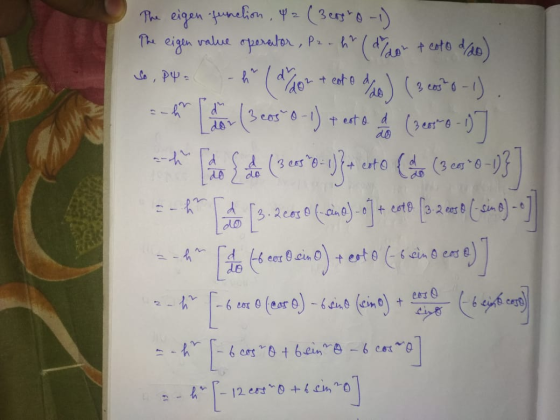
18) Show that the following wave function y (3cos20 -1) is an eigen-function of the operator...
A free electron is described by the wave function: Using the linear momentum operator, derive an expression for the mo...
 A free electron is described by the wave function:
Using the linear momentum operator, derive an expression for
the momentum of the electron. Is your answer consistent with de
Broglie's equation?
Write answers clearly on the sheet. Show all working and underline your final answer 1. A free electron is described by the wave function, *(x) = Ae ** Using the linear momentum operator, P = -ih d/dx, derive an expression for the momentum of the electron. Is your answer...
A free electron is described by the wave function:
Using the linear momentum operator, derive an expression for
the momentum of the electron. Is your answer consistent with de
Broglie's equation?
Write answers clearly on the sheet. Show all working and underline your final answer 1. A free electron is described by the wave function, *(x) = Ae ** Using the linear momentum operator, P = -ih d/dx, derive an expression for the momentum of the electron. Is your answer...
Consider the following wave function: y(x, t) = cos(kx - omega t). a. Show that the...
 Consider the following wave function: y(x, t) = cos(kx - omega t). a. Show that the above function is an eigenfunction of the operator partialdifferential^2/partialdifferential x^2[...] and determine its eigenvalue. b. Show that the above function is a solution of the wave equation expressed as partialdifferential^2 y(x, t)/partialdifferential x^2 = 1/v^2 partialdifferential^2 y(x, t)/partialdifferential t^2, given the wave velocity is v = omega/k (where omega = 2 pi V and k = 2pi/lambda).
both pls 1) Which of the following operator(s) is/are Hermitian? a) id/dy? b) d/dy2 c) id/dy...
 both pls
1) Which of the following operator(s) is/are Hermitian? a) id/dy? b) d/dy2 c) id/dy You may assume that the functions on which these operators operate are appropriately well behaved at infinity. (Hint #1: .. P dy = f. y pudy where the integral hudu = Uv - Sudv. Hint #2: Use y = e) 2) In each case below show (in the space provided directly) that F(y) is an eigen- function of the operator A and find the...
both pls
1) Which of the following operator(s) is/are Hermitian? a) id/dy? b) d/dy2 c) id/dy You may assume that the functions on which these operators operate are appropriately well behaved at infinity. (Hint #1: .. P dy = f. y pudy where the integral hudu = Uv - Sudv. Hint #2: Use y = e) 2) In each case below show (in the space provided directly) that F(y) is an eigen- function of the operator A and find the...
7 marks (4 marks) (3 marks) (a) Is the operator P(v) y'+2ty linear? (Show workings) (b) Find the ...
 please answer question 1) to 3) fully step by step
7 marks (4 marks) (3 marks) (a) Is the operator P(v) y'+2ty linear? (Show workings) (b) Find the null space of the operator in (a) above. Question 2 5 marks Let P be a linear operator. Suppose that y is a particular solution to the equation Ply) = b. Prove that any solution to this equation can be written as y = Yo + yi for yo au clement of...
please answer question 1) to 3) fully step by step
7 marks (4 marks) (3 marks) (a) Is the operator P(v) y'+2ty linear? (Show workings) (b) Find the null space of the operator in (a) above. Question 2 5 marks Let P be a linear operator. Suppose that y is a particular solution to the equation Ply) = b. Prove that any solution to this equation can be written as y = Yo + yi for yo au clement of...
1. Show y = sin ax is not an eigenfunction of the operator d/dx, but is...
 1. Show y = sin ax is not an eigenfunction of the operator d/dx, but is an eigenfunction of the operator da/dx. 2. Show that the function 0 = Aeimo , where i, m, and A are constants, is an eigenfunction of the angular momentum operator is the z-direction: M =; 2i ap' and what are the eigenvalues? 3. Show the the function y = Jź sin MA where n and L are constants, is an eigenfunction of the Hamiltonian...
1. The wave-functions of the states [4) and (0) are given by y(x) and Q(x), respectively....
 1. The wave-functions of the states [4) and (0) are given by y(x) and Q(x), respectively. Derive the expression for the inner product (14) in terms of the wave- functions Q(x) and (x). What is the physical meaning of y(x) and (x)/2? 2. Fig. 1 shows a sketch of y(x). Sketch y(x) such that the states (4) and (o) are orthogonal: (014) = 0. (x) M Figure 1 3. Assume a particle has a wave-function y(x) sketched in Fig. 2....
1. The wave-functions of the states [4) and (0) are given by y(x) and Q(x), respectively....
 1. The wave-functions of the states [4) and (0) are given by y(x) and Q(x), respectively. Derive the expression for the inner product (14) in terms of the wave- functions Q(x) and (x). What is the physical meaning of y(x) and (x)/2? 2. Fig. 1 shows a sketch of y(x). Sketch y(x) such that the states (4) and (o) are orthogonal: (014) = 0. (x) M Figure 1 3. Assume a particle has a wave-function y(x) sketched in Fig. 2....
a) The wave-functions of the states [) and (o) are given by y(x) and (x), respectively....
 a) The wave-functions of the states [) and (o) are given by y(x) and (x), respectively. Derive the expression for the inner product (4) in terms of the wave- functions Q(x) and (x). What is the physical meaning of y(x) and (x)/2? b) Fig. 1 shows a sketch of y(x). Sketch y(x) such that the states [4) and (o) are orthogonal: (14) = 0. (x) M Figure 1 c) Assume a particle has a wave-function y(x) sketched in Fig. 2....
Graph the function 1 y = 4 tan Which of the following is the graph of...
 Graph the function 1 y = 4 tan Which of the following is the graph of y = 4 tan = x? OA OB Ос. OD Grad - 2 8 75 Write each expression in terms of sine and cosine, and then simplify so that no quotients appear in the final expression and all functions are of only. cot? (-A) 1-sin?(-6) 1+ cot? (-0) 1-sinº-0)
2. Jane's utility function has the following form: U (1,y) = 3x2 +2.ry The prices of...
 2. Jane's utility function has the following form: U (1,y) = 3x2 +2.ry The prices of cand y are p, and Py respectively. Jane's income is I. (a) Find the Marshallian demands for and y and the indirect utility function. (b) Without solving the cost minimization problem, recover the Hicksian de mands for x and y and the expenditure function from the Marshallian demands and the indirect utility function. (c) Write down the Slutsky equation determining the effect of a...
 A free electron is described by the wave function:
Using the linear momentum operator, derive an expression for
the momentum of the electron. Is your answer consistent with de
Broglie's equation?
Write answers clearly on the sheet. Show all working and underline your final answer 1. A free electron is described by the wave function, *(x) = Ae ** Using the linear momentum operator, P = -ih d/dx, derive an expression for the momentum of the electron. Is your answer...
A free electron is described by the wave function:
Using the linear momentum operator, derive an expression for
the momentum of the electron. Is your answer consistent with de
Broglie's equation?
Write answers clearly on the sheet. Show all working and underline your final answer 1. A free electron is described by the wave function, *(x) = Ae ** Using the linear momentum operator, P = -ih d/dx, derive an expression for the momentum of the electron. Is your answer...
 Consider the following wave function: y(x, t) = cos(kx - omega t). a. Show that the above function is an eigenfunction of the operator partialdifferential^2/partialdifferential x^2[...] and determine its eigenvalue. b. Show that the above function is a solution of the wave equation expressed as partialdifferential^2 y(x, t)/partialdifferential x^2 = 1/v^2 partialdifferential^2 y(x, t)/partialdifferential t^2, given the wave velocity is v = omega/k (where omega = 2 pi V and k = 2pi/lambda).
 both pls
1) Which of the following operator(s) is/are Hermitian? a) id/dy? b) d/dy2 c) id/dy You may assume that the functions on which these operators operate are appropriately well behaved at infinity. (Hint #1: .. P dy = f. y pudy where the integral hudu = Uv - Sudv. Hint #2: Use y = e) 2) In each case below show (in the space provided directly) that F(y) is an eigen- function of the operator A and find the...
both pls
1) Which of the following operator(s) is/are Hermitian? a) id/dy? b) d/dy2 c) id/dy You may assume that the functions on which these operators operate are appropriately well behaved at infinity. (Hint #1: .. P dy = f. y pudy where the integral hudu = Uv - Sudv. Hint #2: Use y = e) 2) In each case below show (in the space provided directly) that F(y) is an eigen- function of the operator A and find the...
 please answer question 1) to 3) fully step by step
7 marks (4 marks) (3 marks) (a) Is the operator P(v) y'+2ty linear? (Show workings) (b) Find the null space of the operator in (a) above. Question 2 5 marks Let P be a linear operator. Suppose that y is a particular solution to the equation Ply) = b. Prove that any solution to this equation can be written as y = Yo + yi for yo au clement of...
please answer question 1) to 3) fully step by step
7 marks (4 marks) (3 marks) (a) Is the operator P(v) y'+2ty linear? (Show workings) (b) Find the null space of the operator in (a) above. Question 2 5 marks Let P be a linear operator. Suppose that y is a particular solution to the equation Ply) = b. Prove that any solution to this equation can be written as y = Yo + yi for yo au clement of...
 1. Show y = sin ax is not an eigenfunction of the operator d/dx, but is an eigenfunction of the operator da/dx. 2. Show that the function 0 = Aeimo , where i, m, and A are constants, is an eigenfunction of the angular momentum operator is the z-direction: M =; 2i ap' and what are the eigenvalues? 3. Show the the function y = Jź sin MA where n and L are constants, is an eigenfunction of the Hamiltonian...
 1. The wave-functions of the states [4) and (0) are given by y(x) and Q(x), respectively. Derive the expression for the inner product (14) in terms of the wave- functions Q(x) and (x). What is the physical meaning of y(x) and (x)/2? 2. Fig. 1 shows a sketch of y(x). Sketch y(x) such that the states (4) and (o) are orthogonal: (014) = 0. (x) M Figure 1 3. Assume a particle has a wave-function y(x) sketched in Fig. 2....
 1. The wave-functions of the states [4) and (0) are given by y(x) and Q(x), respectively. Derive the expression for the inner product (14) in terms of the wave- functions Q(x) and (x). What is the physical meaning of y(x) and (x)/2? 2. Fig. 1 shows a sketch of y(x). Sketch y(x) such that the states (4) and (o) are orthogonal: (014) = 0. (x) M Figure 1 3. Assume a particle has a wave-function y(x) sketched in Fig. 2....
 a) The wave-functions of the states [) and (o) are given by y(x) and (x), respectively. Derive the expression for the inner product (4) in terms of the wave- functions Q(x) and (x). What is the physical meaning of y(x) and (x)/2? b) Fig. 1 shows a sketch of y(x). Sketch y(x) such that the states [4) and (o) are orthogonal: (14) = 0. (x) M Figure 1 c) Assume a particle has a wave-function y(x) sketched in Fig. 2....
 Graph the function 1 y = 4 tan Which of the following is the graph of y = 4 tan = x? OA OB Ос. OD Grad - 2 8 75 Write each expression in terms of sine and cosine, and then simplify so that no quotients appear in the final expression and all functions are of only. cot? (-A) 1-sin?(-6) 1+ cot? (-0) 1-sinº-0)
 2. Jane's utility function has the following form: U (1,y) = 3x2 +2.ry The prices of cand y are p, and Py respectively. Jane's income is I. (a) Find the Marshallian demands for and y and the indirect utility function. (b) Without solving the cost minimization problem, recover the Hicksian de mands for x and y and the expenditure function from the Marshallian demands and the indirect utility function. (c) Write down the Slutsky equation determining the effect of a...
Most questions answered within 3 hours.
-
Where is the error in this code sequence?
String s1 = "Hello";
String s2 = "ello";...
asked 10 months ago -
Financial data for Joel de Paris, Inc., for last year
follow:
Joel de Paris, Inc.
Balance...
asked 10 months ago -
Consider this reaction:
Al2(SO4)3 (aq)+ BaCl3
(aq) Al2Cl6 (aq)- +
3BaSO4(s) . What is the...
asked 10 months ago -
Suppose that Savneet is considering increasing her
recent random sample from 20 car rentals to 40...
asked 10 months ago -
Trucks arrive at an unloading terminal at an average rate of 120
per hour.
Trucks arrive...
asked 10 months ago -
Why are methanol and ethanol completely soluble in water while
octanol is not very little soluble....
asked 10 months ago -
A facilities manager at a university reads in a research report
that the mean amount of...
asked 10 months ago -
When the CuSO4 is rehydrated by adding water to the anhydrous
compound, is this an endothermic...
asked 10 months ago -
A ray of sunlight is passing from diamond into crown glass; the
angle of incidence is...
asked 10 months ago -
A block of mass 0.249 kg is placed on top of a light, vertical
spring of...
asked 10 months ago -
how do the kidneys compensate in the presences of acidosis
a) trigger hyperventilate
b) reserve acid...
asked 10 months ago -
Question 501 pts
The rental rate of capital to the firm increases. Which of the
following...
asked 10 months ago