

Homework Answers
Add Answer to:
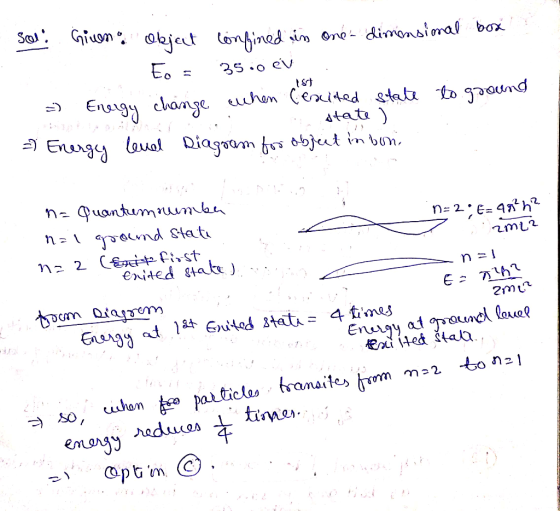
An electron confined to a one-dimensional box has a ground-state energy of 35.0 eV. If the...
An electron is confined in the ground state in a one-dimensional box of width 10-10 m....
 An electron is confined in the ground state in a one-dimensional box of width 10-10 m. Its energy is known to be 38 eV. (a) Calculate the energy of the electron in its first and second excited states (b) Sketch the wave functions for the ground state, the first and the second excited states (c) Estimate the average force (in Newtons) exerted on the walls of the box when the electron is in the ground state. (d) Sketch the new...
An electron is confined to a one-dimensional region in which its ground-state (n = 1) energy...
An electron is confined to a one-dimensional region in which its ground-state (n = 1) energy is 2.05 eV. (a) What is the length L of the region? nm (b) What energy input is required to promote the electron to its first excited state?
An electron is confined to a one-dimensional infinite well. From experiment, the first excited state is...
 An electron is confined to a one-dimensional infinite well. From experiment, the first excited state is measured to have an energy 1.2 eV above the ground state. What must be the width of the well?
An electron in a 10.1-nm one-dimensional box is excited from the ground state into a higher-energy...
 An electron in a 10.1-nm one-dimensional box is excited from the ground state into a higher-energy state by absorbing a photon of electromagnetic radiation with a wavelength of 13,950 nm. Determine the final energy state for this transition. 04 0 0 w Na Un 0 0 1 pts Question 24
an electron is confined to a box. in the third allowed energy level the energy is...
an electron is confined to a box. in the third allowed energy level the energy is 27 eV. Find the length of the box and the energy in ground state.
An electron is confined to a box of width 10 nm. How much energy must be...
An electron is confined to a box of width 10 nm. How much energy must be acquired to boost it into the first excited state, n=2, from the ground state?
An atom has the following energy levels for an electron: ground state, 0.0 eV; 1st excited...
An atom has the following energy levels for an electron: ground state, 0.0 eV; 1st excited state, 2.0 eV; 2nd excited state, 3.6 eV; 3rd excited state, 4.4 eV. How many possible emission lines are there in its spectrum? 1. Four 2. Five 3. Six 4. Three
Assume that four electrons are confined to a one dimensional box 4.95 ✕ 10−10 m in...
Assume that four electrons are confined to a one dimensional box 4.95 ✕ 10−10 m in length. If two electrons can occupy each allowed energy level, calculate the wavelength of electromagnetic radiation necessary to promote the highest-energy electron into the first excited state.
(20 points) Treat the hydrogen atom as a one-dimensional problem, where the electron is confined to the diameter of the atom in the first excited state (n-2). a.) Use the uncertainty principle to...
 (20 points) Treat the hydrogen atom as a one-dimensional problem, where the electron is confined to the diameter of the atom in the first excited state (n-2). a.) Use the uncertainty principle to estimate the minimum kinetic energy of an electron in this state, assuming that the uncertainty in position equal to it's diameter. (Note: Relativistic corrections are not necessary). b.) Assuming this excited electron only remains in this state for 0.1 ns, before emitting a photon and returning to...
An electron in the ground state of a hydrogen atom (-13.6 eV) absorbs a 10.2 eV...
An electron in the ground state of a hydrogen atom (-13.6 eV) absorbs a 10.2 eV photon and jumps to the first excited state. What is the energy in eV of the first excited state?
 An electron is confined in the ground state in a one-dimensional box of width 10-10 m. Its energy is known to be 38 eV. (a) Calculate the energy of the electron in its first and second excited states (b) Sketch the wave functions for the ground state, the first and the second excited states (c) Estimate the average force (in Newtons) exerted on the walls of the box when the electron is in the ground state. (d) Sketch the new...
 An electron is confined to a one-dimensional infinite well. From experiment, the first excited state is measured to have an energy 1.2 eV above the ground state. What must be the width of the well?
 An electron in a 10.1-nm one-dimensional box is excited from the ground state into a higher-energy state by absorbing a photon of electromagnetic radiation with a wavelength of 13,950 nm. Determine the final energy state for this transition. 04 0 0 w Na Un 0 0 1 pts Question 24
 (20 points) Treat the hydrogen atom as a one-dimensional problem, where the electron is confined to the diameter of the atom in the first excited state (n-2). a.) Use the uncertainty principle to estimate the minimum kinetic energy of an electron in this state, assuming that the uncertainty in position equal to it's diameter. (Note: Relativistic corrections are not necessary). b.) Assuming this excited electron only remains in this state for 0.1 ns, before emitting a photon and returning to...
Most questions answered within 3 hours.
-
Where is the error in this code sequence?
String s1 = "Hello";
String s2 = "ello";...
asked 10 months ago -
Financial data for Joel de Paris, Inc., for last year
follow:
Joel de Paris, Inc.
Balance...
asked 10 months ago -
Consider this reaction:
Al2(SO4)3 (aq)+ BaCl3
(aq) Al2Cl6 (aq)- +
3BaSO4(s) . What is the...
asked 10 months ago -
Suppose that Savneet is considering increasing her
recent random sample from 20 car rentals to 40...
asked 10 months ago -
Trucks arrive at an unloading terminal at an average rate of 120
per hour.
Trucks arrive...
asked 10 months ago -
Why are methanol and ethanol completely soluble in water while
octanol is not very little soluble....
asked 10 months ago -
A facilities manager at a university reads in a research report
that the mean amount of...
asked 10 months ago -
When the CuSO4 is rehydrated by adding water to the anhydrous
compound, is this an endothermic...
asked 10 months ago -
A ray of sunlight is passing from diamond into crown glass; the
angle of incidence is...
asked 10 months ago -
A block of mass 0.249 kg is placed on top of a light, vertical
spring of...
asked 10 months ago -
how do the kidneys compensate in the presences of acidosis
a) trigger hyperventilate
b) reserve acid...
asked 10 months ago -
Question 501 pts
The rental rate of capital to the firm increases. Which of the
following...
asked 10 months ago