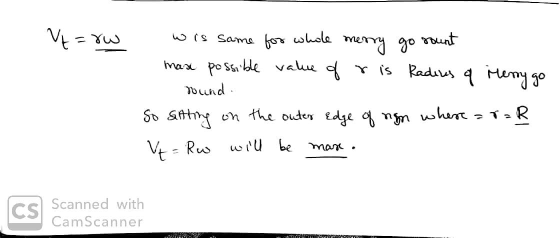
where would you sit on a merry go round to have the largest tangential velocity? why?
where would you sit on a merry go round to have the largest tangential velocity? why?
Homework Answers
Add Answer to:
where would you sit on a merry go round to have the largest
tangential velocity? why?
If you have two children on a merry-go-round they sit next to each other but one...
If you have two children on a merry-go-round they sit next to each other but one child sits on a horse closer to the center of the ride, whilst the other sit on an outside horse, which of the fallowing to the children have in common (select all right answers)? A. Angular Acceleration B. Angular Velocity C. Linear Acceleration D. Linear Velocity E. Distance Traveled F. Tangental Acceleration G. Tangental Velocity
You are sitting on a merry-go-round that is accelerating with a constant angular acceleration. As the...
You are sitting on a merry-go-round that is accelerating with a constant angular acceleration. As the merry-go-round goes faster, which of the following is not increasing? A)Angular Velocity B)Tangential Acceleration C)Centripetal Acceleration D) Tangential Velocity E) All are increasing
Tommy sits on a merry-go-round. While the merry-go-round is spinning, Tommy can sit in the center...
Tommy sits on a merry-go-round. While the merry-go-round is spinning, Tommy can sit in the center without holding on, but as he moves towards the outside he must hold on so he will not fly off. Explain why he feels like he will fly off? Show all your work, including formulas and units.
Suppose a child gets off a rotating merry-go-round. Does the angular velocity of the merry-go-round increase,...
 Suppose a child gets off a rotating merry-go-round. Does the angular velocity of the merry-go-round increase, decrease, or remain the same if: (a) He jumps off radially? (b) He jumps backward to land motionless? (c) He jumps straight up and hangs onto an overhead tree branch? (d) He jumps off forward, tangential to the edge? Explain your answers. (Refer to the figure below)
Alex and Riley are two kids standing on a merry-go-round. Alex has half the mass of...
Alex and Riley are two kids standing on a merry-go-round. Alex has half the mass of Riley and is standing at the very edge of the merry-go-round. Riley is standing halfway between the edge and the center of the merry-go-round. The merry-go-round is turning at a constant rate. Which of the following are true? (Select all that apply.) Alex has the larger moment of inertia on the merry-go-round. Riley has the greater angular velocity. Alex has the larger tangential...
A child exerts a tangential 61.9 N force on the rim of a disk-shaped merry-go-round with...
A child exerts a tangential 61.9 N force on the rim of a disk-shaped merry-go-round with a radius of 2.59 m. the merry-go-round starts at rest and acquires an angular speed of 0.8250 rev/s in 3.50 s, what is its mass
A child exerts a tangential 63.6 N force on the rim of a disk-shaped merry-go-round with...
A child exerts a tangential 63.6 N force on the rim of a disk-shaped merry-go-round with a radius of 2.59 m. If the merry-go-round starts at rest and acquires an angular speed of 0.8250 rev/s in 4.00 s, what is its mass?
A child exerts a tangential 51.7 N force on the rim of a disk-shaped merry-go-round with...
A child exerts a tangential 51.7 N force on the rim of a disk-shaped merry-go-round with a radius of 2.79 m. If the merry-go-round starts at rest and acquires an angular speed of 0.3250 rev/s in 3.00 s, what is its mass?
4. Two children, A and B, each having a mass of 30 kg sit at the edge of the merry-go-round nwhich is rotating at 2 rads Excluding the children, the merry-go-round has a mass of 180 kg and a radiu...
 4. Two children, A and B, each having a mass of 30 kg sit at the edge of the merry-go-round nwhich is rotating at 2 rads Excluding the children, the merry-go-round has a mass of 180 kg and a radius of gyration ofk,-06 m 0.75 m 0.75 m 2 rad/s Use 4 significant figures Be carefiul with units and signs. a. Initial total angular momentum pts. b. If child A jumps off hoeizoetally in the-a directice with a speed of...
A merry-go-round with moment of inertia 400 kg-m^2 and radius 2.0m is rotating with angular speed...
A merry-go-round with moment of inertia 400 kg-m^2 and radius 2.0m is rotating with angular speed 0.50 rad/s in the clockwise direction about a fixed axis. A child of mass 40 kg runs tangentially to the merry-go-round with speed 3.0m/s and grabs onto the outside edge of the merry-go-round. a. What is the final angular velocity of the system (merry-go-round plus child)/ What is the final tangential speed of the child? b. What is the change in kinetic energy? c....
 Suppose a child gets off a rotating merry-go-round. Does the angular velocity of the merry-go-round increase, decrease, or remain the same if: (a) He jumps off radially? (b) He jumps backward to land motionless? (c) He jumps straight up and hangs onto an overhead tree branch? (d) He jumps off forward, tangential to the edge? Explain your answers. (Refer to the figure below)
 4. Two children, A and B, each having a mass of 30 kg sit at the edge of the merry-go-round nwhich is rotating at 2 rads Excluding the children, the merry-go-round has a mass of 180 kg and a radius of gyration ofk,-06 m 0.75 m 0.75 m 2 rad/s Use 4 significant figures Be carefiul with units and signs. a. Initial total angular momentum pts. b. If child A jumps off hoeizoetally in the-a directice with a speed of...
Most questions answered within 3 hours.
-
Where is the error in this code sequence?
String s1 = "Hello";
String s2 = "ello";...
asked 11 months ago -
Financial data for Joel de Paris, Inc., for last year
follow:
Joel de Paris, Inc.
Balance...
asked 11 months ago -
Consider this reaction:
Al2(SO4)3 (aq)+ BaCl3
(aq) Al2Cl6 (aq)- +
3BaSO4(s) . What is the...
asked 11 months ago -
Suppose that Savneet is considering increasing her
recent random sample from 20 car rentals to 40...
asked 11 months ago -
Trucks arrive at an unloading terminal at an average rate of 120
per hour.
Trucks arrive...
asked 11 months ago -
Why are methanol and ethanol completely soluble in water while
octanol is not very little soluble....
asked 11 months ago -
A facilities manager at a university reads in a research report
that the mean amount of...
asked 11 months ago -
When the CuSO4 is rehydrated by adding water to the anhydrous
compound, is this an endothermic...
asked 11 months ago -
A ray of sunlight is passing from diamond into crown glass; the
angle of incidence is...
asked 11 months ago -
A block of mass 0.249 kg is placed on top of a light, vertical
spring of...
asked 11 months ago -
how do the kidneys compensate in the presences of acidosis
a) trigger hyperventilate
b) reserve acid...
asked 11 months ago -
Question 501 pts
The rental rate of capital to the firm increases. Which of the
following...
asked 11 months ago