
Homework Answers
Add Answer to:
order reaction with only one reagent, the reaction was started with a concentration of ar. After...
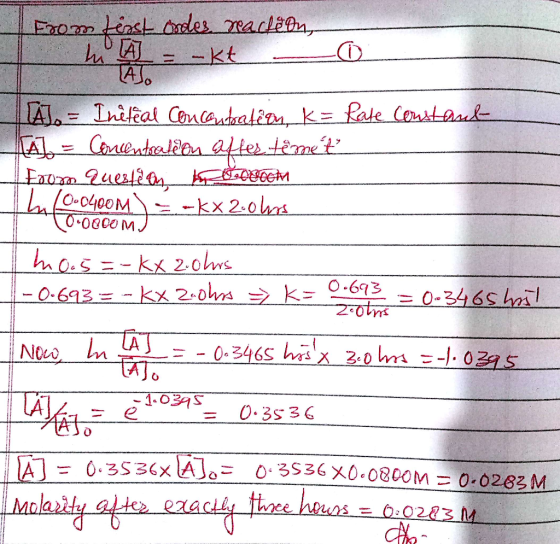
In a first order reaction with only one reagent, the reaction was started with a concentration of reactant equal to 0.0800 molar
In a first order reaction with only one reagent, the reaction was started with a concentration of reactant equal to 0.0800 molar. After exactly two hours, the concentration had fallen to 0.0400 molar. What is the molarity after exactly six hours? a. 0.0000 M b. 0.0100M c. 0.0150 M d. 0.0200 M e. 0.0300 M f. 0.0400M
Part A) The reactant concentration in a zero-order reaction was 7.00×10⁻² M after 200 s and...
Part A) The reactant concentration in a zero-order reaction was 7.00×10⁻² M after 200 s and 1.50×10⁻² M after 370 s . What is the rate constant for this reaction? Part C) The reactant concentration in a first-order reaction was 7.90×10⁻² M after 45.0 s and 2.00×10⁻³ M after 75.0 s . What is the rate constant for this reaction? Part D) The reactant concentration in a second-order reaction was 0.690 M after 220 s and 5.00×10⁻² M after 825...
Part A The reactant concentration in a first-order reaction was 6.90×10⁻²M after 10.0 s and 2.60×10⁻³Mafter...
Part A The reactant concentration in a first-order reaction was 6.90×10⁻²M after 10.0 s and 2.60×10⁻³Mafter 90.0 s . What is the rate constant for this reaction? Part B The reactant concentration in a second-order reaction was 0.110 M after 245 s and 5.10×10⁻²M after 875 s . What is the rate constant for this reaction?
The reactant concentration in a zero-order reaction was 0.100 M after 165 s and 2.50×10⁻²M after...
 The reactant concentration in a zero-order reaction was 0.100
M after 165 s and 2.50×10⁻²M after 345
s, and the rate constant of the reaction is 4.17*10
What was the initial reactant concentration for the reaction
described in Part A?
Express your answer with the appropriate units. Indicate the
multiplication of units, as necessary, explicitly either with a
multiplication dot or a dash.
The integrated rate laws for zero-, first-, and second-order may be arranged such that they resemble the...
The reactant concentration in a zero-order reaction was 0.100
M after 165 s and 2.50×10⁻²M after 345
s, and the rate constant of the reaction is 4.17*10
What was the initial reactant concentration for the reaction
described in Part A?
Express your answer with the appropriate units. Indicate the
multiplication of units, as necessary, explicitly either with a
multiplication dot or a dash.
The integrated rate laws for zero-, first-, and second-order may be arranged such that they resemble the...
Part A: The reactant concentration in a zero-order reaction was 6.00×10⁻² M after 185 s and...
Part A: The reactant concentration in a zero-order reaction was 6.00×10⁻² M after 185 s and 3.00×10⁻² M after 330 s . What is the rate constant for this reaction? Express your answer with the appropriate units. Indicate the multiplication of units, as necessary, explicitly either with a multiplication dot or a dash. k0th = 2.07×10⁻⁴ Ms (I did this one already) Part B: What was the initial reactant concentration for the reaction described in Part A? Express your answer...
For a first-order reaction, the half-life is constant. It depends only on the rate constant k...
For a first-order reaction, the half-life is constant. It depends only on the rate constant k and not on the reactant concentration. It is expressed as t1/2=0.693kt1/2=0.693k For a second-order reaction, the half-life depends on the rate constant and the concentration of the reactant and so is expressed as t1/2=1k[A]0 Part A. A certain first-order reaction (A→products) has a rate constant of 3.00×10⁻³ s−1 at 45 ∘C∘C. How many minutes does it take for the concentration of the reactant, [A],...
QUESTION 7 Give the characteristic of a second order reaction having only one reactant. O The...
 QUESTION 7 Give the characteristic of a second order reaction having only one reactant. O The rate of the reaction is proportional to the natural logarithm of the concentration of the reactant. O The rate of the reaction is not proportional to the concentration of the reactant. 。The rate of the reaction is proportional to the square of the concentration of the reactant. The rate of the reaction is proportional to the square root of the concentration of the reactant....
Part A The reactant concentration in a zero-order reaction was 6.00×10?2M after 105 s and 4.00×10?2M...
Part A The reactant concentration in a zero-order reaction was 6.00×10?2M after 105 s and 4.00×10?2M after 335 s . What is the rate constant for this reaction? Express your answer with the appropriate units. Indicate the multiplication of units, as necessary, explicitly either with a multiplication dot or a dash. Part B What was the initial reactant concentration for the reaction described in Part A? Express your answer with the appropriate units. Indicate the multiplication of units, as necessary,...
if a first order reaction has an initial reactant concentration of 1.79 M and a rate...
if a first order reaction has an initial reactant concentration of 1.79 M and a rate law constant of 1.150 hertz, what is the concentration of this first reactant after 8.0 seconds?
Part A The reactant concentration in a zero-order reaction was 7.00×10⁻²M after 105 s and 1.50×10⁻²Mafter...
Part A The reactant concentration in a zero-order reaction was 7.00×10⁻²M after 105 s and 1.50×10⁻²Mafter 345 s . What is the rate constant for this reaction? Express your answer with the appropriate units. Indicate the multiplication of units, as necessary, explicitly either with a multiplication dot or a dash. Part B What was the initial reactant concentration for the reaction described in Part A? Express your answer with the appropriate units. Indicate the multiplication of units, as necessary, explicitly...
 The reactant concentration in a zero-order reaction was 0.100
M after 165 s and 2.50×10⁻²M after 345
s, and the rate constant of the reaction is 4.17*10
What was the initial reactant concentration for the reaction
described in Part A?
Express your answer with the appropriate units. Indicate the
multiplication of units, as necessary, explicitly either with a
multiplication dot or a dash.
The integrated rate laws for zero-, first-, and second-order may be arranged such that they resemble the...
The reactant concentration in a zero-order reaction was 0.100
M after 165 s and 2.50×10⁻²M after 345
s, and the rate constant of the reaction is 4.17*10
What was the initial reactant concentration for the reaction
described in Part A?
Express your answer with the appropriate units. Indicate the
multiplication of units, as necessary, explicitly either with a
multiplication dot or a dash.
The integrated rate laws for zero-, first-, and second-order may be arranged such that they resemble the...
 QUESTION 7 Give the characteristic of a second order reaction having only one reactant. O The rate of the reaction is proportional to the natural logarithm of the concentration of the reactant. O The rate of the reaction is not proportional to the concentration of the reactant. 。The rate of the reaction is proportional to the square of the concentration of the reactant. The rate of the reaction is proportional to the square root of the concentration of the reactant....
Most questions answered within 3 hours.
-
Where is the error in this code sequence?
String s1 = "Hello";
String s2 = "ello";...
asked 10 months ago -
Financial data for Joel de Paris, Inc., for last year
follow:
Joel de Paris, Inc.
Balance...
asked 10 months ago -
Consider this reaction:
Al2(SO4)3 (aq)+ BaCl3
(aq) Al2Cl6 (aq)- +
3BaSO4(s) . What is the...
asked 10 months ago -
Suppose that Savneet is considering increasing her
recent random sample from 20 car rentals to 40...
asked 10 months ago -
Trucks arrive at an unloading terminal at an average rate of 120
per hour.
Trucks arrive...
asked 10 months ago -
Why are methanol and ethanol completely soluble in water while
octanol is not very little soluble....
asked 10 months ago -
A facilities manager at a university reads in a research report
that the mean amount of...
asked 10 months ago -
When the CuSO4 is rehydrated by adding water to the anhydrous
compound, is this an endothermic...
asked 10 months ago -
A ray of sunlight is passing from diamond into crown glass; the
angle of incidence is...
asked 10 months ago -
A block of mass 0.249 kg is placed on top of a light, vertical
spring of...
asked 10 months ago -
how do the kidneys compensate in the presences of acidosis
a) trigger hyperventilate
b) reserve acid...
asked 10 months ago -
Question 501 pts
The rental rate of capital to the firm increases. Which of the
following...
asked 10 months ago