
Homework Answers
Add Answer to:
For each of the following reactions, balance the chemical equation, calculate the emf, and calculate AGº...
For each of the following reactions, balance the chemical equation, calculate the emf, and calculate G°...
 For each of the following reactions, balance the chemical
equation, calculate the emf, and calculate G° at 298 K. (Use the smallest possible
coefficients for H2O(l),
H+(aq), and HO-(aq). These
may be zero.)
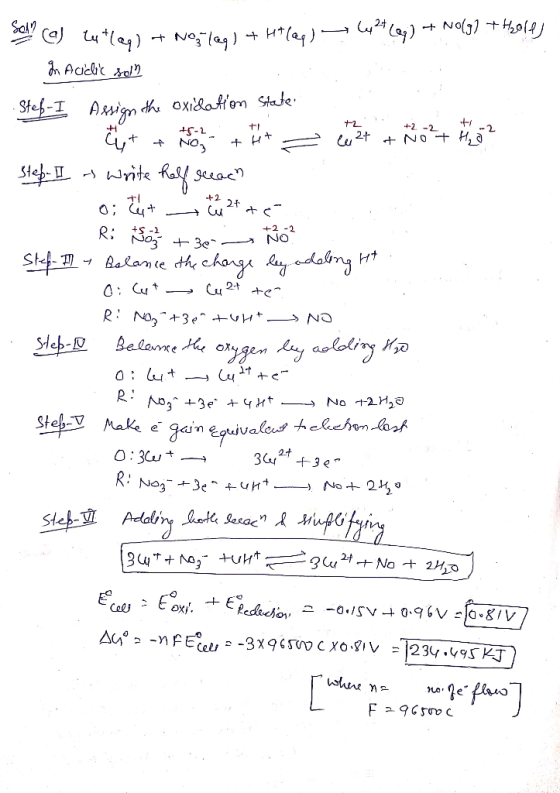
(a) In acidic solution copper(I) ion is oxidized to copper(II)
ion by nitrate ion.
Cu+(aq)
+ NO3-(aq)
+ H+(aq) Cu2+(aq) NO(g)
+ H2O(l)
emf
V
G°
kJ
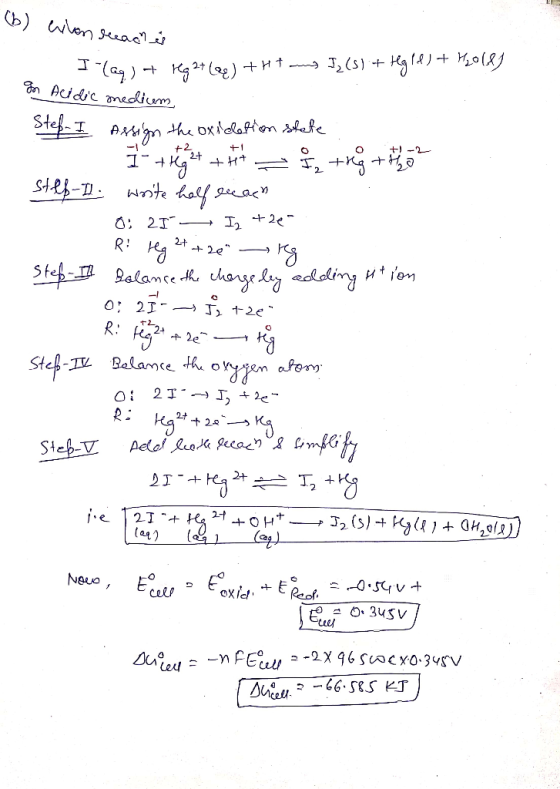
(b) Aqueous iodide ion is oxidized to I2(s) by
Hg22+(aq).
I-(aq)
+ Hg22+(aq)
+ H+ I2(s) Hg(l)
+ H2O(l)
emf
V
G°
kJ
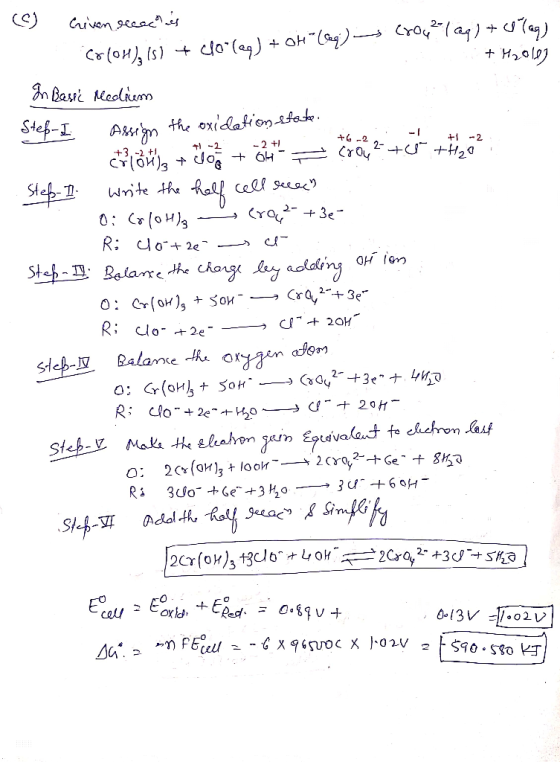
(c) In basic solution Cr(OH)3(s) is...
For each of the following reactions, balance the chemical
equation, calculate the emf, and calculate G° at 298 K. (Use the smallest possible
coefficients for H2O(l),
H+(aq), and HO-(aq). These
may be zero.)
(a) In acidic solution copper(I) ion is oxidized to copper(II)
ion by nitrate ion.
Cu+(aq)
+ NO3-(aq)
+ H+(aq) Cu2+(aq) NO(g)
+ H2O(l)
emf
V
G°
kJ
(b) Aqueous iodide ion is oxidized to I2(s) by
Hg22+(aq).
I-(aq)
+ Hg22+(aq)
+ H+ I2(s) Hg(l)
+ H2O(l)
emf
V
G°
kJ
(c) In basic solution Cr(OH)3(s) is...
For each of the following reactions, balance the chemical equation, calculate the emf, and calculate G°...
For each of the following reactions, balance the chemical equation, calculate the emf, and calculate G° at 298 K. (Use the smallest possible coefficients for H2O(l), H+(aq), and HO-(aq). These may be zero.) (a) In acidic solution copper(I) ion is oxidized to copper(II) ion by nitrate ion. _____Cu+(aq) + _______NO3-(aq) + ____H+(aq) _______Cu2+(aq) _____NO(g) + _____H2O(l) emf_____ V ______G° kJ (b) Aqueous iodide ion is oxidized to I2(s) by Hg22+(aq). ______I-(aq) + ______Hg22+(aq) + ______H+ ________I2(s) _____ Hg(l) + ______H2O(l)...
at 298 K. (Use the For each of the following reactions, balance the chemical equation, calculate...
 at 298 K. (Use the For each of the following reactions, balance the chemical equation, calculate the emf, and calculate AG smallest possible coefficients for H2000), H(aq), and HO (aq). These may be zero.) (a) In basic solution CH(OH)3(s) is oxidized to cro.2(aq) by Cio (aq). Cr(OH)3(s) + Cio(aq) + OH" (aq) - 0 Cro? (aq) O r(aq) + H2O(!) (b) In acidic solution copper(t) lon is oxidized to copper(IT) Ion by nitrate ion. Cu(aq) + NO3(aq) + (aq) +...
need help Question 19 0/1 pts Calculate AGº in kJ at 298 K for the oxidation...
 need help
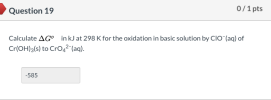
Question 19 0/1 pts Calculate AGº in kJ at 298 K for the oxidation in basic solution by CIO (aq) of Cr(OH)3(s) to CrO42-(aq). -585
need help
Question 19 0/1 pts Calculate AGº in kJ at 298 K for the oxidation in basic solution by CIO (aq) of Cr(OH)3(s) to CrO42-(aq). -585
croHissit Song "14. a) Calculate the standard emf and write the overall equation for the cell...
 croHissit Song "14. a) Calculate the standard emf and write the overall equation for the cell described as: Croaq) Haq) + (aq) → Craq) + 2/8) + H2O(D Cr₂O7991+ 4H₂011 +36-7 reducing Oxidizing 2 croren + 4H20 (0) +36 --> CrotsstSoH + 5% 3(21 691 -> Izintze-) 0.406 14 7 .0 I BOV overall eqn: 200 2 06112 --> 2010 He(s) tel +3120) emf: 0.106 b) Calculate the emf obtained by this cell (based on part a above) from the...
(10 pts) Balance the following redox reactions by first separating the oxidation and reduction half-reactions. a....
 (10 pts) Balance the following redox reactions by first separating the oxidation and reduction half-reactions. a. Cut (aq) + Fe (s) Fe3+ (aq) + Cu(s) b. Cu(s) + HNO3 (aq) Cu2+ (aq) + NO (g) (basic solution) c. NH(aq) + O2(g) → N03 (aq) + H2O(l) (acidic solution) d. Cd(s) + NiO(OH)(s) + Ca(OH)2(s) + Ni(OH)2(s) (Nicad battery) e. The oxidation of iodide ion (1) by permanganate ion (MnO4) in basic solution to yield molecular iodine (12) and manganese(IV) oxide...
16.52 Balance each of the following unbalanced equations for cell reactions in acidic conditions, then calculate...
 16.52 Balance each of the following unbalanced equations for cell reactions in acidic conditions, then calculate the standard cell emf, and decide whether the equation is written in the direction of spontaneous reaction. (a) Sn2+ (aq) + Ag(s) > Sn(s) + Ag+ (aq) (b) Al(s) + Sn4+ (aq) → Sn²+ (aq) + AP+ (aq) (C) CIO3+ (aq) + Ce3+ (aq) —Cl(aq) + Ce++ (aq) (d) Cu(s) + NO3 (aq) —> Cu2+ (aq) + NO(g) 16 .1 APPENDIX F standard Reduction...
31. + -10.1 points 0/4 Submissions Used Balance the following equations. (Use the lowest possible whole-number...
 31. + -10.1 points 0/4 Submissions Used Balance the following equations. (Use the lowest possible whole-number coefficients. These may be zero.) (a) CIO (aq) + 12() = Cl(aq) + 103 (aq) CIO + 12+ H H20 = + 103 + H+ H2O (b) NO3 (aq) + As2O3(s) = N2O3(aq) + H3ASO4(aq) NO3 + As2O3 + H+ + H20 = N203 + C H3A504 + H+ + H2O (c) Cro42-(aq) + N2H4(aq) = Cr(OH)3(s) + N2(9) croq²+ NaH4+ OH + H20...
1) Balance the following reaction under acidic conditions and calculate the cell potential in (V) at...
1) Balance the following reaction under acidic conditions and calculate the cell potential in (V) at 298 K generated by the cell. Report your answer to the hundredths place. Cr2O72-(aq) + I-(aq) → Cr3+(aq) + I2(s) [Cr2O72-] = 2.0 M, [H+] = 1.0 M, [I-] = 1.0 M, [Cr3+] = 1.0 × 10⁻⁵ M 2) What is the value of n for the following reaction? Enter the whole number. 3Ni+(aq) + Cr(OH)3(s) + 5OH-(aq) → 3Ni(s) + CrO42-(aq) + 4H2O(l)
Using data found in Appendix E of your textbook calculate the nonstandard emf for each of...
 Using data found in Appendix E of your textbook calculate the
nonstandard emf for each of the following reactions if the
concentration of each of the ions in these reactions is 0.0005
molar and everything else is standard (use 298 K for the
temperature, R = 8.314 J/mol-K, and F = 96,485 C/mol):
Using data found in Appendix E of your textbook calculate the nonstandard emf for each of the following reactions if the concentration of each of the ions...
Using data found in Appendix E of your textbook calculate the
nonstandard emf for each of the following reactions if the
concentration of each of the ions in these reactions is 0.0005
molar and everything else is standard (use 298 K for the
temperature, R = 8.314 J/mol-K, and F = 96,485 C/mol):
Using data found in Appendix E of your textbook calculate the nonstandard emf for each of the following reactions if the concentration of each of the ions...
 For each of the following reactions, balance the chemical
equation, calculate the emf, and calculate G° at 298 K. (Use the smallest possible
coefficients for H2O(l),
H+(aq), and HO-(aq). These
may be zero.)
(a) In acidic solution copper(I) ion is oxidized to copper(II)
ion by nitrate ion.
Cu+(aq)
+ NO3-(aq)
+ H+(aq) Cu2+(aq) NO(g)
+ H2O(l)
emf
V
G°
kJ
(b) Aqueous iodide ion is oxidized to I2(s) by
Hg22+(aq).
I-(aq)
+ Hg22+(aq)
+ H+ I2(s) Hg(l)
+ H2O(l)
emf
V
G°
kJ
(c) In basic solution Cr(OH)3(s) is...
For each of the following reactions, balance the chemical
equation, calculate the emf, and calculate G° at 298 K. (Use the smallest possible
coefficients for H2O(l),
H+(aq), and HO-(aq). These
may be zero.)
(a) In acidic solution copper(I) ion is oxidized to copper(II)
ion by nitrate ion.
Cu+(aq)
+ NO3-(aq)
+ H+(aq) Cu2+(aq) NO(g)
+ H2O(l)
emf
V
G°
kJ
(b) Aqueous iodide ion is oxidized to I2(s) by
Hg22+(aq).
I-(aq)
+ Hg22+(aq)
+ H+ I2(s) Hg(l)
+ H2O(l)
emf
V
G°
kJ
(c) In basic solution Cr(OH)3(s) is...
 at 298 K. (Use the For each of the following reactions, balance the chemical equation, calculate the emf, and calculate AG smallest possible coefficients for H2000), H(aq), and HO (aq). These may be zero.) (a) In basic solution CH(OH)3(s) is oxidized to cro.2(aq) by Cio (aq). Cr(OH)3(s) + Cio(aq) + OH" (aq) - 0 Cro? (aq) O r(aq) + H2O(!) (b) In acidic solution copper(t) lon is oxidized to copper(IT) Ion by nitrate ion. Cu(aq) + NO3(aq) + (aq) +...
 need help
Question 19 0/1 pts Calculate AGº in kJ at 298 K for the oxidation in basic solution by CIO (aq) of Cr(OH)3(s) to CrO42-(aq). -585
need help
Question 19 0/1 pts Calculate AGº in kJ at 298 K for the oxidation in basic solution by CIO (aq) of Cr(OH)3(s) to CrO42-(aq). -585
 croHissit Song "14. a) Calculate the standard emf and write the overall equation for the cell described as: Croaq) Haq) + (aq) → Craq) + 2/8) + H2O(D Cr₂O7991+ 4H₂011 +36-7 reducing Oxidizing 2 croren + 4H20 (0) +36 --> CrotsstSoH + 5% 3(21 691 -> Izintze-) 0.406 14 7 .0 I BOV overall eqn: 200 2 06112 --> 2010 He(s) tel +3120) emf: 0.106 b) Calculate the emf obtained by this cell (based on part a above) from the...
 (10 pts) Balance the following redox reactions by first separating the oxidation and reduction half-reactions. a. Cut (aq) + Fe (s) Fe3+ (aq) + Cu(s) b. Cu(s) + HNO3 (aq) Cu2+ (aq) + NO (g) (basic solution) c. NH(aq) + O2(g) → N03 (aq) + H2O(l) (acidic solution) d. Cd(s) + NiO(OH)(s) + Ca(OH)2(s) + Ni(OH)2(s) (Nicad battery) e. The oxidation of iodide ion (1) by permanganate ion (MnO4) in basic solution to yield molecular iodine (12) and manganese(IV) oxide...
 16.52 Balance each of the following unbalanced equations for cell reactions in acidic conditions, then calculate the standard cell emf, and decide whether the equation is written in the direction of spontaneous reaction. (a) Sn2+ (aq) + Ag(s) > Sn(s) + Ag+ (aq) (b) Al(s) + Sn4+ (aq) → Sn²+ (aq) + AP+ (aq) (C) CIO3+ (aq) + Ce3+ (aq) —Cl(aq) + Ce++ (aq) (d) Cu(s) + NO3 (aq) —> Cu2+ (aq) + NO(g) 16 .1 APPENDIX F standard Reduction...
 31. + -10.1 points 0/4 Submissions Used Balance the following equations. (Use the lowest possible whole-number coefficients. These may be zero.) (a) CIO (aq) + 12() = Cl(aq) + 103 (aq) CIO + 12+ H H20 = + 103 + H+ H2O (b) NO3 (aq) + As2O3(s) = N2O3(aq) + H3ASO4(aq) NO3 + As2O3 + H+ + H20 = N203 + C H3A504 + H+ + H2O (c) Cro42-(aq) + N2H4(aq) = Cr(OH)3(s) + N2(9) croq²+ NaH4+ OH + H20...
 Using data found in Appendix E of your textbook calculate the
nonstandard emf for each of the following reactions if the
concentration of each of the ions in these reactions is 0.0005
molar and everything else is standard (use 298 K for the
temperature, R = 8.314 J/mol-K, and F = 96,485 C/mol):
Using data found in Appendix E of your textbook calculate the nonstandard emf for each of the following reactions if the concentration of each of the ions...
Using data found in Appendix E of your textbook calculate the
nonstandard emf for each of the following reactions if the
concentration of each of the ions in these reactions is 0.0005
molar and everything else is standard (use 298 K for the
temperature, R = 8.314 J/mol-K, and F = 96,485 C/mol):
Using data found in Appendix E of your textbook calculate the nonstandard emf for each of the following reactions if the concentration of each of the ions...
Most questions answered within 3 hours.
-
Where is the error in this code sequence?
String s1 = "Hello";
String s2 = "ello";...
asked 11 months ago -
Financial data for Joel de Paris, Inc., for last year
follow:
Joel de Paris, Inc.
Balance...
asked 11 months ago -
Consider this reaction:
Al2(SO4)3 (aq)+ BaCl3
(aq) Al2Cl6 (aq)- +
3BaSO4(s) . What is the...
asked 11 months ago -
Suppose that Savneet is considering increasing her
recent random sample from 20 car rentals to 40...
asked 11 months ago -
Trucks arrive at an unloading terminal at an average rate of 120
per hour.
Trucks arrive...
asked 11 months ago -
Why are methanol and ethanol completely soluble in water while
octanol is not very little soluble....
asked 11 months ago -
A facilities manager at a university reads in a research report
that the mean amount of...
asked 11 months ago -
When the CuSO4 is rehydrated by adding water to the anhydrous
compound, is this an endothermic...
asked 11 months ago -
A ray of sunlight is passing from diamond into crown glass; the
angle of incidence is...
asked 11 months ago -
A block of mass 0.249 kg is placed on top of a light, vertical
spring of...
asked 11 months ago -
how do the kidneys compensate in the presences of acidosis
a) trigger hyperventilate
b) reserve acid...
asked 11 months ago -
Question 501 pts
The rental rate of capital to the firm increases. Which of the
following...
asked 11 months ago