Susan saved $500 at the end of every month in her retirement account for 10 years...
Susan saved $500 at the end of every month in her retirement account for 10 years (during age 25-35) and then quit saving. However, she did not make any withdrawal until she turned 65 (i.e., 30 years after she stopped saving). Her friend Cathy started saving $650 at the end of every month for 30 years during age 35 - 65. What will be the difference in accumulated balances in their retirement accounts at age 65 if both earned an average return of 10% (compounded monthly) during the entire period? $235,305 $121,015 $562,479 $31,591
Show work please
Homework Answers
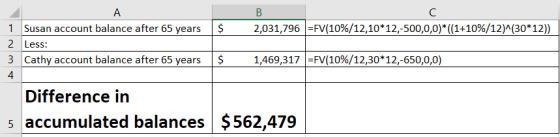
Please rate thumbs up
Add Answer to:
Susan saved $500 at the end of every month in her retirement
account for 10 years...
3. When she turned 35 years of age, Susan realized that she needed to prepare for...
 3. When she turned 35 years of age, Susan realized that she needed to prepare for her retirement. She started by investing $1,000 at the end of the year. She continued saving $1,000 at the end of each year for a total of 10 years. She then doubled her savings to $2,000 per year for the following 10 years. At this point, realizing that retirement was getting uncomfortably close, she doubled her savings again to $4,000 per year for an...
Retirement Finance Question
Your 40-year aunt wants to start saving for her retirement. She expects to retire at 65. She thinks that she will have saved $500,000 by the time she retires. She expects to live to 90.a) How much annual cash flow will your aunt have if she expects her retirement fund return to be 8% per year compounded annually. Assume she makes her first annual withdrawal at the end of the first year of retirement, and the last withdrawal when she...
A woman, with her employer's matching program, contributes $500 at the end of each month to...
 A woman, with her employer's matching program, contributes $500 at the end of each month to her retirement account, which earns 6% interest, compounded monthly. When she retires after 41 years, she plans to make monthly withdrawals for 26 years. If her account earns 5% interest, compounded monthly, then when she retires, what is her maximum possible monthly withdrawal (without running out of money)? The maximum possible monthly withdrawal is approximately $ (Simplify your answer. Round to the nearest cent...
A woman, with her employer's matching program, contributes $500 at the end of each month to...
 A woman, with her employer's matching program, contributes $500 at the end of each month to her retirement account, which earns 7% interest, compounded monthly. When she retires after 46 years, she plans to make monthly withdrawals for 32 years. If her account earns 5% interest, compounded monthly, then when she retires, what is her maximum possible monthly withdrawal (without running out of money)? | The maximum possible monthly withdrawal is approximately $ (Simplify your answer. Round to the nearest...
A woman, with her employers matching program, contribute $500 at the end of each month to...
A woman, with her employers matching program, contribute $500 at the end of each month to her retirement account, which earn 6% interest, compounded monthly. When she retires after 42 years, she plans to make monthly withdrawals for 34 years. If your account is 4% interest, compounded monthly, then when she retires, what is her maximum possible monthly withdrawal (without running out of money)?
Funding your retirement Emily Jacob is 45 years old and has saved nothing for retirement. Fortunately,...
 Funding your retirement Emily Jacob is 45 years old and has saved nothing for retirement. Fortunately, she just inherited S75,000. Emily plans to put a large portion of that money into an investment account earning a(n) 11% return. She will let the money accumulate for 20 years, when she will be ready to retire. She would like to deposit enough money today so she could begin making withdrawals of $50,000 per year starting at age 66 (21 years from now)...
Funding your retirement Emily Jacob is 45 years old and has saved nothing for retirement. Fortunately,...
 Funding your retirement Emily Jacob is 45 years old and has saved nothing for retirement. Fortunately, she just inherited S75,000. Emily plans to put a large portion of that money into an investment account earning a(n) 11% return. She will let the money accumulate for 20 years, when she will be ready to retire. She would like to deposit enough money today so she could begin making withdrawals of S50,000 per year starting at age 66 (21 years from now)...
Nicole has just turned 41 and has accumulated $24 500 in her RRSP. She makes month-end...
Nicole has just turned 41 and has accumulated $24 500 in her RRSP. She makes month-end contributions of $400 to the plan and intends to do so until she retires at the age of 60. The RRSP will be allowed to continue to accumulate until she reaches the age of 65. If the RRSP earns 6% compounded monthly for the next 24 years, how much will her RRSP contain when she turns 65?
retirement planning
37) Your sister turned 35 today, and she is planning to save $7,000 per year for retirement, with the first deposit to be made one year from today. She will invest ina mutual fund that's expected to provide a return of 7.5% per year. She plans to retire 30 years from today, when she turns 65, and she expects to live for 25 yearsafter retirement, to age 90. Under these assumptions, how much can she spend each year after she...
Jill just turned 30. After consulting a financial planner and laying out her retirement goals, she...
Jill just turned 30. After consulting a financial planner and laying out her retirement goals, she calculates that she will need to have a balance of $660,000 in her retirement account to supplement Social Security she plans to start collecting when she turns 67. She plans to start saving immediately and to invest her funds in a market index fund that is expected to have an annual return of 7% over the 37 years she will be saving money for...
 3. When she turned 35 years of age, Susan realized that she needed to prepare for her retirement. She started by investing $1,000 at the end of the year. She continued saving $1,000 at the end of each year for a total of 10 years. She then doubled her savings to $2,000 per year for the following 10 years. At this point, realizing that retirement was getting uncomfortably close, she doubled her savings again to $4,000 per year for an...
 A woman, with her employer's matching program, contributes $500 at the end of each month to her retirement account, which earns 6% interest, compounded monthly. When she retires after 41 years, she plans to make monthly withdrawals for 26 years. If her account earns 5% interest, compounded monthly, then when she retires, what is her maximum possible monthly withdrawal (without running out of money)? The maximum possible monthly withdrawal is approximately $ (Simplify your answer. Round to the nearest cent...
 A woman, with her employer's matching program, contributes $500 at the end of each month to her retirement account, which earns 7% interest, compounded monthly. When she retires after 46 years, she plans to make monthly withdrawals for 32 years. If her account earns 5% interest, compounded monthly, then when she retires, what is her maximum possible monthly withdrawal (without running out of money)? | The maximum possible monthly withdrawal is approximately $ (Simplify your answer. Round to the nearest...
 Funding your retirement Emily Jacob is 45 years old and has saved nothing for retirement. Fortunately, she just inherited S75,000. Emily plans to put a large portion of that money into an investment account earning a(n) 11% return. She will let the money accumulate for 20 years, when she will be ready to retire. She would like to deposit enough money today so she could begin making withdrawals of $50,000 per year starting at age 66 (21 years from now)...
 Funding your retirement Emily Jacob is 45 years old and has saved nothing for retirement. Fortunately, she just inherited S75,000. Emily plans to put a large portion of that money into an investment account earning a(n) 11% return. She will let the money accumulate for 20 years, when she will be ready to retire. She would like to deposit enough money today so she could begin making withdrawals of S50,000 per year starting at age 66 (21 years from now)...
Most questions answered within 3 hours.
-
Where is the error in this code sequence?
String s1 = "Hello";
String s2 = "ello";...
asked 11 months ago -
Financial data for Joel de Paris, Inc., for last year
follow:
Joel de Paris, Inc.
Balance...
asked 11 months ago -
Consider this reaction:
Al2(SO4)3 (aq)+ BaCl3
(aq) Al2Cl6 (aq)- +
3BaSO4(s) . What is the...
asked 11 months ago -
Suppose that Savneet is considering increasing her
recent random sample from 20 car rentals to 40...
asked 11 months ago -
Trucks arrive at an unloading terminal at an average rate of 120
per hour.
Trucks arrive...
asked 11 months ago -
Why are methanol and ethanol completely soluble in water while
octanol is not very little soluble....
asked 11 months ago -
A facilities manager at a university reads in a research report
that the mean amount of...
asked 11 months ago -
When the CuSO4 is rehydrated by adding water to the anhydrous
compound, is this an endothermic...
asked 11 months ago -
A ray of sunlight is passing from diamond into crown glass; the
angle of incidence is...
asked 11 months ago -
A block of mass 0.249 kg is placed on top of a light, vertical
spring of...
asked 11 months ago -
how do the kidneys compensate in the presences of acidosis
a) trigger hyperventilate
b) reserve acid...
asked 11 months ago -
Question 501 pts
The rental rate of capital to the firm increases. Which of the
following...
asked 11 months ago