
Homework Answers
Mass of CuSO4.5H2O = 1.25 g
Molar mass of CuSO4.5H2O = 249.69 g/mol
No. of moles of CuSO4.5H2O = (1.25 g)/(249.69 g/mol) = 0.005 mol
From the reaction, the theoretical number of moles of copper sulfate tetramine sulfate produced = 0.005 mol
Theoretical mass of copper sulfate tetramine sulfate produced = (0.005 mol)(245.79 g/mol) = 1.23 g
The practical mass of copper sulfate tetramine sulfate = 1.12 g
Calculate the percent yield of copper sulfate tetramine sulfate as follows
The percent yield
= [(practical mass of copper sulfate tetramine sulfate)/(Theoretical mass of copper sulfate tetramine sulfate)]x100
= [(1.12 g)/(1.23 g)]x100
= 91.06%
Add Answer to:
1.25 g of CuSO4.5 H2O is treated with excess ammonia, when a deep blue solution is...
What is the color of the product?[1] What do you observe when the product is left...
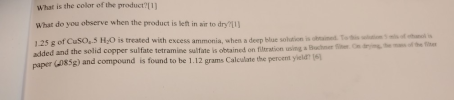 What is the color of the product?[1] What do you observe when the product is left in air to dry?[1] 125 g of CuSO4.5 H20 is treated with excess ammonia, when a deep blue solution is obtained to this solutions dded and the solid copper sulfate tetramine sulfate is obtained on filtration using a Buchner filter on Gr e ase paper (2085g) and compound is found to be 1.12 grams Calculate the percent yield? (6
The deep blue compound Cu(NH3)4SO4 is made by the reaction of copper(II) sulfate and ammonia. CuSO4(aq)...
The deep blue compound Cu(NH3)4SO4 is made by the reaction of copper(II) sulfate and ammonia. CuSO4(aq) + 4NH3(aq) → Cu(NH3)4SO4(aq) If you use 47.0 g of CuSO4 and excess NH3, what is the theoretical yield of Cu(NH3)4SO4? If you isolate 38.2 g of Cu(NH3)4SO4, what is the percent yield of Cu(NH3)4SO4? ______ g Cu(NH3)4SO4 _______ %
The deep blue compound Cu(NH)4SO4 is made by the reaction of copper(ll) sulfate and ammonia Cu(NHs)4SO4...
 The deep blue compound Cu(NH)4SO4 is made by the reaction of copper(ll) sulfate and ammonia Cu(NHs)4SO4 (aq) CuSO4(aq) 4 NHs (aq) > If you use 18.0 g of CuSO4 and excess NH3. what is the theoretical yield of Cu(NHs)4SO4? g Cu(NHs)4SO4 If you isolate 15.3 g of Cu(NH3)4SO4, what is the percent yield of Cu(NH3)4S04?
why bail blue of [Cu(H2O)6]^2+ can turn dark blue when ammonia solution is added?
why bail blue of [Cu(H2O)6]^2+ can turn dark blue when ammonia solution is added?
When concentrated ammonia is added to acidic copper solution, the pale-blue precipitate forms, followed by formation...
When concentrated ammonia is added to acidic copper solution, the pale-blue precipitate forms, followed by formation of bright blue soluble compound. Write formulas of the precipitate and of colored complex.
In experiment 7, when concentrated ammonia is added to acidic copper solution, the pale-blue precipitate forms,...
In experiment 7, when concentrated ammonia is added to acidic copper solution, the pale-blue precipitate forms, followed by formation of bright blue soluble compound. Write formulas of the precipitate and of colored complex. When potassium iodide is added to copper(II) nitrate solution, a brown precipitate forms. Write and balance the corresponding reaction equation. This brown precipitate is titrated with sodium thiosulfate solution. Write and balance the corresponding equation. After titration, a white precipitate is left in the solution. Write the...
Objective Find the ratio of moles of reactant to moles of a product for the reaction...
Objective Find the ratio of moles of reactant to moles of a product for the reaction below. Compare mass and mole amounts of reactants to determine the amount of products that can be/are made. Background Chemical reactions are represented by balanced chemical equations. Proper interpretation of an equation provides a great deal of information about the reaction it represents and about the substances involved in the reaction. For example, the coefficients in a balanced equation indicate the number of moles...
Please help! (These are the instructions I had) 1) Preparation of K2[Cu(C2O4)2] 2H2O CuSO4•5H2O + 2K2C2O4•H2O...
Please help! (These are the instructions I had) 1) Preparation of K2[Cu(C2O4)2] 2H2O CuSO4•5H2O + 2K2C2O4•H2O → K2[Cu(C2O4)2]•2H2O + K2SO4 + 5H2O Heat a solution of 2.5g of potassium oxalate monohydrate in 12.5mL of water contained in a 50mL beaker (approx. 90°C). Heat 1.55g of copper sulfate pentahydrate in 3mL of water to about 90°C and add it rapidly, with vigorous stirring to the hot potassium oxalate solution. Set on the bench and allow to cool to room temperature then...
1. preparing and mixing the reactants mass of weighing boat and CuSO4*5h2O, g : 2.66g Mass...
1. preparing and mixing the reactants mass of weighing boat and CuSO4*5h2O, g : 2.66g Mass of weighing boat, g: .66g mass of CuSO4*5h2O,g: 2.00g Molarity of ammonia solution, M: ???? in this part we added 2.00g of CuSO4*5h2O, and added 6.4mL of water. we then heated the mixture and added 6.45mL of NH3. after it was done heating, 8.3mL of room temp ethanol was added. we then made an ice water bath, and put the beaker in the ice...
4 A common method for analyzing for the nickel content of a sample is to use...
 4 A common method for analyzing for the nickel content of a sample is to use a precipitation reaction. Adding the organic compound dimethylglyoscime to a solution con- taining Nions precipitates a red solid Wwe care Derive the empirical formula for the red solid based on the following composition: Ni, 20.315%; C, 33.258%; H, 4.884%; 0,22.151%, and N, 19.392%. (95) . The reaction of methane and water is one way to y prepare hydrogen for use as a fuel CH...
 What is the color of the product?[1] What do you observe when the product is left in air to dry?[1] 125 g of CuSO4.5 H20 is treated with excess ammonia, when a deep blue solution is obtained to this solutions dded and the solid copper sulfate tetramine sulfate is obtained on filtration using a Buchner filter on Gr e ase paper (2085g) and compound is found to be 1.12 grams Calculate the percent yield? (6
 The deep blue compound Cu(NH)4SO4 is made by the reaction of copper(ll) sulfate and ammonia Cu(NHs)4SO4 (aq) CuSO4(aq) 4 NHs (aq) > If you use 18.0 g of CuSO4 and excess NH3. what is the theoretical yield of Cu(NHs)4SO4? g Cu(NHs)4SO4 If you isolate 15.3 g of Cu(NH3)4SO4, what is the percent yield of Cu(NH3)4S04?
 4 A common method for analyzing for the nickel content of a sample is to use a precipitation reaction. Adding the organic compound dimethylglyoscime to a solution con- taining Nions precipitates a red solid Wwe care Derive the empirical formula for the red solid based on the following composition: Ni, 20.315%; C, 33.258%; H, 4.884%; 0,22.151%, and N, 19.392%. (95) . The reaction of methane and water is one way to y prepare hydrogen for use as a fuel CH...
Most questions answered within 3 hours.
-
Where is the error in this code sequence?
String s1 = "Hello";
String s2 = "ello";...
asked 11 months ago -
Financial data for Joel de Paris, Inc., for last year
follow:
Joel de Paris, Inc.
Balance...
asked 11 months ago -
Consider this reaction:
Al2(SO4)3 (aq)+ BaCl3
(aq) Al2Cl6 (aq)- +
3BaSO4(s) . What is the...
asked 11 months ago -
Suppose that Savneet is considering increasing her
recent random sample from 20 car rentals to 40...
asked 11 months ago -
Trucks arrive at an unloading terminal at an average rate of 120
per hour.
Trucks arrive...
asked 11 months ago -
Why are methanol and ethanol completely soluble in water while
octanol is not very little soluble....
asked 11 months ago -
A facilities manager at a university reads in a research report
that the mean amount of...
asked 11 months ago -
When the CuSO4 is rehydrated by adding water to the anhydrous
compound, is this an endothermic...
asked 11 months ago -
A ray of sunlight is passing from diamond into crown glass; the
angle of incidence is...
asked 11 months ago -
A block of mass 0.249 kg is placed on top of a light, vertical
spring of...
asked 11 months ago -
how do the kidneys compensate in the presences of acidosis
a) trigger hyperventilate
b) reserve acid...
asked 11 months ago -
Question 501 pts
The rental rate of capital to the firm increases. Which of the
following...
asked 11 months ago