![1. Suppose we are going to sample n individuals and ask each sampled person whether they support policy A or not. Let Yi Y0 otherwise 1 if person i in the sample supports the policy, and (a) Assume Y1, , Yn are, conditional on θ. 1.1.d. binary random variables with expec- tation θ. Write down the joint distribution Pr(Yi-yi, . . . ,Ý,-yn(9) in a compact form. Also write down the form of Pr(> Ý,-y|0) (b) For the moment, suppose you believed that θ e {0.0.0.1, , 0.9.1.0). Given that the results of the survey where Σ Y. = 62 for n = 100, compute Pr(ΣΥ, 629) for each of these 11 values of θ and plot these probabilities as a function of θ. (c) Now suppose you had no prior information to believe one of these θ-values over Bayes rule to compute p(이 Σ Yi = 62) for each θ-value. Make a plot of this posterior distribution as a function of θ (d) Now suppose you allow θ to be any value in the interval [0,1]. Using the uniform prior density for θ, so that p(9)-1 , plot the posterior density p(9) x Pr(Σ Y,-62(9) as a function of θ](http://img.homeworklib.com/questions/61fd0c40-71a2-11ea-807e-a7e245e418db.png?x-oss-process=image/resize,w_560)

Homework Answers
R code:
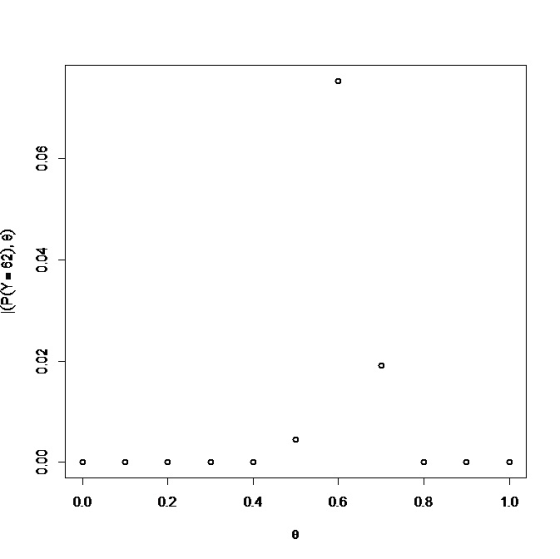
theta=0:10*0.1
P=choose(100,62)*theta^(62)*(1-theta)^(100-62)
plot(theta,P,lwd=2,type="p",ylab=expression(P(Y==62,theta),xlab=expression(theta))
Output:
[1] 0.000000e+00 1.034671e-36 5.430828e-20 2.810801e-11
4.477688e-06
[6] 4.472880e-03 7.537790e-02 1.906659e-02 1.528642e-05
8.253201e-14
[11] 0.000000e+00
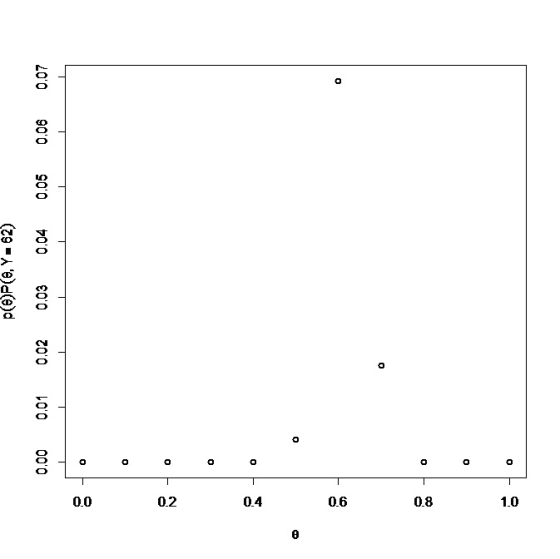
R code:
theta=0:10*0.1
P=choose(100,62)*theta^(62)*(1-theta)^(100-62)
p1=P/(11*sum(P))
p1
plot(theta,p1,lwd=2,type="p",ylab=expression(p(theta)*P(theta,Y==62)),xlab=expression(theta))
Output:
[1] 0.000000e+00 9.507147e-37 4.990155e-20 2.582725e-11
4.114355e-06
[6] 4.109938e-03 6.926152e-02 1.751947e-02 1.404604e-05
7.583513e-14
[11] 0.000000e+00
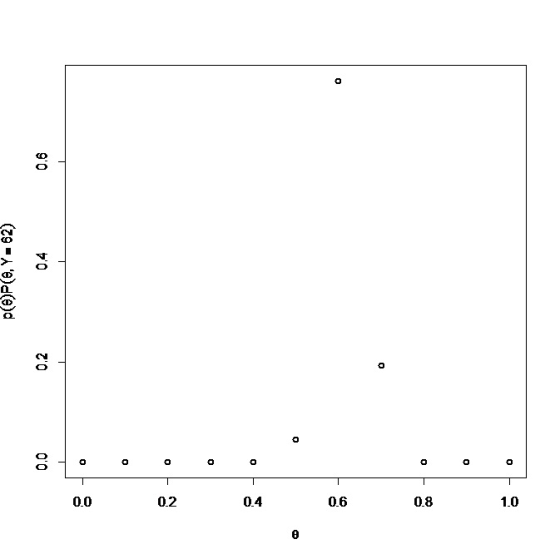
(d)
R code:
theta=0:10*0.1
P=choose(100,62)*theta^(62)*(1-theta)^(100-62)
p1=P/(sum(P))
p1
plot(theta,p1,lwd=2,type="p",ylab=expression(p(theta)*P(theta,Y==62)),xlab=expression(theta))
Output:
[1] 0.000000e+00 1.045786e-35 5.489171e-19 2.840997e-10
4.525791e-05
[6] 4.520932e-02 7.618767e-01 1.927142e-01 1.545064e-04
8.341864e-13
[11] 0.000000e+00
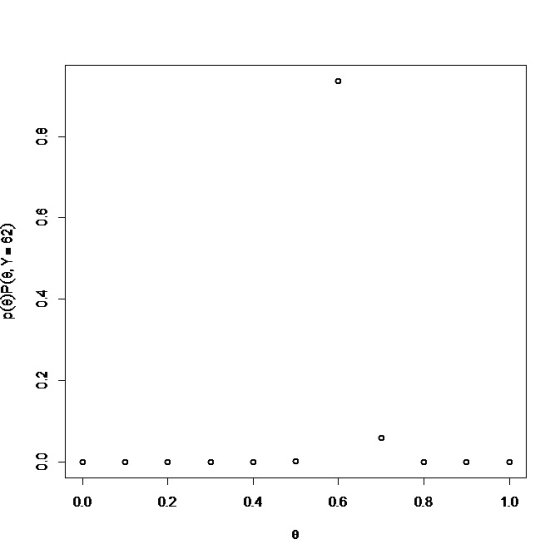
(e)
R code:
theta=0:10*0.1
P=theta^(62)*(1-theta)^(38)*choose(100,62)*theta^(62)*(1-theta)^(100-62)
p1=P/(sum(P))
p1
plot(theta,p1,lwd=2,type="p",ylab=expression(p(theta)*P(theta,Y==62)),xlab=expression(theta))
Output:
p1
[1] 0.000000e+00 1.765010e-70 4.862671e-37 1.302576e-19
3.305601e-09
[6] 3.298506e-03 9.367653e-01 5.993614e-02 3.852605e-08
1.123020e-24
[11] 0.000000e+00
Add Answer to:
1. Suppose we are going to sample n individuals and ask each sampled person whether they...
Suppose we are given two separate groups of data, y1 and y2, which are given by...
Suppose we are given two separate groups of data, y1 and y2, which are given by the following: y1: (y1,...yn)^T and y2: (yn+1,yn+2....yn+m)^T such that yi ~ N (µ, σ^2), i = 1,2,...,n and yi ~ N (µ*, σ^2*), i = n+1, n+2...,n+m. Assume all data are mutually independent and IID, and T = transpose. a) if σ^2 = σ^2* = (σ^2), where (σ^2) is known, find the posterior dist p(µ,µ*|y1,y2) and find bayes estimator for µ and µ* (assume...
Problem 3.1 Suppose that XI, X2,... Xn is a random sample of size n is to...
 Problem 3.1 Suppose that XI, X2,... Xn is a random sample of size n is to be taken from a Bermoulli distribution for which the value of the parameter θ is unknown, and the prior distribution of θ is a Beta(α,β) distribution. Represent the mean of this prior distribution as μο=α/(α+p). The posterior distribution of θ is Beta =e+ ΣΧ, β.-β+n-ΣΧ.) a) Show that the mean of the posterior distribution is a weighted average of the form where yn and...
Suppose observations X1, X2,.. are recorded. We assume these to be conditionally independent and exponen- tially...
 Suppose observations X1, X2,.. are recorded. We assume these to be conditionally independent and exponen- tially distributed given a parameter θ: Xi ~' Exponential(θ), for all i 1, . . . , n. The exponential distribution is controlled by one rate parameter θ > 0, and its density is for r ER+ 1. Plot the graph of p(x:0) for θ 1 in the interval x E [0,4] 2. What is the visual representation of the likelihood of individual data points?...
Question 3 [25] , Yn denote a random sample of size n from a Let Y,...
 Question 3 [25] , Yn denote a random sample of size n from a Let Y, Y2, population with an exponential distribution whose density is given by y > 0 if o, otherwise -E70 cumulative distribution function f(y) L ..,Y} denotes the smallest order statistics, show that Y1) = min{Y1, =nYa) 3.1 show that = nY1) is an unbiased estimator for 0. /12/ /13/ 3.2 find the mean square error for MSE(e). 2 f-llays Iat-k)-at 1-P Question 4[25] 4.1 Distinguish...
2. Estimate the probability 0 of teen recidivism based on a study in which there were...
 2. Estimate the probability 0 of teen recidivism based on a study in which there were n- 43 individuals released from incarceration and y 15 re-offenders within 36 months. (a) Using a Beta(2,8) prior for θ, plot p(9), p(y|0) and p( ly) as functions of θ. Find the posterior mean, mode, and standard deviation of. Find a 95% quantile-based confidence interval. (b) Repeat part (a), but using a Beta(8,2) prior for θ (c) Consider the following prior distribution: 1 г(10)...
: Let Yi, ½' . . . , Yn be an iid random sample from an exponential distribution with parameter where θ > 0. Here each Y, represents the lifetime of the ith battery, while θ represents the the...
 : Let Yi, ½' . . . , Yn be an iid random sample from an exponential distribution with parameter where θ > 0. Here each Y, represents the lifetime of the ith battery, while θ represents the theoretical average lifetime. The pdf of each Y, is therefore given by fy (y) ei-1,2,...,n Consider the empirical average lifetime of the sample of n batteries given by Let a E R be a nonnegative real number. Consider the event A, defined...
Question 2 a. Show that, for the exponential model with gamma prior, the posterior Π(9121m) under...
 Question 2 a. Show that, for the exponential model with gamma prior, the posterior Π(9121m) under n observations can be computed as the posterior given a single observation xn using the prior q(の는 1101r1:n-1). Give the formula for the parameters (an,ßn) of the posterior ll(θ|X1:n, α0,Ao) as a function of (an-1, Bn-1). b. Visualize the gradual change of shape of the posterior II(01:n, ao, Bo) with increasing n: . Generate n 256 exponentially distributed samples with parameter θ-1. . Use...
4 and 5 samples, the other in small samples. Which is which? Explain. (d) Suppose we...
 4
and 5
samples, the other in small samples. Which is which? Explain. (d) Suppose we know that the 5 values are from a symmetric distribution. Then the sample median is also unbiased and consistent for the population mean. The sample mean has lower variance. Would you prefer to use the sample 4. Suppose Yi, Y, are iid r ables with E(n)-μ, Var(K)-σ2 < oo. For large n, find the approximate 5. Suppose we observe Yi...Yn from a normal distribution...
4
and 5
samples, the other in small samples. Which is which? Explain. (d) Suppose we know that the 5 values are from a symmetric distribution. Then the sample median is also unbiased and consistent for the population mean. The sample mean has lower variance. Would you prefer to use the sample 4. Suppose Yi, Y, are iid r ables with E(n)-μ, Var(K)-σ2 < oo. For large n, find the approximate 5. Suppose we observe Yi...Yn from a normal distribution...
Bayesian updating Suppose that we have the model y|μ ~ N(μ, τ-1) where τ > 0 is known and μ is an unknown parameter...
 Bayesian updating Suppose that we have the model y|μ ~ N(μ, τ-1) where τ > 0 is known and μ is an unknown parameter (vi) Suppose that ( of y with a -ab1. Suppose that you observe a realization Compute the posterior distribution value of 1. π(μ|1) and explain how it relates to π(μ). vii) Suppose now that you observe a second realization of y with a value of -1. Update the posterior π(p11) to incorporate this new information.
Bayesian...
Bayesian updating Suppose that we have the model y|μ ~ N(μ, τ-1) where τ > 0 is known and μ is an unknown parameter (vi) Suppose that ( of y with a -ab1. Suppose that you observe a realization Compute the posterior distribution value of 1. π(μ|1) and explain how it relates to π(μ). vii) Suppose now that you observe a second realization of y with a value of -1. Update the posterior π(p11) to incorporate this new information.
Bayesian...
Bayesian updating Suppose that we have the model y|μ ~ N(μ, τ-1) where τ > 0 is known and μ is an unknown parameter...
 Bayesian updating Suppose that we have the model y|μ ~ N(μ, τ-1) where τ > 0 is known and μ is an unknown parameter (vi) Suppose that ( of y with a -ab1. Suppose that you observe a realization Compute the posterior distribution value of 1. π(μ|1) and explain how it relates to π(μ). vii) Suppose now that you observe a second realization of y with a value of -1. Update the posterior π(p11) to incorporate this new information.
Bayesian...
Bayesian updating Suppose that we have the model y|μ ~ N(μ, τ-1) where τ > 0 is known and μ is an unknown parameter (vi) Suppose that ( of y with a -ab1. Suppose that you observe a realization Compute the posterior distribution value of 1. π(μ|1) and explain how it relates to π(μ). vii) Suppose now that you observe a second realization of y with a value of -1. Update the posterior π(p11) to incorporate this new information.
Bayesian...
 Problem 3.1 Suppose that XI, X2,... Xn is a random sample of size n is to be taken from a Bermoulli distribution for which the value of the parameter θ is unknown, and the prior distribution of θ is a Beta(α,β) distribution. Represent the mean of this prior distribution as μο=α/(α+p). The posterior distribution of θ is Beta =e+ ΣΧ, β.-β+n-ΣΧ.) a) Show that the mean of the posterior distribution is a weighted average of the form where yn and...
 Suppose observations X1, X2,.. are recorded. We assume these to be conditionally independent and exponen- tially distributed given a parameter θ: Xi ~' Exponential(θ), for all i 1, . . . , n. The exponential distribution is controlled by one rate parameter θ > 0, and its density is for r ER+ 1. Plot the graph of p(x:0) for θ 1 in the interval x E [0,4] 2. What is the visual representation of the likelihood of individual data points?...
 Question 3 [25] , Yn denote a random sample of size n from a Let Y, Y2, population with an exponential distribution whose density is given by y > 0 if o, otherwise -E70 cumulative distribution function f(y) L ..,Y} denotes the smallest order statistics, show that Y1) = min{Y1, =nYa) 3.1 show that = nY1) is an unbiased estimator for 0. /12/ /13/ 3.2 find the mean square error for MSE(e). 2 f-llays Iat-k)-at 1-P Question 4[25] 4.1 Distinguish...
 2. Estimate the probability 0 of teen recidivism based on a study in which there were n- 43 individuals released from incarceration and y 15 re-offenders within 36 months. (a) Using a Beta(2,8) prior for θ, plot p(9), p(y|0) and p( ly) as functions of θ. Find the posterior mean, mode, and standard deviation of. Find a 95% quantile-based confidence interval. (b) Repeat part (a), but using a Beta(8,2) prior for θ (c) Consider the following prior distribution: 1 г(10)...
 : Let Yi, ½' . . . , Yn be an iid random sample from an exponential distribution with parameter where θ > 0. Here each Y, represents the lifetime of the ith battery, while θ represents the theoretical average lifetime. The pdf of each Y, is therefore given by fy (y) ei-1,2,...,n Consider the empirical average lifetime of the sample of n batteries given by Let a E R be a nonnegative real number. Consider the event A, defined...
 Question 2 a. Show that, for the exponential model with gamma prior, the posterior Π(9121m) under n observations can be computed as the posterior given a single observation xn using the prior q(の는 1101r1:n-1). Give the formula for the parameters (an,ßn) of the posterior ll(θ|X1:n, α0,Ao) as a function of (an-1, Bn-1). b. Visualize the gradual change of shape of the posterior II(01:n, ao, Bo) with increasing n: . Generate n 256 exponentially distributed samples with parameter θ-1. . Use...
 4
and 5
samples, the other in small samples. Which is which? Explain. (d) Suppose we know that the 5 values are from a symmetric distribution. Then the sample median is also unbiased and consistent for the population mean. The sample mean has lower variance. Would you prefer to use the sample 4. Suppose Yi, Y, are iid r ables with E(n)-μ, Var(K)-σ2 < oo. For large n, find the approximate 5. Suppose we observe Yi...Yn from a normal distribution...
4
and 5
samples, the other in small samples. Which is which? Explain. (d) Suppose we know that the 5 values are from a symmetric distribution. Then the sample median is also unbiased and consistent for the population mean. The sample mean has lower variance. Would you prefer to use the sample 4. Suppose Yi, Y, are iid r ables with E(n)-μ, Var(K)-σ2 < oo. For large n, find the approximate 5. Suppose we observe Yi...Yn from a normal distribution...
 Bayesian updating Suppose that we have the model y|μ ~ N(μ, τ-1) where τ > 0 is known and μ is an unknown parameter (vi) Suppose that ( of y with a -ab1. Suppose that you observe a realization Compute the posterior distribution value of 1. π(μ|1) and explain how it relates to π(μ). vii) Suppose now that you observe a second realization of y with a value of -1. Update the posterior π(p11) to incorporate this new information.
Bayesian...
Bayesian updating Suppose that we have the model y|μ ~ N(μ, τ-1) where τ > 0 is known and μ is an unknown parameter (vi) Suppose that ( of y with a -ab1. Suppose that you observe a realization Compute the posterior distribution value of 1. π(μ|1) and explain how it relates to π(μ). vii) Suppose now that you observe a second realization of y with a value of -1. Update the posterior π(p11) to incorporate this new information.
Bayesian...
 Bayesian updating Suppose that we have the model y|μ ~ N(μ, τ-1) where τ > 0 is known and μ is an unknown parameter (vi) Suppose that ( of y with a -ab1. Suppose that you observe a realization Compute the posterior distribution value of 1. π(μ|1) and explain how it relates to π(μ). vii) Suppose now that you observe a second realization of y with a value of -1. Update the posterior π(p11) to incorporate this new information.
Bayesian...
Bayesian updating Suppose that we have the model y|μ ~ N(μ, τ-1) where τ > 0 is known and μ is an unknown parameter (vi) Suppose that ( of y with a -ab1. Suppose that you observe a realization Compute the posterior distribution value of 1. π(μ|1) and explain how it relates to π(μ). vii) Suppose now that you observe a second realization of y with a value of -1. Update the posterior π(p11) to incorporate this new information.
Bayesian...
Most questions answered within 3 hours.
-
Where is the error in this code sequence?
String s1 = "Hello";
String s2 = "ello";...
asked 10 months ago -
Financial data for Joel de Paris, Inc., for last year
follow:
Joel de Paris, Inc.
Balance...
asked 10 months ago -
Consider this reaction:
Al2(SO4)3 (aq)+ BaCl3
(aq) Al2Cl6 (aq)- +
3BaSO4(s) . What is the...
asked 10 months ago -
Suppose that Savneet is considering increasing her
recent random sample from 20 car rentals to 40...
asked 10 months ago -
Trucks arrive at an unloading terminal at an average rate of 120
per hour.
Trucks arrive...
asked 10 months ago -
Why are methanol and ethanol completely soluble in water while
octanol is not very little soluble....
asked 10 months ago -
A facilities manager at a university reads in a research report
that the mean amount of...
asked 10 months ago -
When the CuSO4 is rehydrated by adding water to the anhydrous
compound, is this an endothermic...
asked 10 months ago -
A ray of sunlight is passing from diamond into crown glass; the
angle of incidence is...
asked 10 months ago -
A block of mass 0.249 kg is placed on top of a light, vertical
spring of...
asked 10 months ago -
how do the kidneys compensate in the presences of acidosis
a) trigger hyperventilate
b) reserve acid...
asked 10 months ago -
Question 501 pts
The rental rate of capital to the firm increases. Which of the
following...
asked 10 months ago