Which compound/s (water, acetone, ethanol, hexane, decane, 1-decanol, sodium chloride, and/or iodine) do you think will...
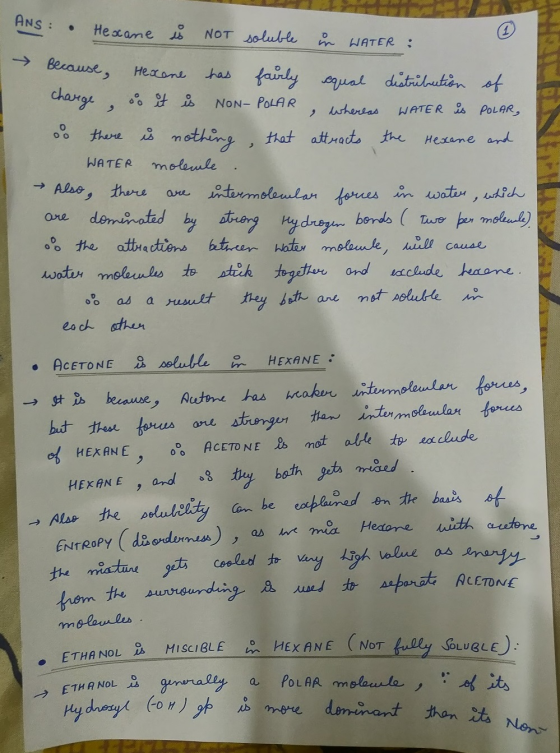
Which compound/s (water, acetone, ethanol, hexane, decane, 1-decanol, sodium chloride, and/or iodine) do you think will be soluble in hexane and explain why. You must discuss intermolecular forces in your explanation.
Homework Answers


Add Answer to:
Which compound/s (water, acetone, ethanol, hexane, decane,
1-decanol, sodium chloride, and/or iodine) do you think will...
Which compound (water, acetone, ethanol, hexane, decane, or 1-decanol) do you think will be the least...
Which compound (water, acetone, ethanol, hexane, decane, or 1-decanol) do you think will be the least volatile and explain why. You must discuss intermolecular forces in your explanation.
2.Consider Table 13.3 (Page 18 of 7/9Slides)and determine which solvents (among water, acetone, methanol, ethanol, hexane,...
2.Consider Table 13.3 (Page 18 of 7/9Slides)and determine which solvents (among water, acetone, methanol, ethanol, hexane, toluene, and carbon tetrachloride) would dissolve the following solutes. In each case, specify the type of solvent-solute intermolecular forces:[3] a.Acetic acid (CH3COOH) b.Sodium nitrate (NaNO3) c.Olive oil Table 13. Common Polar Solvents Common Nonpolar Solvents Water (H2 O) Hexane (C6H14) Acetone (CH3COCH3) Diethyl ether (CH3CH2OCH2CH3) Methanol (CH3OH) Toluene (C7H8) Ethanol (CH3CH2OH) Carbon tetrachloride (CCl4)
which liquid has the strongest intermolecular forces? explain please methanol,ethanol,1-propanol,1-butane,n-hexane,n-heptane,n-octane,acetone,2-propanol
which liquid has the strongest intermolecular forces? explain please methanol,ethanol,1-propanol,1-butane,n-hexane,n-heptane,n-octane,acetone,2-propanol
7). a). Is the acetone molecule non-polar or polar? Circle. Non-polar Polar b). Sketch pictures of...
 7). a). Is the acetone molecule non-polar or polar? Circle. Non-polar Polar b). Sketch pictures of the intermolecular forces that would occur between the molecules of acetone and the molecules of 2- propanone if you have a mixture of the two liquids. What would be the main type of IMF that is responsible for the attraction? (Give a name for the IMF). c). The pentane molecule and the 2-pentanone molecule both have five carbon atoms on their structures. Why 2-pentanone...
Find the compound methylene chloride on the internet. a) Why do you think the name starts...
Find the compound methylene chloride on the internet. a) Why do you think the name starts with the prefix “meth”? How does it relate to the structure of the compound? b) List any other names you found for methylene chloride c) What are the similarities between the names? d) Methylene chloride does not dissolve well in water, but dissolves oily materials like tars and asphalt fairly well. Given what you know about intermolecular forces why might this be the case?...
Table 1 Compound Chemical formula Chemical Structure - Boiling Point (°C) Polar or Nonpolar S Strongest...
 Table 1 Compound Chemical formula Chemical Structure - Boiling Point (°C) Polar or Nonpolar S Strongest Intermolecular Force 1. Acetone C3H60 H OH H-CC-CH 2. Methanol CH4 HC OH 3. Hexane C.H14 HHHHH Hċ-ċ-ċċċ-ċ-H 4. Ethanol C2H60 H------ 5. Water H20 HO H 6. Glycerol C3H403 -c-c-c- 290 Melting Point 80 7. Naphthalene CoHo CI 8. Iodine : 11: 113 H COH 9. Sucrose C12Hz2012 186 w /6-6-1 # 0. 10. Sodium Chloride Naci Na+ c 801
2. Identify the strongest type of intermolecular forces in acetone, ethanol, water and hexane. (Structures listed...
 2. Identify the strongest type of intermolecular forces in acetone, ethanol, water and hexane. (Structures listed on page 15.) Experiment 2 Intermolecular Forces There are three general types of intermolecular forces. All substances exhibit London Dispersion Forces (LDF), and they are generally the weakest of the three types. These London forces are due to the attractions between small, temporary dipoles that arise from the constant, random movement of the electrons in a substance. As molar mass increases, the size of...
Solubitity Depends on Bond Type and Molecular Struetwre L Solubilitity and Bond Type Ionic, Non-p...
 Solubitity Depends on Bond Type and Molecular Struetwre L Solubilitity and Bond Type Ionic, Non-polar Covalent, and rolar Covalent Compounds SolvemWater Substance Hexane Hexane Water Acetone Barium sulfate 3 Heptane Isopropandl Naphthalene Potassium Iodide Sodium bicarbonate Sucrose Xylene o Vegetable oil Analysis: Look at your data for heptane, naphthalene, and vegetable oil. Are they more soluble in water or in hexane? What is it about the structures of these compounds that explains this result? 1. Look at your data for...
Predict and EXPLAIN which compound you would think would have a) the highest rate of evaporation...
Predict and EXPLAIN which compound you would think would have a) the highest rate of evaporation b) the greatest temperature change upon evaporation. These are the compounds: n-pentane n-butanol ethylene glycol acetone tertiary-butanol Hydrogen oxide n-hexane n-propanol methanol ethanol
To do any extraction, you’ll need two liquids or solutions. They must be insoluble in each...
To do any extraction, you’ll need two liquids or solutions. They must be insoluble in each other. a. What does it mean to have 2 insoluble liquids or solutions? b. I have listed twelve liquids and solutions below. Identify if each solution is considered aqueous or organic. Water, acetone, 1.0 M NaOH, 1.0 M HCl, diethylether, brine (saturated sodium chloride in water), dichloromethane, 10% sodium bicarbonate solution, ethyl acetate, chloroform, ethanol, hexane. 2. Which of the organic liquid(s) from 1b...
 7). a). Is the acetone molecule non-polar or polar? Circle. Non-polar Polar b). Sketch pictures of the intermolecular forces that would occur between the molecules of acetone and the molecules of 2- propanone if you have a mixture of the two liquids. What would be the main type of IMF that is responsible for the attraction? (Give a name for the IMF). c). The pentane molecule and the 2-pentanone molecule both have five carbon atoms on their structures. Why 2-pentanone...
 Table 1 Compound Chemical formula Chemical Structure - Boiling Point (°C) Polar or Nonpolar S Strongest Intermolecular Force 1. Acetone C3H60 H OH H-CC-CH 2. Methanol CH4 HC OH 3. Hexane C.H14 HHHHH Hċ-ċ-ċċċ-ċ-H 4. Ethanol C2H60 H------ 5. Water H20 HO H 6. Glycerol C3H403 -c-c-c- 290 Melting Point 80 7. Naphthalene CoHo CI 8. Iodine : 11: 113 H COH 9. Sucrose C12Hz2012 186 w /6-6-1 # 0. 10. Sodium Chloride Naci Na+ c 801
 2. Identify the strongest type of intermolecular forces in acetone, ethanol, water and hexane. (Structures listed on page 15.) Experiment 2 Intermolecular Forces There are three general types of intermolecular forces. All substances exhibit London Dispersion Forces (LDF), and they are generally the weakest of the three types. These London forces are due to the attractions between small, temporary dipoles that arise from the constant, random movement of the electrons in a substance. As molar mass increases, the size of...
 Solubitity Depends on Bond Type and Molecular Struetwre L Solubilitity and Bond Type Ionic, Non-polar Covalent, and rolar Covalent Compounds SolvemWater Substance Hexane Hexane Water Acetone Barium sulfate 3 Heptane Isopropandl Naphthalene Potassium Iodide Sodium bicarbonate Sucrose Xylene o Vegetable oil Analysis: Look at your data for heptane, naphthalene, and vegetable oil. Are they more soluble in water or in hexane? What is it about the structures of these compounds that explains this result? 1. Look at your data for...
Most questions answered within 3 hours.
-
Where is the error in this code sequence?
String s1 = "Hello";
String s2 = "ello";...
asked 10 months ago -
Financial data for Joel de Paris, Inc., for last year
follow:
Joel de Paris, Inc.
Balance...
asked 10 months ago -
Consider this reaction:
Al2(SO4)3 (aq)+ BaCl3
(aq) Al2Cl6 (aq)- +
3BaSO4(s) . What is the...
asked 10 months ago -
Suppose that Savneet is considering increasing her
recent random sample from 20 car rentals to 40...
asked 10 months ago -
Trucks arrive at an unloading terminal at an average rate of 120
per hour.
Trucks arrive...
asked 10 months ago -
Why are methanol and ethanol completely soluble in water while
octanol is not very little soluble....
asked 10 months ago -
A facilities manager at a university reads in a research report
that the mean amount of...
asked 10 months ago -
When the CuSO4 is rehydrated by adding water to the anhydrous
compound, is this an endothermic...
asked 10 months ago -
A ray of sunlight is passing from diamond into crown glass; the
angle of incidence is...
asked 10 months ago -
A block of mass 0.249 kg is placed on top of a light, vertical
spring of...
asked 10 months ago -
how do the kidneys compensate in the presences of acidosis
a) trigger hyperventilate
b) reserve acid...
asked 10 months ago -
Question 501 pts
The rental rate of capital to the firm increases. Which of the
following...
asked 10 months ago