
Homework Answers
Add Answer to:
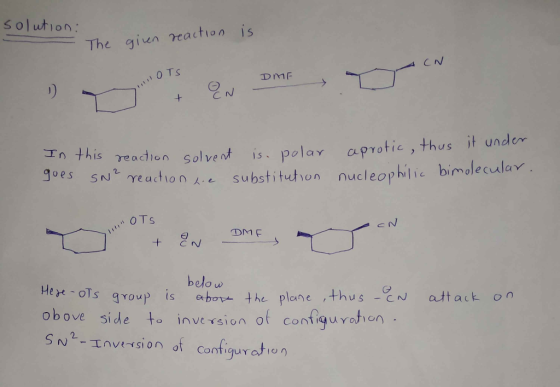
Determine, based on the identity of the substrate, nucleophile, and solvent, the mechanism of nucleophilic substitution...
Complete answers with mechanism and products, with picture details. Determine, based on the identity of the...
 Complete answers with mechanism and products, with
picture details.
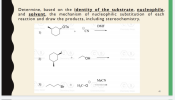
Determine, based on the identity of the substrate, nucleophile and solvent, the mechanism of nucleophilic substitution of each reaction and draw the products, including stereochemistry. DMF OTs Y Steps nistry Steps Chemistry Steps 1) Chemistry t OHmby Ste 2) Chemistry Steps MECN н.с-о — 3) + Br istry Steps Chemistry Steps Chemistry Steps Chemistry Steps
Complete answers with mechanism and products, with
picture details.
Determine, based on the identity of the substrate, nucleophile and solvent, the mechanism of nucleophilic substitution of each reaction and draw the products, including stereochemistry. DMF OTs Y Steps nistry Steps Chemistry Steps 1) Chemistry t OHmby Ste 2) Chemistry Steps MECN н.с-о — 3) + Br istry Steps Chemistry Steps Chemistry Steps Chemistry Steps
1. Determine the mechanism of each nucleophilic substitution reaction and explain why? Draw the products including...
 1. Determine the mechanism of each nucleophilic substitution reaction and explain why? Draw the products including the stereochemistry. (6 points) Br + CN acetone d. ~ + CH,CO2H - Y Y + POCHE UCH DMSO + TOCH.CH DMF b. + B + OCH + CH4OH DMSO – w ! ho + OCHCH , CH,CH,OH DM . Br + CH3OH + CH3CH,OH
4. Considering the structure of the substrate, the nature of the nucleophile, and the solvent (written...
 4. Considering the structure of the substrate, the nature of the nucleophile, and the solvent (written on the arrows), determine the type of mechanism (Snl or S2) for every reaction. Predict the products and draw the mechanism DMF + KN3 ОН + water H-CI а) b) ethanol Br acetone CH3CH20H KI Br d) Br DMSO DMSO Br + КCN KSCH2CH3
4. Considering the structure of the substrate, the nature of the nucleophile, and the solvent (written...
 4. Considering the structure of the substrate, the nature of the nucleophile, and the solvent (written on the arrows), determine the type of mechanism (Sxl or Sx2) for every reaction. Predict the products and draw the mechanism. + KN. DMF a) (KN=N=N) 6 YOH + H-al water ethanol + CH3CH OH acetone Br + KI Br Br + DMSO DMSO CCB + KCN KSCH2CH3 D er + ken DMSO
3. Determine the mechanism of nucleophilic substitution (SNI or SN2) for each reaction and draw the products. Be aw...
 3. Determine the mechanism of nucleophilic substitution (SNI or SN2) for each reaction and draw the products. Be aware of stereochemistry. 8 + CN - dletone m et och cun, DE Br + OCH₂ CH₂ DME 4. Draw all constitutional isomers formed during each elimination reaction after determining whether it is E1 or E2. habel it as El or E2. госна. a y "ocha, B b. Tă CH₃OH Br -OH
1.) Determine the mechanism. (Sn1 or Sn2) 2.) Show step by step reaction mechanism of nucleophilic...
 1.) Determine the mechanism. (Sn1 or Sn2)
2.) Show step by step reaction mechanism of nucleophilic
substitution including transition states
3.) Draw the products, including stereochemistry
Br + CN acetone
1.) Determine the mechanism. (Sn1 or Sn2)
2.) Show step by step reaction mechanism of nucleophilic
substitution including transition states
3.) Draw the products, including stereochemistry
Br + CN acetone
Based on nucleophile, substrate, and reaction conditions, state the most likely reaction mechanism (s_n 1 or...
 Based on nucleophile, substrate, and reaction conditions, state the most likely reaction mechanism (s_n 1 or s_n 2) in each example. Draw the products, including stereochemistry as needed. Predict the product of the following reactions:
Draw the mechanism for Nucleophilic Acyl Substitution of an acid chloride and a nucleophile (Nu:-). Be...
 Draw the mechanism for Nucleophilic Acyl Substitution of an acid
chloride and a nucleophile (Nu:-). Be
sure to draw all starting materials, products, intermediate, and
curved arrows necessary to describe this mechanism.
Draw the two products for the following reaction: H30+ N
Draw the mechanism for Nucleophilic Acyl Substitution of an acid
chloride and a nucleophile (Nu:-). Be
sure to draw all starting materials, products, intermediate, and
curved arrows necessary to describe this mechanism.
Draw the two products for the following reaction: H30+ N
6. Determine the mechanism of nucleophilic substitution for each reaction and indicate the stereochemistry of the p...
 6. Determine the mechanism of nucleophilic substitution for each reaction and indicate the stereochemistry of the products. (in WORDS - DON'T DRAW DRAW PRODUCT BUT NOT Stereochemistry A. Br Brt + CN-acetons B. Br or n + CH₃OH Hochz - + OCHCH DME> c. 7. Label each stereogenic center as Rors A. a c. HO B ...oh OH NH 8. How is each compound related to the first compound D-erythrose (A+B) Oh. HK CH OH 04 I CH -04 D-erythrose...
2. Predict the product(s) of each of the reaction conditions below. Specify the substrate type (primary,...
 2. Predict the product(s) of each of the reaction conditions
below. Specify the substrate type (primary, secondary, or tertiary
alkyl halide), nucleophile (strong or poor), and the solvent type
(protic or aptrotic). Specify the type of reaction mechanism (SN1
or SN2), show the curved arrow mechanism and draw the products as
3D structures to illustrate stereochemistry.
Predict the product(s) of each of the reaction conditions below. Specify the substrate type (1º, 2º, or 3 alkyl halide). mucleophile (strong or poor),...
2. Predict the product(s) of each of the reaction conditions
below. Specify the substrate type (primary, secondary, or tertiary
alkyl halide), nucleophile (strong or poor), and the solvent type
(protic or aptrotic). Specify the type of reaction mechanism (SN1
or SN2), show the curved arrow mechanism and draw the products as
3D structures to illustrate stereochemistry.
Predict the product(s) of each of the reaction conditions below. Specify the substrate type (1º, 2º, or 3 alkyl halide). mucleophile (strong or poor),...
 Complete answers with mechanism and products, with
picture details.
Determine, based on the identity of the substrate, nucleophile and solvent, the mechanism of nucleophilic substitution of each reaction and draw the products, including stereochemistry. DMF OTs Y Steps nistry Steps Chemistry Steps 1) Chemistry t OHmby Ste 2) Chemistry Steps MECN н.с-о — 3) + Br istry Steps Chemistry Steps Chemistry Steps Chemistry Steps
Complete answers with mechanism and products, with
picture details.
Determine, based on the identity of the substrate, nucleophile and solvent, the mechanism of nucleophilic substitution of each reaction and draw the products, including stereochemistry. DMF OTs Y Steps nistry Steps Chemistry Steps 1) Chemistry t OHmby Ste 2) Chemistry Steps MECN н.с-о — 3) + Br istry Steps Chemistry Steps Chemistry Steps Chemistry Steps
 1. Determine the mechanism of each nucleophilic substitution reaction and explain why? Draw the products including the stereochemistry. (6 points) Br + CN acetone d. ~ + CH,CO2H - Y Y + POCHE UCH DMSO + TOCH.CH DMF b. + B + OCH + CH4OH DMSO – w ! ho + OCHCH , CH,CH,OH DM . Br + CH3OH + CH3CH,OH
 4. Considering the structure of the substrate, the nature of the nucleophile, and the solvent (written on the arrows), determine the type of mechanism (Snl or S2) for every reaction. Predict the products and draw the mechanism DMF + KN3 ОН + water H-CI а) b) ethanol Br acetone CH3CH20H KI Br d) Br DMSO DMSO Br + КCN KSCH2CH3
 4. Considering the structure of the substrate, the nature of the nucleophile, and the solvent (written on the arrows), determine the type of mechanism (Sxl or Sx2) for every reaction. Predict the products and draw the mechanism. + KN. DMF a) (KN=N=N) 6 YOH + H-al water ethanol + CH3CH OH acetone Br + KI Br Br + DMSO DMSO CCB + KCN KSCH2CH3 D er + ken DMSO
 3. Determine the mechanism of nucleophilic substitution (SNI or SN2) for each reaction and draw the products. Be aware of stereochemistry. 8 + CN - dletone m et och cun, DE Br + OCH₂ CH₂ DME 4. Draw all constitutional isomers formed during each elimination reaction after determining whether it is E1 or E2. habel it as El or E2. госна. a y "ocha, B b. Tă CH₃OH Br -OH
 1.) Determine the mechanism. (Sn1 or Sn2)
2.) Show step by step reaction mechanism of nucleophilic
substitution including transition states
3.) Draw the products, including stereochemistry
Br + CN acetone
1.) Determine the mechanism. (Sn1 or Sn2)
2.) Show step by step reaction mechanism of nucleophilic
substitution including transition states
3.) Draw the products, including stereochemistry
Br + CN acetone
 Based on nucleophile, substrate, and reaction conditions, state the most likely reaction mechanism (s_n 1 or s_n 2) in each example. Draw the products, including stereochemistry as needed. Predict the product of the following reactions:
 Draw the mechanism for Nucleophilic Acyl Substitution of an acid
chloride and a nucleophile (Nu:-). Be
sure to draw all starting materials, products, intermediate, and
curved arrows necessary to describe this mechanism.
Draw the two products for the following reaction: H30+ N
Draw the mechanism for Nucleophilic Acyl Substitution of an acid
chloride and a nucleophile (Nu:-). Be
sure to draw all starting materials, products, intermediate, and
curved arrows necessary to describe this mechanism.
Draw the two products for the following reaction: H30+ N
 6. Determine the mechanism of nucleophilic substitution for each reaction and indicate the stereochemistry of the products. (in WORDS - DON'T DRAW DRAW PRODUCT BUT NOT Stereochemistry A. Br Brt + CN-acetons B. Br or n + CH₃OH Hochz - + OCHCH DME> c. 7. Label each stereogenic center as Rors A. a c. HO B ...oh OH NH 8. How is each compound related to the first compound D-erythrose (A+B) Oh. HK CH OH 04 I CH -04 D-erythrose...
 2. Predict the product(s) of each of the reaction conditions
below. Specify the substrate type (primary, secondary, or tertiary
alkyl halide), nucleophile (strong or poor), and the solvent type
(protic or aptrotic). Specify the type of reaction mechanism (SN1
or SN2), show the curved arrow mechanism and draw the products as
3D structures to illustrate stereochemistry.
Predict the product(s) of each of the reaction conditions below. Specify the substrate type (1º, 2º, or 3 alkyl halide). mucleophile (strong or poor),...
2. Predict the product(s) of each of the reaction conditions
below. Specify the substrate type (primary, secondary, or tertiary
alkyl halide), nucleophile (strong or poor), and the solvent type
(protic or aptrotic). Specify the type of reaction mechanism (SN1
or SN2), show the curved arrow mechanism and draw the products as
3D structures to illustrate stereochemistry.
Predict the product(s) of each of the reaction conditions below. Specify the substrate type (1º, 2º, or 3 alkyl halide). mucleophile (strong or poor),...
Most questions answered within 3 hours.
-
Where is the error in this code sequence?
String s1 = "Hello";
String s2 = "ello";...
asked 10 months ago -
Financial data for Joel de Paris, Inc., for last year
follow:
Joel de Paris, Inc.
Balance...
asked 10 months ago -
Consider this reaction:
Al2(SO4)3 (aq)+ BaCl3
(aq) Al2Cl6 (aq)- +
3BaSO4(s) . What is the...
asked 10 months ago -
Suppose that Savneet is considering increasing her
recent random sample from 20 car rentals to 40...
asked 10 months ago -
Trucks arrive at an unloading terminal at an average rate of 120
per hour.
Trucks arrive...
asked 10 months ago -
Why are methanol and ethanol completely soluble in water while
octanol is not very little soluble....
asked 10 months ago -
A facilities manager at a university reads in a research report
that the mean amount of...
asked 10 months ago -
When the CuSO4 is rehydrated by adding water to the anhydrous
compound, is this an endothermic...
asked 10 months ago -
A ray of sunlight is passing from diamond into crown glass; the
angle of incidence is...
asked 10 months ago -
A block of mass 0.249 kg is placed on top of a light, vertical
spring of...
asked 10 months ago -
how do the kidneys compensate in the presences of acidosis
a) trigger hyperventilate
b) reserve acid...
asked 10 months ago -
Question 501 pts
The rental rate of capital to the firm increases. Which of the
following...
asked 10 months ago