
Homework Answers
This device satisfy the first law of thermodynamics as it is a conservation of energy law in theory.
here we can see that the energy input from the two reservoirs ( 300 J + 400 J ) is equal to the outgoing energy from the device which is equal to 700 J of energy.
feel free to drop comment if you have any doubt.
Add Answer to:
B. Device 2, shown at right, represents a proposed cyclic device that operates between reservoirs at...
please help 1 and 2 ! A. Device 1, shown at right, represents a heat engine...
 please help 1 and 2 !
A. Device 1, shown at right, represents a heat engine operating between reservoirs at 900K and 400 K. (The system interacting with the reservoirs is represented by the dashed region.) The numbers and arrows indicate either thermal energy transfers or work done during each cycle. 900 K 800 J 400 J How much work is done on the system during each cycle? Be sure 1. to indicate whether it is positive or negative. 400...
please help 1 and 2 !
A. Device 1, shown at right, represents a heat engine operating between reservoirs at 900K and 400 K. (The system interacting with the reservoirs is represented by the dashed region.) The numbers and arrows indicate either thermal energy transfers or work done during each cycle. 900 K 800 J 400 J How much work is done on the system during each cycle? Be sure 1. to indicate whether it is positive or negative. 400...
Please help and show work for 1-4! 900 K + 800 J 400] A. Device 1,...
 Please help and show work for 1-4!
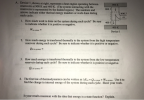
900 K + 800 J 400] A. Device 1, shown at right, represents a heat engine operating between reservoirs at 900 K and 400 K. (The system interacting with the reservoirs is represented by the dashed region.) The numbers and arrows indicate either thermal energy transfers or work done during each cycle. 1. How much work is done on the system during each cycle? Be sure to indicate whether it is positive or...
Please help and show work for 1-4!
900 K + 800 J 400] A. Device 1, shown at right, represents a heat engine operating between reservoirs at 900 K and 400 K. (The system interacting with the reservoirs is represented by the dashed region.) The numbers and arrows indicate either thermal energy transfers or work done during each cycle. 1. How much work is done on the system during each cycle? Be sure to indicate whether it is positive or...
Please show work for A 1-4! 1. Heat engines A heat engine is a device that...
 Please show work for A 1-4!
1. Heat engines A heat engine is a device that does work by exchanging thermal energy with its environment. All heat engines operate in cycles during which a system, also known as the working substance, passes through a series of thermodynamic processes returning repeatedly to each state. A. Device 1, shown at right, represents a heat engine operating between 900 K reservoirs at 900 K and 400 K. (The system interacting with the reservoirs...
Please show work for A 1-4!
1. Heat engines A heat engine is a device that does work by exchanging thermal energy with its environment. All heat engines operate in cycles during which a system, also known as the working substance, passes through a series of thermodynamic processes returning repeatedly to each state. A. Device 1, shown at right, represents a heat engine operating between 900 K reservoirs at 900 K and 400 K. (The system interacting with the reservoirs...
Question 30 3 pts A heat engine operates between 200 K and 100 K. In each...
 Question 30 3 pts A heat engine operates between 200 K and 100 K. In each cycle it takes 100 J from the hot reservoir, loses 25 J to the cold reservoir, and does 85 J of work. This heat engine violates: o the second law but not the first law of thermodynamics o both the first and second laws of thermodynamics O the first law but not the second law of thermodynamics O neither the first law nor the...
An ideal Refrigerator Operates between two reservoirs one of Temperature= 400 K and one of Temperature=...
An ideal Refrigerator Operates between two reservoirs one of Temperature= 400 K and one of Temperature= 320 K. For Every 100 J of heat drawn from the cold reservoir, find: a) the work required b) the heat deposited into the hot reservoir, c) the the coeffcient of performance. Again state how the ideal and real answers would compare.
NAME: OSU ID: A reversible heat engine operates between two thermal reservoirs, with temperatures of and...
 NAME: OSU ID: A reversible heat engine operates between two thermal reservoirs, with temperatures of and 400 °C. The net power (electrical work) output of the cycle is 1 kW. What is the heat input to the cycle? 3. 20°C (A) 1.05 k W (B) 0.56 kW (C) 1.79 kW (D) Not enough information
A power cycle operates between hot and cold reservoirs at 600 K and 300 K, respectively. At steady state the cycle deve...
A power cycle operates between hot and cold reservoirs at 600 K and 300 K, respectively. At steady state the cycle develops a power output of 0.45 MW while receiving energy by heat transfer from the hot reservoir at the rate of 1 MW. (a) Determine the thermal efficiency and the rate at which energy is rejected by heat transfer to the cold reservoir, in MW. (b) Compare the results of part (a) with those of a reversible power cycle...
Problem 2 (28%) An inventor has proposed to build a device to continuously create hot and...
 Problem 2 (28%) An inventor has proposed to build a device to continuously create hot and cold air from a high pressure air stream at room temperature, shown in Figure 1. She claims that she can feed air at 25°C and 10 bar into this device and obtain cold air (0°C and 1 bar) and hot air (40°C and 1 bar). The device has no energy input, no moving parts, and loses no heat to the surroundings. Assume a constant...
(b) Water flows under gravity through a pipeline connecting two reservoirs as shown in Figure 2....
 (b) Water flows under gravity through a pipeline connecting two reservoirs as shown in Figure 2. The pipeline consists of 2 km of pipe diameter 400 mm and sand roughness equivalent 0.03 mm followed by an abrupt change to 3 km of 500 mm diameter pipe of sand roughness equivalent 0.08 mm. The pipe discharges as a free jet into a reservoir. The difference in elevation between the water surface of the upstream reservoir and the discharging jet is 21...
6) In a reversible Carnot heat engine which operates between reservoirs at Thigh 500 K and...
 6) In a reversible Carnot heat engine which operates between reservoirs at Thigh 500 K and Tlow = 300 K with a net power output of 600 W, methane gas is used as working fluid. Methane can be considered here as an ideal gas with M 16.043 g mol-, and average heat capacities c 4 R and cp- 5 R. The cycle operates in a steady state with a substance flow rate of 0.375 mol s . Before the isothermal...
 please help 1 and 2 !
A. Device 1, shown at right, represents a heat engine operating between reservoirs at 900K and 400 K. (The system interacting with the reservoirs is represented by the dashed region.) The numbers and arrows indicate either thermal energy transfers or work done during each cycle. 900 K 800 J 400 J How much work is done on the system during each cycle? Be sure 1. to indicate whether it is positive or negative. 400...
please help 1 and 2 !
A. Device 1, shown at right, represents a heat engine operating between reservoirs at 900K and 400 K. (The system interacting with the reservoirs is represented by the dashed region.) The numbers and arrows indicate either thermal energy transfers or work done during each cycle. 900 K 800 J 400 J How much work is done on the system during each cycle? Be sure 1. to indicate whether it is positive or negative. 400...
 Please help and show work for 1-4!
900 K + 800 J 400] A. Device 1, shown at right, represents a heat engine operating between reservoirs at 900 K and 400 K. (The system interacting with the reservoirs is represented by the dashed region.) The numbers and arrows indicate either thermal energy transfers or work done during each cycle. 1. How much work is done on the system during each cycle? Be sure to indicate whether it is positive or...
Please help and show work for 1-4!
900 K + 800 J 400] A. Device 1, shown at right, represents a heat engine operating between reservoirs at 900 K and 400 K. (The system interacting with the reservoirs is represented by the dashed region.) The numbers and arrows indicate either thermal energy transfers or work done during each cycle. 1. How much work is done on the system during each cycle? Be sure to indicate whether it is positive or...
 Please show work for A 1-4!
1. Heat engines A heat engine is a device that does work by exchanging thermal energy with its environment. All heat engines operate in cycles during which a system, also known as the working substance, passes through a series of thermodynamic processes returning repeatedly to each state. A. Device 1, shown at right, represents a heat engine operating between 900 K reservoirs at 900 K and 400 K. (The system interacting with the reservoirs...
Please show work for A 1-4!
1. Heat engines A heat engine is a device that does work by exchanging thermal energy with its environment. All heat engines operate in cycles during which a system, also known as the working substance, passes through a series of thermodynamic processes returning repeatedly to each state. A. Device 1, shown at right, represents a heat engine operating between 900 K reservoirs at 900 K and 400 K. (The system interacting with the reservoirs...
 Question 30 3 pts A heat engine operates between 200 K and 100 K. In each cycle it takes 100 J from the hot reservoir, loses 25 J to the cold reservoir, and does 85 J of work. This heat engine violates: o the second law but not the first law of thermodynamics o both the first and second laws of thermodynamics O the first law but not the second law of thermodynamics O neither the first law nor the...
 NAME: OSU ID: A reversible heat engine operates between two thermal reservoirs, with temperatures of and 400 °C. The net power (electrical work) output of the cycle is 1 kW. What is the heat input to the cycle? 3. 20°C (A) 1.05 k W (B) 0.56 kW (C) 1.79 kW (D) Not enough information
 Problem 2 (28%) An inventor has proposed to build a device to continuously create hot and cold air from a high pressure air stream at room temperature, shown in Figure 1. She claims that she can feed air at 25°C and 10 bar into this device and obtain cold air (0°C and 1 bar) and hot air (40°C and 1 bar). The device has no energy input, no moving parts, and loses no heat to the surroundings. Assume a constant...
 (b) Water flows under gravity through a pipeline connecting two reservoirs as shown in Figure 2. The pipeline consists of 2 km of pipe diameter 400 mm and sand roughness equivalent 0.03 mm followed by an abrupt change to 3 km of 500 mm diameter pipe of sand roughness equivalent 0.08 mm. The pipe discharges as a free jet into a reservoir. The difference in elevation between the water surface of the upstream reservoir and the discharging jet is 21...
 6) In a reversible Carnot heat engine which operates between reservoirs at Thigh 500 K and Tlow = 300 K with a net power output of 600 W, methane gas is used as working fluid. Methane can be considered here as an ideal gas with M 16.043 g mol-, and average heat capacities c 4 R and cp- 5 R. The cycle operates in a steady state with a substance flow rate of 0.375 mol s . Before the isothermal...
Most questions answered within 3 hours.
-
Where is the error in this code sequence?
String s1 = "Hello";
String s2 = "ello";...
asked 10 months ago -
Financial data for Joel de Paris, Inc., for last year
follow:
Joel de Paris, Inc.
Balance...
asked 10 months ago -
Consider this reaction:
Al2(SO4)3 (aq)+ BaCl3
(aq) Al2Cl6 (aq)- +
3BaSO4(s) . What is the...
asked 10 months ago -
Suppose that Savneet is considering increasing her
recent random sample from 20 car rentals to 40...
asked 10 months ago -
Trucks arrive at an unloading terminal at an average rate of 120
per hour.
Trucks arrive...
asked 10 months ago -
Why are methanol and ethanol completely soluble in water while
octanol is not very little soluble....
asked 10 months ago -
A facilities manager at a university reads in a research report
that the mean amount of...
asked 10 months ago -
When the CuSO4 is rehydrated by adding water to the anhydrous
compound, is this an endothermic...
asked 10 months ago -
A ray of sunlight is passing from diamond into crown glass; the
angle of incidence is...
asked 10 months ago -
A block of mass 0.249 kg is placed on top of a light, vertical
spring of...
asked 10 months ago -
how do the kidneys compensate in the presences of acidosis
a) trigger hyperventilate
b) reserve acid...
asked 10 months ago -
Question 501 pts
The rental rate of capital to the firm increases. Which of the
following...
asked 10 months ago