Different between: Preferred stock vs common stock Short vs medium financing Outstanding vs issued share
Different between:
Preferred stock vs common stock
Short vs medium financing
Outstanding vs issued share
Homework Answers
| Preferred Stock | Common Stock |
| Have no Voting rights | Have Voting rights |
| Priority over company income than common stock | Priority after preferred stock |
| Paid Fixed dividend preference share holders | Paid variable dividend equity share holders |
| In Liquidation preference stake holders have a greater claim to company assets and earnings | In Liquidation lesser claim compared to preferred stock holders |
| preference shares have a callability feature,which gives issuer right to redeem the shares from market after predermined period | No such feature |
| Short Finance | Medium Finance |
| These are generally in range of up to 12 months | These are generally in range of 1 to 3 years |
| Usually have higher interest rates | Usually have lower interest rates than short finance |
| Only for working capital or for bridge financing purpose,also called working capital financing | Used for financial expansion of business |
| Generally lower repayment period compared to medium finance. | Higher repayment period compared to short term finance. |
| Examples are Merchant cash advancing,Invoice factoring | Examples are Asset based lending ,Equipment financing |
| Outstanding Shares | Issued shares |
| These are all shares which are issued minus shares held in treasury.These are actual number of shares which are held by the investors | These are shares held by the investors and share holders of the company ,they are also include the shares held by the company in that treasury after it buys back its shares |
| It does n't include treasury stock | It includes the treasury stock |
| Outstanding stock is reported on financial statements | These are not reported in financial statements |
| These are mainly used to measure the performance of the company and find key ratios on per share basis | It does n't give complete picture about the financial performance of the company while measuring key ratios on per share basis |
| there are used to determine total shares available for voting and percentage of share holding and voting rights of each share holder | These are include treasury stock which doe n't have voting power |
| Shares are less than or equal to issued shares. | They are more than equal to the outstanding shares |
Add Answer to:
Different between:
Preferred stock vs common stock
Short vs medium financing
Outstanding vs issued share
Preferred stock—5% cumulative, $25 par value, $30 callprice, 10,000 shares issued and outstanding $ 250,000 Common...
Preferred stock—5% cumulative, $25 par value, $30 callprice, 10,000 shares issued and outstanding $ 250,000 Common stock—$10 par value, 45,000 shares issued and outstanding 450,000 Retained earnings 267,500 Total stockholders’ equity $ 967,500 Determine the book value per share of the preferred and common stock under two separate situations. 1. No preferred dividends are in arrears. Preferred stock—5% cumulative, $25 par value, $30 callprice, 10,000 shares issued and outstanding $ 250,000 Common stock—$10 par value, 45,000 shares issued and outstanding...
Preferred stock- $25 par value, 10,eee shares authorized, 6,800 shares issued and outstanding Common stock-$10 par...
 Preferred stock- $25 par value, 10,eee shares authorized, 6,800 shares issued and outstanding Common stock-$10 par value, 100,00e shares authorized, 80,0e0 shares issued and outstanding Total paid-in' capital Retained earnings Total stockholders' equity $ 170, eee 800,e00 $ 970,000 550,e00 $1,520,000 The number of issued and outstanding shares of both preferred and common stock have been the same for the last two years Dividends on preferred stock are 8 percent of par value and have been paid each year the...
Ahnberg Corporation had 820.000 shares of common stock issued and outstanding at January 1, No common...
 Ahnberg Corporation had 820.000 shares of common stock issued and outstanding at January 1, No common shares were issued during the year, but on January 1, Ahnberg issued 440,000 shares of convertible preferred stock. The preferred shares are convertible Into 880.000 shares of common stock. During the year Ahnberg paid $264,000 cash dividends on the preferred stock. Net Income was $3.790,000 What were Ahnberg's basic and diluted earnings per share for the year? (Round your answers to 2 decimal places.)...
Party, Inc. has no preferred stock outstanding. The company had 40,000 shares of common stock outstanding...
Party, Inc. has no preferred stock outstanding. The company had 40,000 shares of common stock outstanding on January 1, 2019 and issued 12,000 additional shares on May 1. If Party’s net income was $200,000, the company should report earnings per share of (to the nearest cent): Select one: A. $4.17 B. $3.85 C. $5.24 D. $4.44
Contributed Capital: Common Stock - $4 par value, 5,000,000 shares authorized, 300,000 shares issued and outstanding...
 Contributed Capital: Common Stock - $4 par value, 5,000,000 shares authorized, 300,000 shares issued and outstanding Paid capital in Excess of Par, Common Retained Earnings Total Stockholders' Equity $1,200,000 1.600.000 2.000.000 $4,800,000 The following transactions occurred in sequence during 2019: a. Issued 40,000 shares of $100 par value, 10% cumulative preferred stock at par, b. Declared a 2 per 1 stock split on outstanding common shares. c. Bought land valued at $980,000 by using 100,000 shares of common stock. d....
A company has the following capital stock outstanding: preferred shares of $15,000, common shares of $30,000,...
A company has the following capital stock outstanding: preferred shares of $15,000, common shares of $30,000, retained earnings of $100,000. Preferred dividends in arrears amount to $5,000. There are 10,000 common shares and 1,000 preferred shares issued. What is the book value one share of preferred stock? a. $12.50 b. $20 c. $105 d. $125
Carson Corporation has the following capital stock outstanding at December 31, 2019: 9% Preferred stock, $100...
Carson Corporation has the following capital stock outstanding at December 31, 2019: 9% Preferred stock, $100 par value, cumulative 15,000 shares issued and outstanding $ 1,500,000 Common stock, no par, $10 stated value, 500,000 shares authorized, 350,000 shares issued and outstanding $ 3,500,000 The preferred stock was issued at $ 110 per share. The common stock was issued at $ 16 per share. Instructions Prepare the paid-in capital section of the balance sheet at December 31, 2019.
Throughout 2014, H had 3,770,000 shares of common stock issued and outstanding and 100,000 shares of...
Throughout 2014, H had 3,770,000 shares of common stock issued and outstanding and 100,000 shares of 6%, $50 par value convertible preferred stock issued outstanding. Each share of preferred stock can be converted into 4 shares of B’s common stock. H’s net income for 2014 was $9,420,000. During 2014 H paid $300,000 of preferred dividends. H’s income tax rate is 20%. During the entire year ending 12-31-14, H had 400,000 outstanding and exercisable employee stock options that were granted to...
Effect of Financing on Earnings Per Share Three different plans for financing an $3,500,000 corporation are...
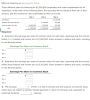 Effect of Financing on Earnings Per Share Three different plans for financing an $3,500,000 corporation are under consideration by its organizers. Under each of the following plans, the securities will be issued at their par or face amount, and the income tax rate is estimated at 40% of income: Plan 1 Plan 2 Plan 3 10% Bonds Preferred 5% stock, $80 par $1,750,000 $1,750,000 875,000 875,000 Common stock, $3.5 par $3,500,000 $ 3,500,000 1,750,000 $3,500,000 Total $3,500,000 Required: 1. Determine...
Effect of Financing on Earnings Per Share Three different plans for financing an $5,300,000 corporation are...
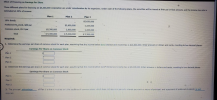 Effect of Financing on Earnings Per Share Three different plans for financing an $5,300,000 corporation are under consideration by its organizers. Under each of the following plans, the securities will be issued at their par or face amount, and the income tax rate is estimated at 40% of income: Plan 1 Plan 2 Plan 3 10% Bonds Preferred 5% stock, $80 par Common stock, $5.3 par $2,650,000 1,325,000 1,325,000 $2,650,000 2,650,000 $5,300,000 $5,300,000 $ 5,300,000 Total $5,300,000 Required: 1. Determine...
 Preferred stock- $25 par value, 10,eee shares authorized, 6,800 shares issued and outstanding Common stock-$10 par value, 100,00e shares authorized, 80,0e0 shares issued and outstanding Total paid-in' capital Retained earnings Total stockholders' equity $ 170, eee 800,e00 $ 970,000 550,e00 $1,520,000 The number of issued and outstanding shares of both preferred and common stock have been the same for the last two years Dividends on preferred stock are 8 percent of par value and have been paid each year the...
 Ahnberg Corporation had 820.000 shares of common stock issued and outstanding at January 1, No common shares were issued during the year, but on January 1, Ahnberg issued 440,000 shares of convertible preferred stock. The preferred shares are convertible Into 880.000 shares of common stock. During the year Ahnberg paid $264,000 cash dividends on the preferred stock. Net Income was $3.790,000 What were Ahnberg's basic and diluted earnings per share for the year? (Round your answers to 2 decimal places.)...
 Contributed Capital: Common Stock - $4 par value, 5,000,000 shares authorized, 300,000 shares issued and outstanding Paid capital in Excess of Par, Common Retained Earnings Total Stockholders' Equity $1,200,000 1.600.000 2.000.000 $4,800,000 The following transactions occurred in sequence during 2019: a. Issued 40,000 shares of $100 par value, 10% cumulative preferred stock at par, b. Declared a 2 per 1 stock split on outstanding common shares. c. Bought land valued at $980,000 by using 100,000 shares of common stock. d....
 Effect of Financing on Earnings Per Share Three different plans for financing an $3,500,000 corporation are under consideration by its organizers. Under each of the following plans, the securities will be issued at their par or face amount, and the income tax rate is estimated at 40% of income: Plan 1 Plan 2 Plan 3 10% Bonds Preferred 5% stock, $80 par $1,750,000 $1,750,000 875,000 875,000 Common stock, $3.5 par $3,500,000 $ 3,500,000 1,750,000 $3,500,000 Total $3,500,000 Required: 1. Determine...
 Effect of Financing on Earnings Per Share Three different plans for financing an $5,300,000 corporation are under consideration by its organizers. Under each of the following plans, the securities will be issued at their par or face amount, and the income tax rate is estimated at 40% of income: Plan 1 Plan 2 Plan 3 10% Bonds Preferred 5% stock, $80 par Common stock, $5.3 par $2,650,000 1,325,000 1,325,000 $2,650,000 2,650,000 $5,300,000 $5,300,000 $ 5,300,000 Total $5,300,000 Required: 1. Determine...
Most questions answered within 3 hours.
-
Where is the error in this code sequence?
String s1 = "Hello";
String s2 = "ello";...
asked 10 months ago -
Financial data for Joel de Paris, Inc., for last year
follow:
Joel de Paris, Inc.
Balance...
asked 10 months ago -
Consider this reaction:
Al2(SO4)3 (aq)+ BaCl3
(aq) Al2Cl6 (aq)- +
3BaSO4(s) . What is the...
asked 10 months ago -
Suppose that Savneet is considering increasing her
recent random sample from 20 car rentals to 40...
asked 10 months ago -
Trucks arrive at an unloading terminal at an average rate of 120
per hour.
Trucks arrive...
asked 10 months ago -
Why are methanol and ethanol completely soluble in water while
octanol is not very little soluble....
asked 10 months ago -
A facilities manager at a university reads in a research report
that the mean amount of...
asked 10 months ago -
When the CuSO4 is rehydrated by adding water to the anhydrous
compound, is this an endothermic...
asked 10 months ago -
A ray of sunlight is passing from diamond into crown glass; the
angle of incidence is...
asked 10 months ago -
A block of mass 0.249 kg is placed on top of a light, vertical
spring of...
asked 10 months ago -
how do the kidneys compensate in the presences of acidosis
a) trigger hyperventilate
b) reserve acid...
asked 10 months ago -
Question 501 pts
The rental rate of capital to the firm increases. Which of the
following...
asked 10 months ago