find 5 carbons that are different from each other and predict the chemical shift for each stating whether each would be <100 or >100 ppm

Mefeanic Acid
Homework Answers

Add Answer to:
find 5 carbons that are different from each other and
predict the chemical shift for each...
10c.) Indicate the chemical shift in ppm's of each of the protons and carbons indicated in...
 10c.) Indicate the chemical shift in ppm's of each of the protons and carbons indicated in the appropriate diagram below. These values should be experimental values from the NMR you obtained. The C NMR is provided for you. If you did not form the desired product, indicate this and predict what the ppm values should be. proton NMR results carbon NMR results 10d.) What splitting pattern would you expect to see for protons A and B in 'H NMR?
How would you distinguish the following carboxylic acid from its aldehyde derivative using chemical shift in...
 How would you distinguish the following carboxylic acid from its aldehyde derivative using chemical shift in 1H NMR? Select all different chemical shift ranges that apply. 0.9.1.7 ppm 19-2.5 ppm 2.6-3.0 ppm 3.5-4.3 ppm 50-6.0 ppm 6.5-7.5 ppm 8.0-9.0 pom 90-10.0 ppm 110-12.0 ppm 0.3 pts Question 11 How would you distinguish the following compounds using chemical shift in 1H NMR? Select all different chemical shift ranges that apply. 0 0.9-1.7 ppm 1.9-2.5 ppm 26-3 0 ppm 35-4.3 ppn 50-60...
Predict the approximate chemical shift position for each of the different hydrogens in the ^1H- NMR...
 Predict the approximate chemical shift position for each of the different hydrogens in the ^1H- NMR spectrum of this compound and simulate an NMR spectrum for the compound.
Question 7 5 points Save and Consider the chemical shift of carbons in aromatic systems. To...
 Question 7 5 points Save and Consider the chemical shift of carbons in aromatic systems. To estimate these chemical shifts when the aromatic ring is substituted with halogens can be tricky. Please find below Table 1 that allows you to calculate the chemical shifts. What is the chemicals of the meta carbon of Fluorobenzene and the chemicals of the para carbon of chlorobenvene 03 +0.9 CHERci (attachment) C2 F +35.1 -14.3 al +6.4 +0.2 Br -5.4 +3.4 -32.2 +9.9 Note...
The chemical shift of Ha in the molecule below was recorded at 3.85 ppm downfield from...
 The chemical shift of Ha in the molecule below was recorded at
3.85 ppm downfield from TMS on a 500 MHz spectrometer. What is this
chemical shift, in Hz, on a 250 MHz NMR? Other hydrogen’s are
omitted for clarity. ppm = (chemical shift in Hz)/(spectrometer
frequency in MHz)
The chemical shift of Ha in the molecule below was recorded at
3.85 ppm downfield from TMS on a 500 MHz spectrometer. What is this
chemical shift, in Hz, on a 250 MHz NMR? Other hydrogen’s are
omitted for clarity. ppm = (chemical shift in Hz)/(spectrometer
frequency in MHz)
III. Structure from NMR 5. Using the skills developed so far, predict the structure of the...
 III. Structure from NMR 5. Using the skills developed so far, predict the structure of the analyzed compound from the given spectra. a. For the molecular formula CH100 Intensity TMS 10 9 8 02001 Brooks Cole - Thomson Learning 0 ppm 65 Chemical shift (8) b. For the molecular formula C.H.O. (IR spectrum has been included) singlet triplet quartet 0 ppm Chemical Shift (d) C40 BACHER
13C NMR Signal and Chemical Shift tural abundance of the ich is 99.985% of hydrogen Sassi...
 13C NMR Signal and Chemical Shift tural abundance of the ich is 99.985% of hydrogen Sassi The isotope 18C is another NMR active nucleus. The natural abundance isotope is only 1.1% of carbon atoms compared to the 'H isotope which is 99.985% of atoms. Therefore the intensity of WC peaks is lower. It takes a longer time to obtain a spectrum compared to a 'H NMR spectrum. Adjacent WC - WC splitting does occur. chance of two "C atoms being...
Match each of the equivalent types of hydrogen with the correct chemical shift. A. 3.4 -...
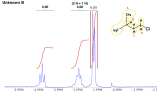 Match each of the equivalent types of hydrogen with the correct
chemical shift.
A. 3.4 - 3.8 ppm
B. 1.0 ppm
C. 1.4-2.0 ppm
1. Label A
2. Label B + C
3. Label D
Unknown B 2.00 (2 H + 1 H) 3.00 6.00 CH3 I + c I 5 PPM 4 PPM. 3 PPM2 PPM PPMO PPM -1 PPM -27
Match each of the equivalent types of hydrogen with the correct
chemical shift.
A. 3.4 - 3.8 ppm
B. 1.0 ppm
C. 1.4-2.0 ppm
1. Label A
2. Label B + C
3. Label D
Unknown B 2.00 (2 H + 1 H) 3.00 6.00 CH3 I + c I 5 PPM 4 PPM. 3 PPM2 PPM PPMO PPM -1 PPM -27
im not really sure how to predict chemical shift i know the more electronegative the more...
 im not really sure how to predict chemical shift i know the
more electronegative the more downfield it will be is there an
equation or something? please help me with this problem
1) These molecules have different 'H NMR chemical shifts of the methylene group. Look at the data: 2.6 3.6 1.4 CHE "SH OH Based on this trend, rank order the following molecules in terms of chemical shift (most downfield to most upfield), and estimate the proton chemical shift...
im not really sure how to predict chemical shift i know the
more electronegative the more downfield it will be is there an
equation or something? please help me with this problem
1) These molecules have different 'H NMR chemical shifts of the methylene group. Look at the data: 2.6 3.6 1.4 CHE "SH OH Based on this trend, rank order the following molecules in terms of chemical shift (most downfield to most upfield), and estimate the proton chemical shift...
question regarding H NMR why in the two different spectrums CH3 is in a different ppm...
 question regarding H NMR why
in the two different spectrums CH3 is in a different ppm
Construct a simulated HNMR spectru m, including proton integrations, for CH3CHCI2. Drag the appropriate Degrees of Unsaturation 2c 2 N-H -x C carbons H hydrog splitting patterns to the approximate chemical shift positions; place the integration values in the small bins N snitrogens X. trhaloger above the associated chemical shift. Splitting patterns and integrations may be used more than once, or not at all,...
question regarding H NMR why
in the two different spectrums CH3 is in a different ppm
Construct a simulated HNMR spectru m, including proton integrations, for CH3CHCI2. Drag the appropriate Degrees of Unsaturation 2c 2 N-H -x C carbons H hydrog splitting patterns to the approximate chemical shift positions; place the integration values in the small bins N snitrogens X. trhaloger above the associated chemical shift. Splitting patterns and integrations may be used more than once, or not at all,...
 10c.) Indicate the chemical shift in ppm's of each of the protons and carbons indicated in the appropriate diagram below. These values should be experimental values from the NMR you obtained. The C NMR is provided for you. If you did not form the desired product, indicate this and predict what the ppm values should be. proton NMR results carbon NMR results 10d.) What splitting pattern would you expect to see for protons A and B in 'H NMR?
 How would you distinguish the following carboxylic acid from its aldehyde derivative using chemical shift in 1H NMR? Select all different chemical shift ranges that apply. 0.9.1.7 ppm 19-2.5 ppm 2.6-3.0 ppm 3.5-4.3 ppm 50-6.0 ppm 6.5-7.5 ppm 8.0-9.0 pom 90-10.0 ppm 110-12.0 ppm 0.3 pts Question 11 How would you distinguish the following compounds using chemical shift in 1H NMR? Select all different chemical shift ranges that apply. 0 0.9-1.7 ppm 1.9-2.5 ppm 26-3 0 ppm 35-4.3 ppn 50-60...
 Predict the approximate chemical shift position for each of the different hydrogens in the ^1H- NMR spectrum of this compound and simulate an NMR spectrum for the compound.
 Question 7 5 points Save and Consider the chemical shift of carbons in aromatic systems. To estimate these chemical shifts when the aromatic ring is substituted with halogens can be tricky. Please find below Table 1 that allows you to calculate the chemical shifts. What is the chemicals of the meta carbon of Fluorobenzene and the chemicals of the para carbon of chlorobenvene 03 +0.9 CHERci (attachment) C2 F +35.1 -14.3 al +6.4 +0.2 Br -5.4 +3.4 -32.2 +9.9 Note...
 The chemical shift of Ha in the molecule below was recorded at
3.85 ppm downfield from TMS on a 500 MHz spectrometer. What is this
chemical shift, in Hz, on a 250 MHz NMR? Other hydrogen’s are
omitted for clarity. ppm = (chemical shift in Hz)/(spectrometer
frequency in MHz)
The chemical shift of Ha in the molecule below was recorded at
3.85 ppm downfield from TMS on a 500 MHz spectrometer. What is this
chemical shift, in Hz, on a 250 MHz NMR? Other hydrogen’s are
omitted for clarity. ppm = (chemical shift in Hz)/(spectrometer
frequency in MHz)
 III. Structure from NMR 5. Using the skills developed so far, predict the structure of the analyzed compound from the given spectra. a. For the molecular formula CH100 Intensity TMS 10 9 8 02001 Brooks Cole - Thomson Learning 0 ppm 65 Chemical shift (8) b. For the molecular formula C.H.O. (IR spectrum has been included) singlet triplet quartet 0 ppm Chemical Shift (d) C40 BACHER
 13C NMR Signal and Chemical Shift tural abundance of the ich is 99.985% of hydrogen Sassi The isotope 18C is another NMR active nucleus. The natural abundance isotope is only 1.1% of carbon atoms compared to the 'H isotope which is 99.985% of atoms. Therefore the intensity of WC peaks is lower. It takes a longer time to obtain a spectrum compared to a 'H NMR spectrum. Adjacent WC - WC splitting does occur. chance of two "C atoms being...
 Match each of the equivalent types of hydrogen with the correct
chemical shift.
A. 3.4 - 3.8 ppm
B. 1.0 ppm
C. 1.4-2.0 ppm
1. Label A
2. Label B + C
3. Label D
Unknown B 2.00 (2 H + 1 H) 3.00 6.00 CH3 I + c I 5 PPM 4 PPM. 3 PPM2 PPM PPMO PPM -1 PPM -27
Match each of the equivalent types of hydrogen with the correct
chemical shift.
A. 3.4 - 3.8 ppm
B. 1.0 ppm
C. 1.4-2.0 ppm
1. Label A
2. Label B + C
3. Label D
Unknown B 2.00 (2 H + 1 H) 3.00 6.00 CH3 I + c I 5 PPM 4 PPM. 3 PPM2 PPM PPMO PPM -1 PPM -27
 im not really sure how to predict chemical shift i know the
more electronegative the more downfield it will be is there an
equation or something? please help me with this problem
1) These molecules have different 'H NMR chemical shifts of the methylene group. Look at the data: 2.6 3.6 1.4 CHE "SH OH Based on this trend, rank order the following molecules in terms of chemical shift (most downfield to most upfield), and estimate the proton chemical shift...
im not really sure how to predict chemical shift i know the
more electronegative the more downfield it will be is there an
equation or something? please help me with this problem
1) These molecules have different 'H NMR chemical shifts of the methylene group. Look at the data: 2.6 3.6 1.4 CHE "SH OH Based on this trend, rank order the following molecules in terms of chemical shift (most downfield to most upfield), and estimate the proton chemical shift...
 question regarding H NMR why
in the two different spectrums CH3 is in a different ppm
Construct a simulated HNMR spectru m, including proton integrations, for CH3CHCI2. Drag the appropriate Degrees of Unsaturation 2c 2 N-H -x C carbons H hydrog splitting patterns to the approximate chemical shift positions; place the integration values in the small bins N snitrogens X. trhaloger above the associated chemical shift. Splitting patterns and integrations may be used more than once, or not at all,...
question regarding H NMR why
in the two different spectrums CH3 is in a different ppm
Construct a simulated HNMR spectru m, including proton integrations, for CH3CHCI2. Drag the appropriate Degrees of Unsaturation 2c 2 N-H -x C carbons H hydrog splitting patterns to the approximate chemical shift positions; place the integration values in the small bins N snitrogens X. trhaloger above the associated chemical shift. Splitting patterns and integrations may be used more than once, or not at all,...
Most questions answered within 3 hours.
-
Where is the error in this code sequence?
String s1 = "Hello";
String s2 = "ello";...
asked 10 months ago -
Financial data for Joel de Paris, Inc., for last year
follow:
Joel de Paris, Inc.
Balance...
asked 10 months ago -
Consider this reaction:
Al2(SO4)3 (aq)+ BaCl3
(aq) Al2Cl6 (aq)- +
3BaSO4(s) . What is the...
asked 10 months ago -
Suppose that Savneet is considering increasing her
recent random sample from 20 car rentals to 40...
asked 10 months ago -
Trucks arrive at an unloading terminal at an average rate of 120
per hour.
Trucks arrive...
asked 10 months ago -
Why are methanol and ethanol completely soluble in water while
octanol is not very little soluble....
asked 10 months ago -
A facilities manager at a university reads in a research report
that the mean amount of...
asked 10 months ago -
When the CuSO4 is rehydrated by adding water to the anhydrous
compound, is this an endothermic...
asked 10 months ago -
A ray of sunlight is passing from diamond into crown glass; the
angle of incidence is...
asked 10 months ago -
A block of mass 0.249 kg is placed on top of a light, vertical
spring of...
asked 10 months ago -
how do the kidneys compensate in the presences of acidosis
a) trigger hyperventilate
b) reserve acid...
asked 10 months ago -
Question 501 pts
The rental rate of capital to the firm increases. Which of the
following...
asked 10 months ago