
Homework Answers
Due to presence of HOMEWORKLIB POLICY, I am answering one question.
18.
Ans:
| Budget Deficit | Public Debt |
| Difference between what the federal government spends (called outlays) and what it takes in (called revenue or receipts). | Result of the federal government borrowing money to cover years and years of budget deficits |
| Flow concept | Stock concept |
| Concerned for an year only. | Concerned for all time health of economy |
If you are satisfied with the answer, please provide a positive rating. Feel free to comment in case of queries.
Have a nice day ahead!
Add Answer to:
for: 18., and 19.
16. When output deviates from potential GDP, automatic stabilizers work to push...
for: 16. 17. 18. 19. 16. When output deviates from potential GDP, automatic stabilizers work to...
 for:
16.
17.
18.
19.
16. When output deviates from potential GDP, automatic stabilizers work to push the economy through the work of automatic stabilizers. Give two examples of automatic stabilizers. 17. Crowding out effect: what does it mean? 18. Distinguish between public debt and budget deficit. 19. Mention which of the two output gap occurs in the following cases: recessionary gap or inflationary gap? a. the economy is creating less output than its potential b. the economy is creating...
for:
16.
17.
18.
19.
16. When output deviates from potential GDP, automatic stabilizers work to push the economy through the work of automatic stabilizers. Give two examples of automatic stabilizers. 17. Crowding out effect: what does it mean? 18. Distinguish between public debt and budget deficit. 19. Mention which of the two output gap occurs in the following cases: recessionary gap or inflationary gap? a. the economy is creating less output than its potential b. the economy is creating...
16. When output deviates from potential GDP, automatic stabilizers work to push the economy through the...
 16. When output deviates from potential GDP, automatic stabilizers work to push the economy through the work of automatic stabilizers. Give two examples of automatic stabilizers. 17. Crowding out effect: what does it mean? 18. Distinguish between public debt and budget deficit. 19. Mention which of the two output gap occurs in the following cases: recessionary gap or inflationary gap? a. the economy is creating less output than its potential b. the economy is creating more output than its potential
16. When output deviates from potential GDP, automatic stabilizers work to push the economy through the...
 16. When output deviates from potential GDP, automatic stabilizers work to push the economy through the work of automatic stabilizers. Give two examples of automatic stabilizers.
19. Mention which of the two output gap occurs in the following cases: recessionary gap or...
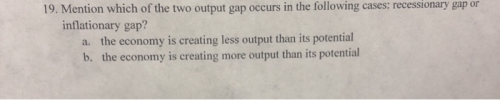 19. Mention which of the two output gap occurs in the following cases: recessionary gap or inflationary gap? a. the economy is creating less output than its potential b. the economy is creating more output than its potential
19. Mention which of the two output gap occurs in the following cases: recessionary gap or...
 19. Mention which of the two output gap occurs in the following cases: recessionary gap or inflationary gap? a. the economy is creating less output than its potential b. the economy is creating more output than its potential
1. Suppose in a simple closed economy with MPC = 0.75, the planned investment spending nas...
 1. Suppose in a simple closed economy with MPC = 0.75, the planned investment spending nas suddenly fallen, reducing AD and output to a level that below the natural level of output by 100 Million. Assume that the real interest rate is constant so that there is no crowding out of (gross) investment. (a) If the government decided to try to get the output back to the natural level of output using only a change in government spending (AG), by...
1. GDP is _____ 11 trillion/ 16 trillion/ 10 trillion / 14 trillion /12 trillion 2. currently...
 1. GDP is _____ 11
trillion/ 16 trillion/ 10 trillion / 14 trillion /12
trillion
2. currently _____ recessionary gap / inflationary
gap
3. of ______ 4 trillion / 1 trillion / 5 trillion / 2
trillion / 3 trillion
4. the Fed will ____ increase / decrease
5. which will _____ increase/ decrease
6. incentive to ____ increase / decrease
7. shifting the ____ AD / SRAS / LRAS
8. curve to the ____ left / right
9. relatively high...
1. GDP is _____ 11
trillion/ 16 trillion/ 10 trillion / 14 trillion /12
trillion
2. currently _____ recessionary gap / inflationary
gap
3. of ______ 4 trillion / 1 trillion / 5 trillion / 2
trillion / 3 trillion
4. the Fed will ____ increase / decrease
5. which will _____ increase/ decrease
6. incentive to ____ increase / decrease
7. shifting the ____ AD / SRAS / LRAS
8. curve to the ____ left / right
9. relatively high...
9.What is Say’s Law and what do classical economists say about prices, wages, and interest rates?...
9.What is Say’s Law and what do classical economists say about prices, wages, and interest rates? What are the three states of the economy in relating the real GDP to natural real GDP? In a recessionary gap, is there a surplus or a shortage of production? What does that imply about the labor market and how wages may change? Understand the differences between a recessionary gap, inflationary gap, and long run equilibrium. How is the physical production possibilities frontier (PPF)...
Please just help spent the semester in the hospital and apparently have to do an assignment.....
 Please just help spent the semester in the hospital and
apparently have to do an assignment..
11. Government spending and taxation changes that cause fiscal policy to be expansionary when the economy contracts and contractionary when the economy expands are known as: A) discretionary fiscal policy. B) automatic stabilizers. autonomous spending policies. destabilizing fiscal policies. 12. 4) The government budget balance equals: taxes plus government purchases plus government transfers. taxes minus government purchases minus government transfers. taxes minus government purchases...
Please just help spent the semester in the hospital and
apparently have to do an assignment..
11. Government spending and taxation changes that cause fiscal policy to be expansionary when the economy contracts and contractionary when the economy expands are known as: A) discretionary fiscal policy. B) automatic stabilizers. autonomous spending policies. destabilizing fiscal policies. 12. 4) The government budget balance equals: taxes plus government purchases plus government transfers. taxes minus government purchases minus government transfers. taxes minus government purchases...
1. Expain the effect of a discretionary cut in taxes of $40 billion on the economy when the economy’s marginal propensity to consume is .75. How does this discretionary fiscal policy differ from a...
1. Expain the effect of a discretionary cut in taxes of $40 billion on the economy when the economy’s marginal propensity to consume is .75. How does this discretionary fiscal policy differ from a discretionary increase in government spending of $40 billion? 2.Explain what is meant by a built-in stabilizer and give two examples. 3.Differentiate between discretionary fiscal policy and nondiscretionary or built-in stabilization policy. 4.What does the “standardized budget” measure and of what significance is this concept? 5.What are...
 for:
16.
17.
18.
19.
16. When output deviates from potential GDP, automatic stabilizers work to push the economy through the work of automatic stabilizers. Give two examples of automatic stabilizers. 17. Crowding out effect: what does it mean? 18. Distinguish between public debt and budget deficit. 19. Mention which of the two output gap occurs in the following cases: recessionary gap or inflationary gap? a. the economy is creating less output than its potential b. the economy is creating...
for:
16.
17.
18.
19.
16. When output deviates from potential GDP, automatic stabilizers work to push the economy through the work of automatic stabilizers. Give two examples of automatic stabilizers. 17. Crowding out effect: what does it mean? 18. Distinguish between public debt and budget deficit. 19. Mention which of the two output gap occurs in the following cases: recessionary gap or inflationary gap? a. the economy is creating less output than its potential b. the economy is creating...
 16. When output deviates from potential GDP, automatic stabilizers work to push the economy through the work of automatic stabilizers. Give two examples of automatic stabilizers. 17. Crowding out effect: what does it mean? 18. Distinguish between public debt and budget deficit. 19. Mention which of the two output gap occurs in the following cases: recessionary gap or inflationary gap? a. the economy is creating less output than its potential b. the economy is creating more output than its potential
 16. When output deviates from potential GDP, automatic stabilizers work to push the economy through the work of automatic stabilizers. Give two examples of automatic stabilizers.
 19. Mention which of the two output gap occurs in the following cases: recessionary gap or inflationary gap? a. the economy is creating less output than its potential b. the economy is creating more output than its potential
 19. Mention which of the two output gap occurs in the following cases: recessionary gap or inflationary gap? a. the economy is creating less output than its potential b. the economy is creating more output than its potential
 1. Suppose in a simple closed economy with MPC = 0.75, the planned investment spending nas suddenly fallen, reducing AD and output to a level that below the natural level of output by 100 Million. Assume that the real interest rate is constant so that there is no crowding out of (gross) investment. (a) If the government decided to try to get the output back to the natural level of output using only a change in government spending (AG), by...
 1. GDP is _____ 11
trillion/ 16 trillion/ 10 trillion / 14 trillion /12
trillion
2. currently _____ recessionary gap / inflationary
gap
3. of ______ 4 trillion / 1 trillion / 5 trillion / 2
trillion / 3 trillion
4. the Fed will ____ increase / decrease
5. which will _____ increase/ decrease
6. incentive to ____ increase / decrease
7. shifting the ____ AD / SRAS / LRAS
8. curve to the ____ left / right
9. relatively high...
1. GDP is _____ 11
trillion/ 16 trillion/ 10 trillion / 14 trillion /12
trillion
2. currently _____ recessionary gap / inflationary
gap
3. of ______ 4 trillion / 1 trillion / 5 trillion / 2
trillion / 3 trillion
4. the Fed will ____ increase / decrease
5. which will _____ increase/ decrease
6. incentive to ____ increase / decrease
7. shifting the ____ AD / SRAS / LRAS
8. curve to the ____ left / right
9. relatively high...
 Please just help spent the semester in the hospital and
apparently have to do an assignment..
11. Government spending and taxation changes that cause fiscal policy to be expansionary when the economy contracts and contractionary when the economy expands are known as: A) discretionary fiscal policy. B) automatic stabilizers. autonomous spending policies. destabilizing fiscal policies. 12. 4) The government budget balance equals: taxes plus government purchases plus government transfers. taxes minus government purchases minus government transfers. taxes minus government purchases...
Please just help spent the semester in the hospital and
apparently have to do an assignment..
11. Government spending and taxation changes that cause fiscal policy to be expansionary when the economy contracts and contractionary when the economy expands are known as: A) discretionary fiscal policy. B) automatic stabilizers. autonomous spending policies. destabilizing fiscal policies. 12. 4) The government budget balance equals: taxes plus government purchases plus government transfers. taxes minus government purchases minus government transfers. taxes minus government purchases...
Most questions answered within 3 hours.
-
Where is the error in this code sequence?
String s1 = "Hello";
String s2 = "ello";...
asked 11 months ago -
Financial data for Joel de Paris, Inc., for last year
follow:
Joel de Paris, Inc.
Balance...
asked 11 months ago -
Consider this reaction:
Al2(SO4)3 (aq)+ BaCl3
(aq) Al2Cl6 (aq)- +
3BaSO4(s) . What is the...
asked 11 months ago -
Suppose that Savneet is considering increasing her
recent random sample from 20 car rentals to 40...
asked 11 months ago -
Trucks arrive at an unloading terminal at an average rate of 120
per hour.
Trucks arrive...
asked 11 months ago -
Why are methanol and ethanol completely soluble in water while
octanol is not very little soluble....
asked 11 months ago -
A facilities manager at a university reads in a research report
that the mean amount of...
asked 11 months ago -
When the CuSO4 is rehydrated by adding water to the anhydrous
compound, is this an endothermic...
asked 11 months ago -
A ray of sunlight is passing from diamond into crown glass; the
angle of incidence is...
asked 11 months ago -
A block of mass 0.249 kg is placed on top of a light, vertical
spring of...
asked 11 months ago -
how do the kidneys compensate in the presences of acidosis
a) trigger hyperventilate
b) reserve acid...
asked 11 months ago -
Question 501 pts
The rental rate of capital to the firm increases. Which of the
following...
asked 11 months ago