
Homework Answers

Add Answer to:
Lewis structure for three resonance forms of the nitrate
ion
2 of 22 Many free radicals...
Many free radicals combine to form molecules that do not contain any unpaired electrons. The driving...
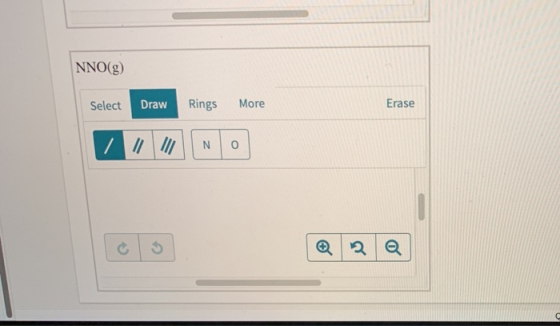
Many free radicals combine to form molecules that do not contain any unpaired electrons. The driving force for the radical-radical combination reaction is the formation of a new electron-pair bond. Write Lewis formulas for the reactant and product species in the following chemical equation. Include nonbonding electrons. N(g)-->NO(g)-->NNO(g
Many free radicals combine to form molecules that do not contain any unpaired electrons. The driving...
 Many free radicals combine to form molecules that do not contain any unpaired electrons. The driving force for the radical-radical combination reaction is the formation of a new electron-pair bond. Write Lewis formulas for the reactant and product species in the following chemical equation. Induce nonbonding electrons 2O_H(g)right arrow H_2O_2(g)
A Lewis structure of the carbamate ion is shown. :0: H. H Lewis structure A Draw...
 A Lewis structure of the carbamate ion is shown. :0: H. H Lewis structure A Draw the two other major resonance structures. Be sure to include all nonbonding electrons and formal charges where appropriate, Lewis structure C Lewis structure B More Rings Select Draw Erase Rings More Select Draw H C z Question 1 of9 The charges and sizes of the ions in an ionic compound affect the strength of the electrostatic attraction holding that compound together. Based on ion...
Add missing charges and non-bonding electrons. A Lewis structure for the carbonate ion (CO3-) is shown,...
 Add missing charges and non-bonding electrons. A Lewis structure for the carbonate ion (CO3-) is shown, but incomplete. Complete the structure by adding in formal charges and non-bonding electrons. Then draw the other two major resonance structures that fit the octet rule. Select Draw Rings More Erase III co 0- 2 Draw major resonance structure 2. Be sure to add charges and non-bonding electrons where appropriate. Draw major resonance structure 3. Be sure to add charges and non-bonding electrons where...
Free Radicals are molecules or ions that have an unpaired electron. They tend to be very reactive and are thought to contribute to the aging process. A "dimer" forms when two of the same m...
Free Radicals are molecules or ions that have an unpaired electron. They tend to be very reactive and are thought to contribute to the aging process. A "dimer" forms when two of the same molecules combine (dimerize). Draw a Lewis structure for each of the substances below and indicate which are free radicals. For a free radical the unpaired electron goes on the least electronegative element, which is usually the central atom. Key: ... y = Yes ... n =...
 Many free radicals combine to form molecules that do not contain any unpaired electrons. The driving force for the radical-radical combination reaction is the formation of a new electron-pair bond. Write Lewis formulas for the reactant and product species in the following chemical equation. Induce nonbonding electrons 2O_H(g)right arrow H_2O_2(g)
 A Lewis structure of the carbamate ion is shown. :0: H. H Lewis structure A Draw the two other major resonance structures. Be sure to include all nonbonding electrons and formal charges where appropriate, Lewis structure C Lewis structure B More Rings Select Draw Erase Rings More Select Draw H C z Question 1 of9 The charges and sizes of the ions in an ionic compound affect the strength of the electrostatic attraction holding that compound together. Based on ion...
 Add missing charges and non-bonding electrons. A Lewis structure for the carbonate ion (CO3-) is shown, but incomplete. Complete the structure by adding in formal charges and non-bonding electrons. Then draw the other two major resonance structures that fit the octet rule. Select Draw Rings More Erase III co 0- 2 Draw major resonance structure 2. Be sure to add charges and non-bonding electrons where appropriate. Draw major resonance structure 3. Be sure to add charges and non-bonding electrons where...
Most questions answered within 3 hours.
-
Where is the error in this code sequence?
String s1 = "Hello";
String s2 = "ello";...
asked 10 months ago -
Financial data for Joel de Paris, Inc., for last year
follow:
Joel de Paris, Inc.
Balance...
asked 10 months ago -
Consider this reaction:
Al2(SO4)3 (aq)+ BaCl3
(aq) Al2Cl6 (aq)- +
3BaSO4(s) . What is the...
asked 10 months ago -
Suppose that Savneet is considering increasing her
recent random sample from 20 car rentals to 40...
asked 10 months ago -
Trucks arrive at an unloading terminal at an average rate of 120
per hour.
Trucks arrive...
asked 10 months ago -
Why are methanol and ethanol completely soluble in water while
octanol is not very little soluble....
asked 10 months ago -
A facilities manager at a university reads in a research report
that the mean amount of...
asked 10 months ago -
When the CuSO4 is rehydrated by adding water to the anhydrous
compound, is this an endothermic...
asked 10 months ago -
A ray of sunlight is passing from diamond into crown glass; the
angle of incidence is...
asked 10 months ago -
A block of mass 0.249 kg is placed on top of a light, vertical
spring of...
asked 10 months ago -
how do the kidneys compensate in the presences of acidosis
a) trigger hyperventilate
b) reserve acid...
asked 10 months ago -
Question 501 pts
The rental rate of capital to the firm increases. Which of the
following...
asked 10 months ago