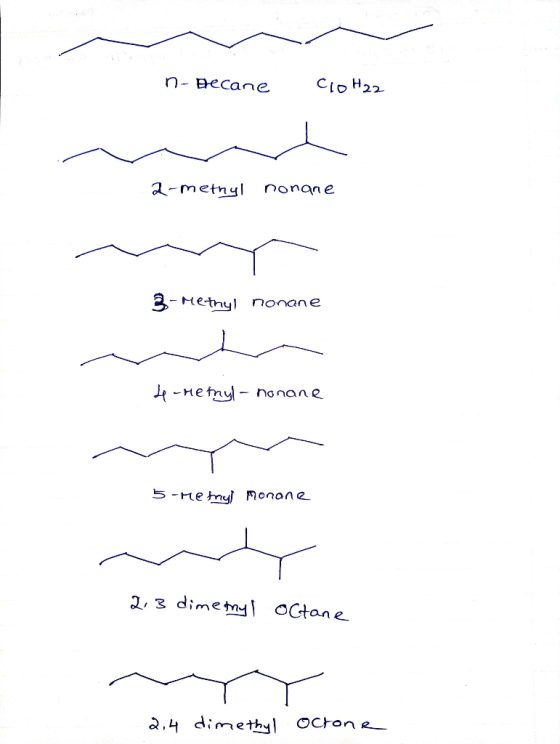
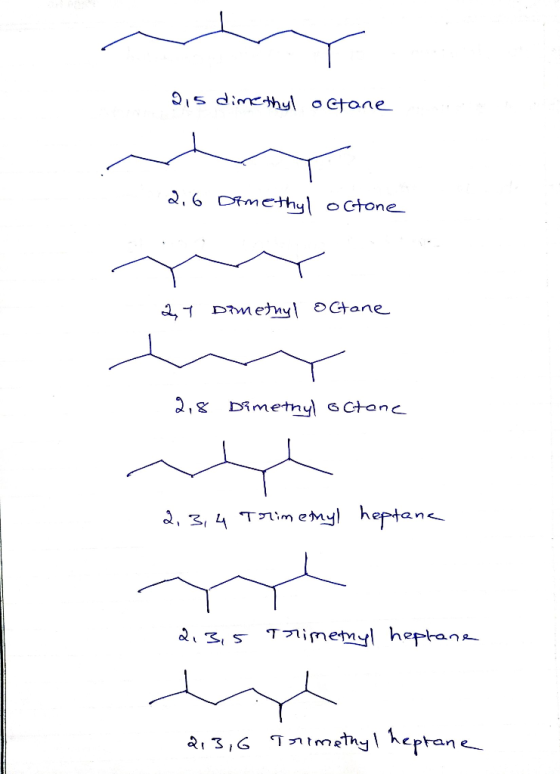
C10H22 acyclic isomers with no optical isomerism
Homework Answers

C10H18 acyclic hydrocarbon with 2 double bonds that has optical isomerism and with complete catalytic hydrogenation...
C10H18 acyclic hydrocarbon with 2 double bonds that has optical isomerism and with complete catalytic hydrogenation (H2/Ni) gives an alkane without optical isomerism
Write all the geometrical isomers of [Pt(NH3)(Br)(Cl)(py)] and how many of these will exhibit optical isomerism...
Write all the geometrical isomers of [Pt(NH3)(Br)(Cl)(py)] and how many of these will exhibit optical isomerism ? Here, py = Pyridine
FOTO UV 1. Which of the molecules shown can exhibit optical isomerism? Use an arrow to...
 FOTO UV 1. Which of the molecules shown can exhibit optical isomerism? Use an arrow to indicate the chiral center in each optically active molecule. OH NH2 CH3-CH-COOH glycine CH3CH-COOH lactic acids ОН row S1 HOCH CH-CH2OH cibo no glycerol DUO 2. In this experiment, you found that a molecule with one chiral center has two optical isomers, and a com- pound with two chiral centers has four optical isomers. How many optical isomers are possible for a com- pound...
Can someone explain why C is correct and how to tell if they exhibit optical isomerism...
 Can someone explain why C is correct and how to tell if they
exhibit optical isomerism or not.
Which of the following can exhibit optical isomerism?
Can someone explain why C is correct and how to tell if they
exhibit optical isomerism or not.
Which of the following can exhibit optical isomerism?
Determine whether the compound exhibits optical isomerism: CH_3CH_2CHClCH_3 yes no Part B Determine whether the compound...
 Determine whether the compound exhibits optical isomerism: CH_3CH_2CHClCH_3 yes no Part B Determine whether the compound exhibits optical isomerism: CH_3CCl_2CH_3 yes no Part D Determine whether the compound exhibits optical isomerism: yes no
Which of the following compounds can exhibit geometric isomerism (has cis-trans isomers)? Type the letter of...
 Which of the following compounds can exhibit geometric isomerism (has cis-trans isomers)? Type the letter of the compounds that can exhibit geometric isomerism in the box, capitalization and order do not matter (ABC is the same as bCa)
1) Describe optical isomerism in [Co" (en) Cl2] What is the oxidation state? What is the...
 1) Describe optical isomerism in [Co" (en) Cl2] What is the oxidation state? What is the d electron count? 2) Describe the octahedral crystal field of [Ti(H20)613* The Act has a "max = 20,300 cm-1 Explain what this value means?
which of the compounds can exist as optical isomers(enantiomers)
 which of the compounds can exist as optical isomers(enantiomers)
The complex [Co(NEt3)4(NCS)cl] can form cis and trans isomers and can also exhibit linkage isomerism. Draw...
 The complex [Co(NEt3)4(NCS)cl] can form cis and trans isomers and can also exhibit linkage isomerism. Draw both cis and trans forms and show how the linkage isomerism arises.
For each pair of isomers in the table below, indicate the type of isomerism that is...
 For each pair of isomers in the table below, indicate the type of isomerism that is present from the following list: chain, position, functional group, geometric (cis-trans), enantiomer 2. OH CH3CH2CH2OH CHяCHCHз CH3CH2OH CH30CH3 COOH HOOC Нас н он Hu C CHз но CI H H H CH3 CH3CH2CH2CH3 CH3CHCH3 3. Write the systematic IUPAC name of the compound:
 FOTO UV 1. Which of the molecules shown can exhibit optical isomerism? Use an arrow to indicate the chiral center in each optically active molecule. OH NH2 CH3-CH-COOH glycine CH3CH-COOH lactic acids ОН row S1 HOCH CH-CH2OH cibo no glycerol DUO 2. In this experiment, you found that a molecule with one chiral center has two optical isomers, and a com- pound with two chiral centers has four optical isomers. How many optical isomers are possible for a com- pound...
 Can someone explain why C is correct and how to tell if they
exhibit optical isomerism or not.
Which of the following can exhibit optical isomerism?
Can someone explain why C is correct and how to tell if they
exhibit optical isomerism or not.
Which of the following can exhibit optical isomerism?
 Determine whether the compound exhibits optical isomerism: CH_3CH_2CHClCH_3 yes no Part B Determine whether the compound exhibits optical isomerism: CH_3CCl_2CH_3 yes no Part D Determine whether the compound exhibits optical isomerism: yes no
 Which of the following compounds can exhibit geometric isomerism (has cis-trans isomers)? Type the letter of the compounds that can exhibit geometric isomerism in the box, capitalization and order do not matter (ABC is the same as bCa)
 1) Describe optical isomerism in [Co" (en) Cl2] What is the oxidation state? What is the d electron count? 2) Describe the octahedral crystal field of [Ti(H20)613* The Act has a "max = 20,300 cm-1 Explain what this value means?
 which of the compounds can exist as optical isomers(enantiomers)
 The complex [Co(NEt3)4(NCS)cl] can form cis and trans isomers and can also exhibit linkage isomerism. Draw both cis and trans forms and show how the linkage isomerism arises.
 For each pair of isomers in the table below, indicate the type of isomerism that is present from the following list: chain, position, functional group, geometric (cis-trans), enantiomer 2. OH CH3CH2CH2OH CHяCHCHз CH3CH2OH CH30CH3 COOH HOOC Нас н он Hu C CHз но CI H H H CH3 CH3CH2CH2CH3 CH3CHCH3 3. Write the systematic IUPAC name of the compound:
Most questions answered within 3 hours.
-
Where is the error in this code sequence?
String s1 = "Hello";
String s2 = "ello";...
asked 10 months ago -
Financial data for Joel de Paris, Inc., for last year
follow:
Joel de Paris, Inc.
Balance...
asked 10 months ago -
Consider this reaction:
Al2(SO4)3 (aq)+ BaCl3
(aq) Al2Cl6 (aq)- +
3BaSO4(s) . What is the...
asked 10 months ago -
Suppose that Savneet is considering increasing her
recent random sample from 20 car rentals to 40...
asked 10 months ago -
Trucks arrive at an unloading terminal at an average rate of 120
per hour.
Trucks arrive...
asked 10 months ago -
Why are methanol and ethanol completely soluble in water while
octanol is not very little soluble....
asked 10 months ago -
A facilities manager at a university reads in a research report
that the mean amount of...
asked 10 months ago -
When the CuSO4 is rehydrated by adding water to the anhydrous
compound, is this an endothermic...
asked 10 months ago -
A ray of sunlight is passing from diamond into crown glass; the
angle of incidence is...
asked 10 months ago -
A block of mass 0.249 kg is placed on top of a light, vertical
spring of...
asked 10 months ago -
how do the kidneys compensate in the presences of acidosis
a) trigger hyperventilate
b) reserve acid...
asked 10 months ago -
Question 501 pts
The rental rate of capital to the firm increases. Which of the
following...
asked 10 months ago