Most corporations pay quarterly dividends on their common stock rather than annual dividends. Barring any unusual...
|
Most corporations pay quarterly dividends on their common stock rather than annual dividends. Barring any unusual circumstances during the year, the board raises, lowers, or maintains the current dividend once a year and then pays this dividend out in equal quarterly installments to its shareholders. |
| a. |
Suppose a company currently pays an annual dividend of $6.00 on its common stock in a single annual installment, and management plans on raising this dividend by 5 percent per year indefinitely. If the required return on this stock is 14 percent, what is the current share price? (Do not round intermediate calculations and round your answer to 2 decimal places, e.g., 32.16.) |
| b. | Now suppose the company in (a) actually pays its annual dividend in equal quarterly installments; thus, the company has just paid a dividend of $1.50 per share, as it has for the previous three quarters. What is your value for the current share price now? (Hint: Find the equivalent annual end-of-year dividend for each year.) (Do not round intermediate calculations and round your answ |
Homework Answers
For this, we'd use the gordon growth model, which is :-
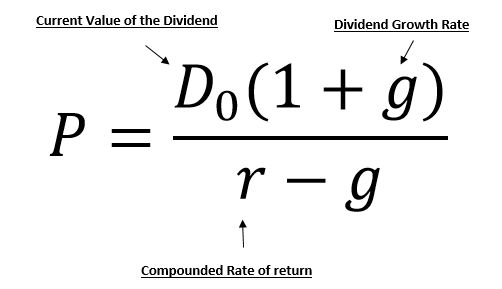
So, the price is
P = 6 * (1+5%) / (14%-5%)
= 70 $ / Share
For part B, The annual dividend is divided into four quarters. Hence, multiplying the per quarter dividend by 4 we get $6 Value for the dividend in the current year. Hence, the intrinsic value for the stock price would be same in this case too, as all the numbers would be the same as in part a.
Add Answer to:
Most corporations pay
quarterly dividends on their common stock rather than annual
dividends. Barring any unusual...
Most corporations pay quarterly dividends on their common stock rather than annual dividends. Barring any unusual ci...
Most corporations pay quarterly dividends on their common stock rather than annual dividends. Barring any unusual circumstances during the year, the board raises, lowers, or maintains the current dividend once a year and then pays this dividend out in equal quarterly installments to its shareholders. a. Suppose a company currently pays an annual dividend of $3.60 on its common stock in a single annual installment and management plans on raising this dividend by 2 percent per year, indefinitely. If the...
Problem 6-34 Stock Valuation Most corporations pay quarterly dividends on their common stock rather than annual...
Problem 6-34 Stock Valuation Most corporations pay quarterly dividends on their common stock rather than annual dividends. Barring any unusual circumstances during the year, the board raises, lowers, or maintains the current dividend once a year and then pays this dividend out in equal quarterly installments to its shareholders. a. Suppose a company currently pays an annual dividend of $2.80 on its common stock in a single annual installment, and management plans on raising this dividend by 5 percent per...
Problem 6-34 Stock Valuation Most corporations pay quarterly dividends on their common stock rather than annual...
 Problem 6-34 Stock Valuation Most corporations pay quarterly dividends on their common stock rather than annual dividends. Barring any unusual circumstances during the year, the board raises, lowers, or maintains the current dividend once a year and then pays this dividend out in equal quarterly installments to its shareholders. a. Suppose a company currently pays an annual dividend of $2.50 on its common stock in a single annual installment, and management plans on raising this dividend by 4 percent per...
Corporate Finance
 34. Stock Valuation Most corporations pay quarterly dividends on their common
stock rather than annual dividends. Barring any unusual circumstances during the
year, the board raises, lowers, or maintains the current dividend once a year and then
pays this dividend out in equal quarterly installments to its shareholders
a. Suppose a company currently pays a $3.20 annual dividend on its common stock
in a single annual installment, and management plans on raising this dividend by
Chapter 9 Stock Valuation
303...
34. Stock Valuation Most corporations pay quarterly dividends on their common
stock rather than annual dividends. Barring any unusual circumstances during the
year, the board raises, lowers, or maintains the current dividend once a year and then
pays this dividend out in equal quarterly installments to its shareholders
a. Suppose a company currently pays a $3.20 annual dividend on its common stock
in a single annual installment, and management plans on raising this dividend by
Chapter 9 Stock Valuation
303...
1.What is the value of a share of preferred stock that promises to pay a quarterly...
1.What is the value of a share of preferred stock that promises to pay a quarterly dividend of $1.87, indefinitely, if you have a required rate of return of 13.78%? (Round answer to 2 decimal places. Do not round intermediate calculations). 2. Magnetic Corporation just experienced a technological breakthrough in one of its primary divisions and expects dividends to grow at a rate of 13.0% for the next two years. After two years, dividends are expected to grow at a...
In practice, a common way to value a share of stock when a company pays dividends...
 In practice, a common way to value a share of stock when a company pays dividends is to value the dividends over the next five years or so, then find the "terminal" stock price using a benchmark PE o. Suppose a company just paid a dividend of $1.17. The dividends are expected to grow at 12 percent over the next five years. The company has a payout ratio of 40 percent and a benchmark PE of 19. The required return...
In practice, a common way to value a share of stock when a company pays dividends...
In practice, a common way to value a share of stock when a company pays dividends is to value the dividends over the next five years or so, then find the “terminal” stock price using a benchmark PE ratio. Suppose a company just paid a dividend of $1.21. The dividends are expected to grow at 16 percent over the next five years. The company has a payout ratio of 40 percent and a benchmark PE of 23. The required return...
"Finance3000" is a young start-up company. It will not pay any dividends on its stock over...
 "Finance3000" is a young start-up company. It will not pay any dividends on its stock over the next nine years because it plans to use retained earnings on expanding its business. "Finance3000" will pay a $12 per share dividend 10 years from today. After that the company will increase the dividend by 6 percent per year, in perpetuity. The required return on this stock is 11 percent. Calculate the value of one share of "Finance3000"'s stock. (Do not round intermediate...
The Herjavec Co just paid a dividend of 2.00 per share on its stock. The dividends...
 The
Herjavec Co just paid a dividend of 2.00 per share on its stock.
The dividends are expected to grow at a constant rate of 4 percent
per year indefinitely. Investors require a return of 12 percent on
the company's stock.
The Herjavec Co.just paid a dividend of $2.00 per share on its stock. The dividends are expected to grow at a constant rate of 4 percent per year indefinitely. Investors require a return of 12 percent on the company's...
The
Herjavec Co just paid a dividend of 2.00 per share on its stock.
The dividends are expected to grow at a constant rate of 4 percent
per year indefinitely. Investors require a return of 12 percent on
the company's stock.
The Herjavec Co.just paid a dividend of $2.00 per share on its stock. The dividends are expected to grow at a constant rate of 4 percent per year indefinitely. Investors require a return of 12 percent on the company's...
In practice, a common way to value a share of stock when a company pays dividends is to value the dividends over the...
In practice, a common way to value a share of stock when a company pays dividends is to value the dividends over the next five years or so, then find the “terminal” stock price using a benchmark PE ratio. Suppose a company just paid a dividend of $1.35. The dividends are expected to grow at 13 percent over the next five years. In five years, the estimated payout ratio is 35 percent and the benchmark PE ratio is 25. ...
 Problem 6-34 Stock Valuation Most corporations pay quarterly dividends on their common stock rather than annual dividends. Barring any unusual circumstances during the year, the board raises, lowers, or maintains the current dividend once a year and then pays this dividend out in equal quarterly installments to its shareholders. a. Suppose a company currently pays an annual dividend of $2.50 on its common stock in a single annual installment, and management plans on raising this dividend by 4 percent per...
 In practice, a common way to value a share of stock when a company pays dividends is to value the dividends over the next five years or so, then find the "terminal" stock price using a benchmark PE o. Suppose a company just paid a dividend of $1.17. The dividends are expected to grow at 12 percent over the next five years. The company has a payout ratio of 40 percent and a benchmark PE of 19. The required return...
 "Finance3000" is a young start-up company. It will not pay any dividends on its stock over the next nine years because it plans to use retained earnings on expanding its business. "Finance3000" will pay a $12 per share dividend 10 years from today. After that the company will increase the dividend by 6 percent per year, in perpetuity. The required return on this stock is 11 percent. Calculate the value of one share of "Finance3000"'s stock. (Do not round intermediate...
 The
Herjavec Co just paid a dividend of 2.00 per share on its stock.
The dividends are expected to grow at a constant rate of 4 percent
per year indefinitely. Investors require a return of 12 percent on
the company's stock.
The Herjavec Co.just paid a dividend of $2.00 per share on its stock. The dividends are expected to grow at a constant rate of 4 percent per year indefinitely. Investors require a return of 12 percent on the company's...
The
Herjavec Co just paid a dividend of 2.00 per share on its stock.
The dividends are expected to grow at a constant rate of 4 percent
per year indefinitely. Investors require a return of 12 percent on
the company's stock.
The Herjavec Co.just paid a dividend of $2.00 per share on its stock. The dividends are expected to grow at a constant rate of 4 percent per year indefinitely. Investors require a return of 12 percent on the company's...
Most questions answered within 3 hours.
-
Where is the error in this code sequence?
String s1 = "Hello";
String s2 = "ello";...
asked 11 months ago -
Financial data for Joel de Paris, Inc., for last year
follow:
Joel de Paris, Inc.
Balance...
asked 11 months ago -
Consider this reaction:
Al2(SO4)3 (aq)+ BaCl3
(aq) Al2Cl6 (aq)- +
3BaSO4(s) . What is the...
asked 11 months ago -
Suppose that Savneet is considering increasing her
recent random sample from 20 car rentals to 40...
asked 11 months ago -
Trucks arrive at an unloading terminal at an average rate of 120
per hour.
Trucks arrive...
asked 11 months ago -
Why are methanol and ethanol completely soluble in water while
octanol is not very little soluble....
asked 11 months ago -
A facilities manager at a university reads in a research report
that the mean amount of...
asked 11 months ago -
When the CuSO4 is rehydrated by adding water to the anhydrous
compound, is this an endothermic...
asked 11 months ago -
A ray of sunlight is passing from diamond into crown glass; the
angle of incidence is...
asked 11 months ago -
A block of mass 0.249 kg is placed on top of a light, vertical
spring of...
asked 11 months ago -
how do the kidneys compensate in the presences of acidosis
a) trigger hyperventilate
b) reserve acid...
asked 11 months ago -
Question 501 pts
The rental rate of capital to the firm increases. Which of the
following...
asked 11 months ago