
Homework Answers
Add Answer to:
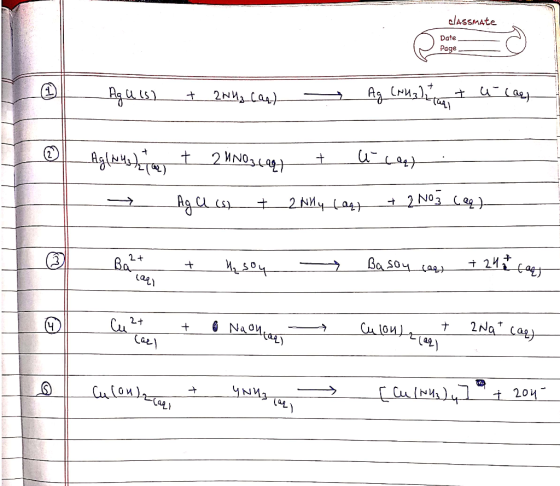
Questions 1-5
For #1 - #5 questions of Exp. 16, complete the following chemical reaction equations...
16 Cts with aqueous copper(II) chloride accord- 101. Zinc metal reacts with aqueous copper(1) ing to...
 16 Cts with aqueous copper(II) chloride accord- 101. Zinc metal reacts with aqueous copper(1) ing to this equation: Zn (s) + CuCl2 (aq) → ZnCl2 (aq) + Cu (s) In this reaction, what mass of copper metal can be pro- duced from the reaction of 500 mL of 1.20-M aq. cu 2 with excess zinc? 10 103. The concentration of bromide ion may be determined by gravimetric analysis, using this reaction: Ag+ (aq) + Br (aq) → AgBr (s) A...
Another form of this equation (called the complete ionic equation) indicates the species that are actually...
 Another form of this equation (called the complete ionic equation) indicates the species that are actually present in solution. 2Na+ + CO32-+2hr + 2 cr . 4 co2 +H2O + 2 Na. + 2 cr Since balanced chemical equations indicate only substances that change, this equation simplifies to This simplified equation is called a net ionic equation. The evolution of CO2 gas is visible as tiny bubbles. Sulfate, so2 Sulfate, So,, is found in compounds such as NaSO4. If a...
Review equation 16.10 and step B2. Ag+1(aq) and NH3(aq) will form a soluble complex ion. Use...
Review equation 16.10 and step B2. Ag+1(aq) and NH3(aq) will form a soluble complex ion. Use rule 3 of Water-Insoluble Salts in Appendix E to determine what would happen if Ag+1(aq) was combined with KOH instead of NH3. Write the net ionic equation with phase subscripts, where K+1 is a spectator ion which is cancelled out. Equation 16.10: Ag^+(aq) + Cl^-(aq) ⇄ AgCl(s) ⇅ 2NH3(aq) [Ag(NH3)2]^+(aq) Step B2: Silver Chloride equilibrium. To the clear solution from part B.1, add 5...
1. Convert each of the following names into chemical formulas and then balance the reaction. Make...
 1. Convert each of the following names into chemical formulas and then balance the reaction. Make sure you include phases for each reactant and product in the reaction. (s = solid. 1 = liquid, g = gas, aq = aqueous) a. Zinc solid reacts with aqueous silver nitrate to form aqueous zinc nitrate and silver metal. b. Aqueous sodium hydroxide reacts with aqueous oxalic acid to form aqueous sodium oxa- late and liquid water. c. Aqueous lithium phosphate is reacted...
Chemical Reactions For each reaction you observed, the names of the reactants and products are given...
 Chemical Reactions For each reaction you observed, the names of the reactants and products are given below. You must: 1. Write the correct formula for each reactant and product. Balance each equation. 2. A. Combination reactions magnesium oxide 1. Magnesium + oxygen (unbalanced) Mg+ O, MgO sulfur dioxide 2. Sulfur + oxygen B. Analysis of the Copper Content of a Penny po zinc chloride + hydrogen zinc + hydrochloric acid HCI ZnCl, 1. (unbalanced) н, Zn + C. Single Replacement...
In an ammonia solution, the silver ion, Ag, forms the colorless, but soluble diamminesilver(I) complex ion,...
 In an ammonia solution, the silver ion, Ag, forms the colorless, but soluble diamminesilver(I) complex ion, Ag(NH3)2. If ammonia is added to a solution that contains an AgCI precipitate, the solid dissolves completely. Write a net-ionic equation for the equilibrium involved and explain the shift that takes place. Choose the best answer. AgCl(s) +2 NH3(a)Ag(NH3)2 (aa) C(aq) Adding ammonia to AgCl(s) dissolves the solid by displacing chloride ions with ammonia molecules, forming a soluble complex ion Ag (a2 NH3(aq) Ag(NH32...
The value of the equilibrium constant for the following chemical equation is Kc = 5.2 ×10³...
The value of the equilibrium constant for the following chemical equation is Kc = 5.2 ×10³ AgCl (s) + 2S2O32-<-->[Ag(S2O3)2]3- (aq) + Cl– (aq) Calculate the solubility of AgCl (s) in an aqueous solution whose equilibrium concentration of S2O32- is 0.015 M. Ksp = 1.8 × 10⁻¹⁰ M2 for AgCl
please write legible 1. Identify each of the following reactions as a precipitation reaction, an acid-base...
 please write legible
1. Identify each of the following reactions as a precipitation reaction, an acid-base reaction, or as a redox reaction + a. Pb(NO3)2 (aq) + 2 HCl(aq) PbCl (s) + 2 HNO, (aq) b. 2 Hxe + O2 + 2 H2O c. HNO, (aq) + KOH(aq) KNO, (aq) + H20 (1) d. Zna + 2HCl(a) - ZnClaraq) + Halle e. Ba?'(aq) + 2 Br(aq) + 2 Na(aq) + SO/"(aq) BaSO. (s) + 2 Na'(aq) + 2 Br" (aq)...
please write legible
1. Identify each of the following reactions as a precipitation reaction, an acid-base reaction, or as a redox reaction + a. Pb(NO3)2 (aq) + 2 HCl(aq) PbCl (s) + 2 HNO, (aq) b. 2 Hxe + O2 + 2 H2O c. HNO, (aq) + KOH(aq) KNO, (aq) + H20 (1) d. Zna + 2HCl(a) - ZnClaraq) + Halle e. Ba?'(aq) + 2 Br(aq) + 2 Na(aq) + SO/"(aq) BaSO. (s) + 2 Na'(aq) + 2 Br" (aq)...
I need the chemical equation and net ionic equation for the following : 1. The reaction...
I need the chemical equation and net ionic equation for the following : 1. The reaction of the aqueous copper (II) ion with aqueous iodate ion. 2. The reaction of solid copper (II) chloride with aqueous ammonia to form the aqueous tetraammine copper (II) complex ion.
1. Convert each of the following names into the following names into chemical formulas and then balance the reaction. K...
 1. Convert each of the following names into the following names into chemical formulas and then balance the reaction. Ke sure you include phases for each reactant and product in the reaction. I = liquid, g = gas, aq = aqueous) 4 dinc solid reacts with aqueous silver nitrate to form aqueous zinc nitrate and silver metal. b. Aqueous sodium hydroxide reacts with aqueous oxalic acid to form aqueous sodium oxa- late and liquid water. c. Aqueous lithium phosphate is...
 16 Cts with aqueous copper(II) chloride accord- 101. Zinc metal reacts with aqueous copper(1) ing to this equation: Zn (s) + CuCl2 (aq) → ZnCl2 (aq) + Cu (s) In this reaction, what mass of copper metal can be pro- duced from the reaction of 500 mL of 1.20-M aq. cu 2 with excess zinc? 10 103. The concentration of bromide ion may be determined by gravimetric analysis, using this reaction: Ag+ (aq) + Br (aq) → AgBr (s) A...
 Another form of this equation (called the complete ionic equation) indicates the species that are actually present in solution. 2Na+ + CO32-+2hr + 2 cr . 4 co2 +H2O + 2 Na. + 2 cr Since balanced chemical equations indicate only substances that change, this equation simplifies to This simplified equation is called a net ionic equation. The evolution of CO2 gas is visible as tiny bubbles. Sulfate, so2 Sulfate, So,, is found in compounds such as NaSO4. If a...
 1. Convert each of the following names into chemical formulas and then balance the reaction. Make sure you include phases for each reactant and product in the reaction. (s = solid. 1 = liquid, g = gas, aq = aqueous) a. Zinc solid reacts with aqueous silver nitrate to form aqueous zinc nitrate and silver metal. b. Aqueous sodium hydroxide reacts with aqueous oxalic acid to form aqueous sodium oxa- late and liquid water. c. Aqueous lithium phosphate is reacted...
 Chemical Reactions For each reaction you observed, the names of the reactants and products are given below. You must: 1. Write the correct formula for each reactant and product. Balance each equation. 2. A. Combination reactions magnesium oxide 1. Magnesium + oxygen (unbalanced) Mg+ O, MgO sulfur dioxide 2. Sulfur + oxygen B. Analysis of the Copper Content of a Penny po zinc chloride + hydrogen zinc + hydrochloric acid HCI ZnCl, 1. (unbalanced) н, Zn + C. Single Replacement...
 In an ammonia solution, the silver ion, Ag, forms the colorless, but soluble diamminesilver(I) complex ion, Ag(NH3)2. If ammonia is added to a solution that contains an AgCI precipitate, the solid dissolves completely. Write a net-ionic equation for the equilibrium involved and explain the shift that takes place. Choose the best answer. AgCl(s) +2 NH3(a)Ag(NH3)2 (aa) C(aq) Adding ammonia to AgCl(s) dissolves the solid by displacing chloride ions with ammonia molecules, forming a soluble complex ion Ag (a2 NH3(aq) Ag(NH32...
 please write legible
1. Identify each of the following reactions as a precipitation reaction, an acid-base reaction, or as a redox reaction + a. Pb(NO3)2 (aq) + 2 HCl(aq) PbCl (s) + 2 HNO, (aq) b. 2 Hxe + O2 + 2 H2O c. HNO, (aq) + KOH(aq) KNO, (aq) + H20 (1) d. Zna + 2HCl(a) - ZnClaraq) + Halle e. Ba?'(aq) + 2 Br(aq) + 2 Na(aq) + SO/"(aq) BaSO. (s) + 2 Na'(aq) + 2 Br" (aq)...
please write legible
1. Identify each of the following reactions as a precipitation reaction, an acid-base reaction, or as a redox reaction + a. Pb(NO3)2 (aq) + 2 HCl(aq) PbCl (s) + 2 HNO, (aq) b. 2 Hxe + O2 + 2 H2O c. HNO, (aq) + KOH(aq) KNO, (aq) + H20 (1) d. Zna + 2HCl(a) - ZnClaraq) + Halle e. Ba?'(aq) + 2 Br(aq) + 2 Na(aq) + SO/"(aq) BaSO. (s) + 2 Na'(aq) + 2 Br" (aq)...
 1. Convert each of the following names into the following names into chemical formulas and then balance the reaction. Ke sure you include phases for each reactant and product in the reaction. I = liquid, g = gas, aq = aqueous) 4 dinc solid reacts with aqueous silver nitrate to form aqueous zinc nitrate and silver metal. b. Aqueous sodium hydroxide reacts with aqueous oxalic acid to form aqueous sodium oxa- late and liquid water. c. Aqueous lithium phosphate is...
Most questions answered within 3 hours.
-
Where is the error in this code sequence?
String s1 = "Hello";
String s2 = "ello";...
asked 11 months ago -
Financial data for Joel de Paris, Inc., for last year
follow:
Joel de Paris, Inc.
Balance...
asked 11 months ago -
Consider this reaction:
Al2(SO4)3 (aq)+ BaCl3
(aq) Al2Cl6 (aq)- +
3BaSO4(s) . What is the...
asked 11 months ago -
Suppose that Savneet is considering increasing her
recent random sample from 20 car rentals to 40...
asked 11 months ago -
Trucks arrive at an unloading terminal at an average rate of 120
per hour.
Trucks arrive...
asked 11 months ago -
Why are methanol and ethanol completely soluble in water while
octanol is not very little soluble....
asked 11 months ago -
A facilities manager at a university reads in a research report
that the mean amount of...
asked 11 months ago -
When the CuSO4 is rehydrated by adding water to the anhydrous
compound, is this an endothermic...
asked 11 months ago -
A ray of sunlight is passing from diamond into crown glass; the
angle of incidence is...
asked 11 months ago -
A block of mass 0.249 kg is placed on top of a light, vertical
spring of...
asked 11 months ago -
how do the kidneys compensate in the presences of acidosis
a) trigger hyperventilate
b) reserve acid...
asked 11 months ago -
Question 501 pts
The rental rate of capital to the firm increases. Which of the
following...
asked 11 months ago