
Homework Answers
| Shift in the direction of the products | Shift in the direction of the reactants | equilibrium does not change |
3 O2 (g)  2 O3 (g)
 |
4 NH3 (g) + 5 O2 (g)
4 NO (g) + 6 H2O (g) |
|
| 2 NOBr (g)
2 NO (g) + Br2 (g) |
Explanation
Decrease in volume of container will favor that side of equilibrium which has less gaseous species.
Add Answer to:
Part A Would decreasing the volume of the container for each of the following reactions cause...
Determine whether each reaction indicates an endothermic or an exothermic reaction. Drag the appropriate items to...
 Determine whether each reaction indicates an endothermic or an exothermic reaction. Drag the appropriate items to their respective bins. View Available Hint(s) Reset Help AB(1)-A() +B(1) 4NH3(g) +502(g) 4NO(g) + 6H2(gC(s) + H2O(g)-CO() +H,($) energy of reactants = - 184 k1ergy of reactants = -242 kJC(s) + energy of products = - 1086 k malergy of products = - 111 kJ/mot 0,() +CO(g) Exothermic Endothermic
For the following equilibrium reaction, predict the direction of the equilibrium shift by specifying if each...
For the following equilibrium reaction, predict the direction of the equilibrium shift by specifying if each stress will cause the concentration of reactants or products to increase NH3(g)+H2O(l) ⇋ NH4+(aq)+OH−(aq) Drag the appropriate stresses to their respective bins. Adding NH4+(aq) Adding NH3(g) Adding OH-(aq) Removing NH4+(aq) Removing OH-(aq) Shifts in the direction of the reactants: Shift in the direction of the products:
6. For the following reaction at equilibrium, which change will cause the equilibrium to shift to...
 6. For the following reaction at equilibrium, which change will cause the equilibrium to shift to the left? sle . 2NOBr(g) = 2NO(g) + Br2(g) AH®rxn = 30 kJ/mol A) Decrease the temperature.se (0.5 pt) B) Increase the temperature. C) Increase the container volume. D) Remove some NO. E) Add more NOBr. DOLDS F) Remove some Br2.
Without doing any calculations, determine the sign of ΔSsysΔSsys for each of the following chemical reactions....
 Without doing any calculations, determine the sign of ΔSsysΔSsys
for each of the following chemical reactions.
Drag the appropriate items to their respective bins.
Part A Without doing any calculations, determine the sign of ASsys for each of the following chemical reactions. Drag the appropriate items to their respective bins. Reset Help + CH=CH(g) + H2(g)→ CH2=CH2(g) 2NO(g) + O2(g) +2NO2(g) 4Li(s) + O2(g) +2Li20(s) 2KMnO4(s)→ K2MnO4(s) + MnO2(s) + O2(g) ASsys > 0 ASsys < 0
Without doing any calculations, determine the sign of ΔSsysΔSsys
for each of the following chemical reactions.
Drag the appropriate items to their respective bins.
Part A Without doing any calculations, determine the sign of ASsys for each of the following chemical reactions. Drag the appropriate items to their respective bins. Reset Help + CH=CH(g) + H2(g)→ CH2=CH2(g) 2NO(g) + O2(g) +2NO2(g) 4Li(s) + O2(g) +2Li20(s) 2KMnO4(s)→ K2MnO4(s) + MnO2(s) + O2(g) ASsys > 0 ASsys < 0
Given the reaction below, which of the following would cause an increase in the concentration of...
Given the reaction below, which of the following would cause an increase in the concentration of products? 4NH3(g) + 3O2(g) <=> 2N2(g) + 6H2O(g) A. addition of water B. removal of ammonia C. adding a catalyst D. decreasing the volume of the container E. There is no way to increase the concentration of products in the equilibrium reaction.
Chapter 9 59. The following sequence of reactions occurs in the commercial production of aqueous nitric...
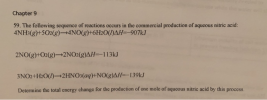 Chapter 9 59. The following sequence of reactions occurs in the commercial production of aqueous nitric acid: 4NH3(g)+502(g)-4NO(g)+6H2O(1)AH=-907kJ 2NO(g)+O2(g)—2NO2(g)AH--113kJ 3NO2+H2O(1)-2HNO3(aq)+NO(g)AH--139kJ Determine the total energy change for the production of one mole of aqueous nitric acid by this process.
Predict whether each of the following reactions contains mostly reactants or products AT EQUILIBRIUM the formulas ar...
 Predict whether each of the following reactions contains mostly
reactants or products AT EQUILIBRIUM
the formulas are :
CO3^2- (aq) + H2O (l) <---> HCO3^-)aq) + OH^- (aq)
NH4^+(aq) + OH^- <-->NH3 (aq) +H2O(l)
H2S (aq) + F^-(aq)+HS^-(aq)
please do not break apart the formulas and tell me what is the
product and reactant like the previous person did. I want to know
which formula is which at equalibrium as a whole formula
Predict whether each of the following reactions...
Predict whether each of the following reactions contains mostly
reactants or products AT EQUILIBRIUM
the formulas are :
CO3^2- (aq) + H2O (l) <---> HCO3^-)aq) + OH^- (aq)
NH4^+(aq) + OH^- <-->NH3 (aq) +H2O(l)
H2S (aq) + F^-(aq)+HS^-(aq)
please do not break apart the formulas and tell me what is the
product and reactant like the previous person did. I want to know
which formula is which at equalibrium as a whole formula
Predict whether each of the following reactions...
Part A Classily the following reactions as synthesis, decomposition, single-displacement, or double-displacement reactions Drag the items...
 Part A Classily the following reactions as synthesis, decomposition, single-displacement, or double-displacement reactions Drag the items to their respective bins. View Available Hint(s) Reset Help CH,+Br2 - CH_Br2 2H, 0 2H2 +02 2Pb(NO3)2 - 2PbO + 4NO2 + O2 8C + S 8Cas Na2CO3 + 2HCI 2NaCl + H2CO, Mg + 2HCI - MgCl2 + H2 2NO - N2+0) NOM Pb(NO3)2 + 2Naci - 2NaNO3 + PbCl2 Synthesis Decomposition Single-displacement Double-displacement Submit
Tedict and explain whether the follo ind explain whether the following reactions will be nonspontaneous at all temp...
 Tedict and explain whether the follo ind explain whether the following reactions will be nonspontaneous at all temperatures or spontaneous at all, low, or high temperatures. (a) 2POCI(8) ► 2PC(s) + O2(8) Air - 572 3; AS - 179 3K (b) 302(g) → 203(g) AF - 286 kJ; AS = -1373/ (c) 4NH3(g) + 502(g) → 4NO(g) + 6H2O() AH = -1274 kJ; AS = 180 J/K (d) 2PbS(s) + 302(g) → 2PbO(s) + 2502(8) AH = -844 kJ; AS...
For each of the following reactions, use the pKa values given in the Table to predict...
 For
each of the following reactions, use the pKa values given in the
Table to predict whether reactants or products are favored at
equilibrium.
For each of the following reactions, use the pKa values given in the Table to predict whether reactants or products are favored at equilibrium Compound Hydronium ion (H30*) Dichloroacetic acid (C2H202Cl2) Dihydrogen sulfide (H2S) Phenol (C6H5OH) Piperidinium ion (C5H12N*) Water (H20) pKa 1.7 1.35 7.0 10.0 11.2 15.7 Drag the appropriate items to their respective bins....
For
each of the following reactions, use the pKa values given in the
Table to predict whether reactants or products are favored at
equilibrium.
For each of the following reactions, use the pKa values given in the Table to predict whether reactants or products are favored at equilibrium Compound Hydronium ion (H30*) Dichloroacetic acid (C2H202Cl2) Dihydrogen sulfide (H2S) Phenol (C6H5OH) Piperidinium ion (C5H12N*) Water (H20) pKa 1.7 1.35 7.0 10.0 11.2 15.7 Drag the appropriate items to their respective bins....
 Determine whether each reaction indicates an endothermic or an exothermic reaction. Drag the appropriate items to their respective bins. View Available Hint(s) Reset Help AB(1)-A() +B(1) 4NH3(g) +502(g) 4NO(g) + 6H2(gC(s) + H2O(g)-CO() +H,($) energy of reactants = - 184 k1ergy of reactants = -242 kJC(s) + energy of products = - 1086 k malergy of products = - 111 kJ/mot 0,() +CO(g) Exothermic Endothermic
 6. For the following reaction at equilibrium, which change will cause the equilibrium to shift to the left? sle . 2NOBr(g) = 2NO(g) + Br2(g) AH®rxn = 30 kJ/mol A) Decrease the temperature.se (0.5 pt) B) Increase the temperature. C) Increase the container volume. D) Remove some NO. E) Add more NOBr. DOLDS F) Remove some Br2.
 Without doing any calculations, determine the sign of ΔSsysΔSsys
for each of the following chemical reactions.
Drag the appropriate items to their respective bins.
Part A Without doing any calculations, determine the sign of ASsys for each of the following chemical reactions. Drag the appropriate items to their respective bins. Reset Help + CH=CH(g) + H2(g)→ CH2=CH2(g) 2NO(g) + O2(g) +2NO2(g) 4Li(s) + O2(g) +2Li20(s) 2KMnO4(s)→ K2MnO4(s) + MnO2(s) + O2(g) ASsys > 0 ASsys < 0
Without doing any calculations, determine the sign of ΔSsysΔSsys
for each of the following chemical reactions.
Drag the appropriate items to their respective bins.
Part A Without doing any calculations, determine the sign of ASsys for each of the following chemical reactions. Drag the appropriate items to their respective bins. Reset Help + CH=CH(g) + H2(g)→ CH2=CH2(g) 2NO(g) + O2(g) +2NO2(g) 4Li(s) + O2(g) +2Li20(s) 2KMnO4(s)→ K2MnO4(s) + MnO2(s) + O2(g) ASsys > 0 ASsys < 0
 Chapter 9 59. The following sequence of reactions occurs in the commercial production of aqueous nitric acid: 4NH3(g)+502(g)-4NO(g)+6H2O(1)AH=-907kJ 2NO(g)+O2(g)—2NO2(g)AH--113kJ 3NO2+H2O(1)-2HNO3(aq)+NO(g)AH--139kJ Determine the total energy change for the production of one mole of aqueous nitric acid by this process.
 Predict whether each of the following reactions contains mostly
reactants or products AT EQUILIBRIUM
the formulas are :
CO3^2- (aq) + H2O (l) <---> HCO3^-)aq) + OH^- (aq)
NH4^+(aq) + OH^- <-->NH3 (aq) +H2O(l)
H2S (aq) + F^-(aq)+HS^-(aq)
please do not break apart the formulas and tell me what is the
product and reactant like the previous person did. I want to know
which formula is which at equalibrium as a whole formula
Predict whether each of the following reactions...
Predict whether each of the following reactions contains mostly
reactants or products AT EQUILIBRIUM
the formulas are :
CO3^2- (aq) + H2O (l) <---> HCO3^-)aq) + OH^- (aq)
NH4^+(aq) + OH^- <-->NH3 (aq) +H2O(l)
H2S (aq) + F^-(aq)+HS^-(aq)
please do not break apart the formulas and tell me what is the
product and reactant like the previous person did. I want to know
which formula is which at equalibrium as a whole formula
Predict whether each of the following reactions...
 Part A Classily the following reactions as synthesis, decomposition, single-displacement, or double-displacement reactions Drag the items to their respective bins. View Available Hint(s) Reset Help CH,+Br2 - CH_Br2 2H, 0 2H2 +02 2Pb(NO3)2 - 2PbO + 4NO2 + O2 8C + S 8Cas Na2CO3 + 2HCI 2NaCl + H2CO, Mg + 2HCI - MgCl2 + H2 2NO - N2+0) NOM Pb(NO3)2 + 2Naci - 2NaNO3 + PbCl2 Synthesis Decomposition Single-displacement Double-displacement Submit
 Tedict and explain whether the follo ind explain whether the following reactions will be nonspontaneous at all temperatures or spontaneous at all, low, or high temperatures. (a) 2POCI(8) ► 2PC(s) + O2(8) Air - 572 3; AS - 179 3K (b) 302(g) → 203(g) AF - 286 kJ; AS = -1373/ (c) 4NH3(g) + 502(g) → 4NO(g) + 6H2O() AH = -1274 kJ; AS = 180 J/K (d) 2PbS(s) + 302(g) → 2PbO(s) + 2502(8) AH = -844 kJ; AS...
 For
each of the following reactions, use the pKa values given in the
Table to predict whether reactants or products are favored at
equilibrium.
For each of the following reactions, use the pKa values given in the Table to predict whether reactants or products are favored at equilibrium Compound Hydronium ion (H30*) Dichloroacetic acid (C2H202Cl2) Dihydrogen sulfide (H2S) Phenol (C6H5OH) Piperidinium ion (C5H12N*) Water (H20) pKa 1.7 1.35 7.0 10.0 11.2 15.7 Drag the appropriate items to their respective bins....
For
each of the following reactions, use the pKa values given in the
Table to predict whether reactants or products are favored at
equilibrium.
For each of the following reactions, use the pKa values given in the Table to predict whether reactants or products are favored at equilibrium Compound Hydronium ion (H30*) Dichloroacetic acid (C2H202Cl2) Dihydrogen sulfide (H2S) Phenol (C6H5OH) Piperidinium ion (C5H12N*) Water (H20) pKa 1.7 1.35 7.0 10.0 11.2 15.7 Drag the appropriate items to their respective bins....
Most questions answered within 3 hours.
-
Where is the error in this code sequence?
String s1 = "Hello";
String s2 = "ello";...
asked 10 months ago -
Financial data for Joel de Paris, Inc., for last year
follow:
Joel de Paris, Inc.
Balance...
asked 10 months ago -
Consider this reaction:
Al2(SO4)3 (aq)+ BaCl3
(aq) Al2Cl6 (aq)- +
3BaSO4(s) . What is the...
asked 10 months ago -
Suppose that Savneet is considering increasing her
recent random sample from 20 car rentals to 40...
asked 10 months ago -
Trucks arrive at an unloading terminal at an average rate of 120
per hour.
Trucks arrive...
asked 10 months ago -
Why are methanol and ethanol completely soluble in water while
octanol is not very little soluble....
asked 10 months ago -
A facilities manager at a university reads in a research report
that the mean amount of...
asked 10 months ago -
When the CuSO4 is rehydrated by adding water to the anhydrous
compound, is this an endothermic...
asked 10 months ago -
A ray of sunlight is passing from diamond into crown glass; the
angle of incidence is...
asked 10 months ago -
A block of mass 0.249 kg is placed on top of a light, vertical
spring of...
asked 10 months ago -
how do the kidneys compensate in the presences of acidosis
a) trigger hyperventilate
b) reserve acid...
asked 10 months ago -
Question 501 pts
The rental rate of capital to the firm increases. Which of the
following...
asked 10 months ago