
Homework Answers
Add Answer to:
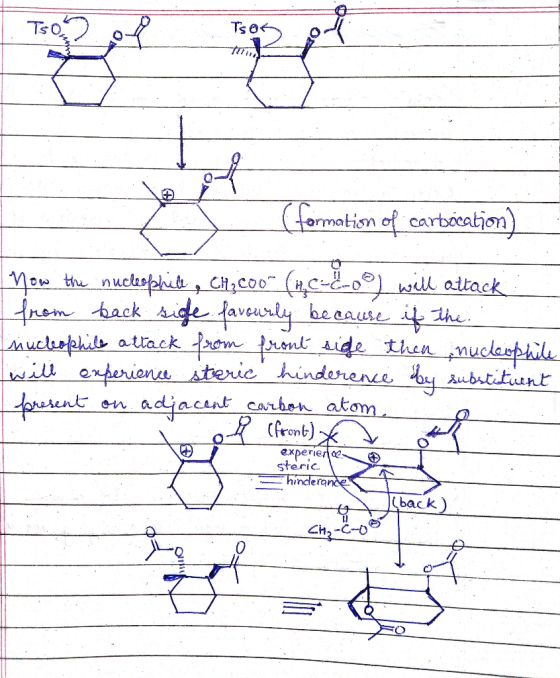
1. The following reactions begin with starting materials of differing stereochemistry yet each provide the same...
1. The following reactions begin with starting materials of differing stereochemistry yet each provide the same...
 1. The following reactions begin with starting materials of differing stereochemistry yet each provide the same stereoisomer of the product. Explain this observation using an arrow-pushing mechanism Tso сH,со; CH-со,н TsO CH,со, CH3CO2H
For each of the following reactions, provide the product with proper stereochemistry if applicable. In addition,...
 For each of the following reactions, provide the product with proper stereochemistry if applicable. In addition, draw the arrow-pushing mechanism for the reaction. 1. CH HCI 2. CH HBr ROOR 3. CH, Н,0 H, SO 4. CH3 1. Hg(OA), 2. NaBH + 5. CH, 1. BH, THF 2. HO, NaOH
(10 points) Provide the Starting Materials/Reagents/Major Products for the following transformations. YOU MUST INDICATE STEREOCHEMISTRY AS...
 (10 points) Provide the Starting Materials/Reagents/Major Products for the following transformations. YOU MUST INDICATE STEREOCHEMISTRY AS NEEDED. (You may use asterisks to indicate an equal mixture of the two isomers at a given stereocenter). For each of these reactions, show a detailed arrow pushing mechanism (For problems b, c, and d, only show the first step of the mechanism) H.O. Me Me 1) BD, THF d) 2) D202 OD tBu e) Ch DCM
1. Provide the missing starting materials, reagents, or products in each of the following reactions. H+...
 1. Provide the missing starting materials, reagents, or products in each of the following reactions. H+ OH CH,OH NaOH Meo NH2 room temp. HO OH Meo Me ОН Meo 2. Provide appropriate conditions to convert each of the following starting mana hexanoic acid (some transformations may require more than one step): It each of the following starting materials into OH OH ОMe "NH₂
3. Provide a full arrow-pushing mechanism for each of the following reactions. Wood CHAMBRE Cascos - LX i. CH3MgBr...
 3. Provide a full arrow-pushing mechanism for each of the following reactions. Wood CHAMBRE Cascos - LX i. CH3MgBr (excess) ii. H+ OH OCH; 4. Provide the major product of the following reaction and provide a mechanism for its formation. HO1 OH A 5. You need to synthesize a large amount of molecule C, and you have just enough of each of molecules A and B in your chemical inventory. Provide a synthetic route showing how you can efficiently synthesize...
3. Provide the reagents necessary to carry out the following reactions or provide the starting materials...
 3. Provide the reagents necessary to carry out the following reactions or provide the starting materials or major products of the following reactions, Indicate racemic mixtures where necessary. (39 pts) 1)AIC осн, a. Ph 2) PaC H Н,со 45 1) HS0, HNO b. 2) Pd/c. H Н,со он c. Ph HO, он
6) Draw the starting materials required to make the following product. 5pts A fi 7) Provide...
 6) Draw the starting materials required to make the following product. 5pts A fi 7) Provide the mechanism, including arrow pushing, for the following reaction. 2pts 8) Which of these dienes is capable of undergoing the Diels Alder reaction? 3pts 0.84 K 0$ D С
Q2. Provide the missing information of the following reactions. (such as reagents, starting materials, products_etc.) 21...
 Q2. Provide the missing information of the following reactions. (such as reagents, starting materials, products_etc.) 21 1. CH,CH-CH=PP 1-Propanol 2-methylpentan-3-one H+, heat H2N Н. + HO- Н HO- + Y. H trace HCI H НО. OH H3C сн. H30.4 H2CH2CO OCH CH3
For each of the following reactions, draw the structure of the major organic product in the...
 For each of the following reactions, draw the structure of the major organic product in the box provided. Each numbered set of reagents above or below the arrow represents a complete separate reaction. For multi-step reactions, give only the structure of the final product. ETOA earrangement Oceurs H,PO Reagement Our KOCH.CH HOCH-CH, Show Specific Stereochemistry CH,CHE + CH -CH NaOCH, HOCH OCH) Show Specific Stereochemistry KOCH.CH HOCH.CH KOB HO.Bu Provide a complete, stepwise mechanism to explain the following transformation. Be...
2. (16 pts) Reactions Provide reagents, products or starting materials for the following reactions. Show stereochemistry...
 2. (16 pts) Reactions Provide reagents, products or starting materials for the following reactions. Show stereochemistry when relevant (or loss thereof). If a reaction produces no significant products, write "NR". If you have a question about an abbreviation, just ask. NaBr OH 1. TsCI 2. Nal, DMF CI DMSO OH 1. PBrg NaCN 2. KOC(CH3)3 Ether LDA НОН THE NaH NaH PO Acetone Heat, water
 1. The following reactions begin with starting materials of differing stereochemistry yet each provide the same stereoisomer of the product. Explain this observation using an arrow-pushing mechanism Tso сH,со; CH-со,н TsO CH,со, CH3CO2H
 For each of the following reactions, provide the product with proper stereochemistry if applicable. In addition, draw the arrow-pushing mechanism for the reaction. 1. CH HCI 2. CH HBr ROOR 3. CH, Н,0 H, SO 4. CH3 1. Hg(OA), 2. NaBH + 5. CH, 1. BH, THF 2. HO, NaOH
 (10 points) Provide the Starting Materials/Reagents/Major Products for the following transformations. YOU MUST INDICATE STEREOCHEMISTRY AS NEEDED. (You may use asterisks to indicate an equal mixture of the two isomers at a given stereocenter). For each of these reactions, show a detailed arrow pushing mechanism (For problems b, c, and d, only show the first step of the mechanism) H.O. Me Me 1) BD, THF d) 2) D202 OD tBu e) Ch DCM
 1. Provide the missing starting materials, reagents, or products in each of the following reactions. H+ OH CH,OH NaOH Meo NH2 room temp. HO OH Meo Me ОН Meo 2. Provide appropriate conditions to convert each of the following starting mana hexanoic acid (some transformations may require more than one step): It each of the following starting materials into OH OH ОMe "NH₂
 3. Provide a full arrow-pushing mechanism for each of the following reactions. Wood CHAMBRE Cascos - LX i. CH3MgBr (excess) ii. H+ OH OCH; 4. Provide the major product of the following reaction and provide a mechanism for its formation. HO1 OH A 5. You need to synthesize a large amount of molecule C, and you have just enough of each of molecules A and B in your chemical inventory. Provide a synthetic route showing how you can efficiently synthesize...
 3. Provide the reagents necessary to carry out the following reactions or provide the starting materials or major products of the following reactions, Indicate racemic mixtures where necessary. (39 pts) 1)AIC осн, a. Ph 2) PaC H Н,со 45 1) HS0, HNO b. 2) Pd/c. H Н,со он c. Ph HO, он
 6) Draw the starting materials required to make the following product. 5pts A fi 7) Provide the mechanism, including arrow pushing, for the following reaction. 2pts 8) Which of these dienes is capable of undergoing the Diels Alder reaction? 3pts 0.84 K 0$ D С
 Q2. Provide the missing information of the following reactions. (such as reagents, starting materials, products_etc.) 21 1. CH,CH-CH=PP 1-Propanol 2-methylpentan-3-one H+, heat H2N Н. + HO- Н HO- + Y. H trace HCI H НО. OH H3C сн. H30.4 H2CH2CO OCH CH3
 For each of the following reactions, draw the structure of the major organic product in the box provided. Each numbered set of reagents above or below the arrow represents a complete separate reaction. For multi-step reactions, give only the structure of the final product. ETOA earrangement Oceurs H,PO Reagement Our KOCH.CH HOCH-CH, Show Specific Stereochemistry CH,CHE + CH -CH NaOCH, HOCH OCH) Show Specific Stereochemistry KOCH.CH HOCH.CH KOB HO.Bu Provide a complete, stepwise mechanism to explain the following transformation. Be...
 2. (16 pts) Reactions Provide reagents, products or starting materials for the following reactions. Show stereochemistry when relevant (or loss thereof). If a reaction produces no significant products, write "NR". If you have a question about an abbreviation, just ask. NaBr OH 1. TsCI 2. Nal, DMF CI DMSO OH 1. PBrg NaCN 2. KOC(CH3)3 Ether LDA НОН THE NaH NaH PO Acetone Heat, water
Most questions answered within 3 hours.
-
Where is the error in this code sequence?
String s1 = "Hello";
String s2 = "ello";...
asked 10 months ago -
Financial data for Joel de Paris, Inc., for last year
follow:
Joel de Paris, Inc.
Balance...
asked 10 months ago -
Consider this reaction:
Al2(SO4)3 (aq)+ BaCl3
(aq) Al2Cl6 (aq)- +
3BaSO4(s) . What is the...
asked 10 months ago -
Suppose that Savneet is considering increasing her
recent random sample from 20 car rentals to 40...
asked 10 months ago -
Trucks arrive at an unloading terminal at an average rate of 120
per hour.
Trucks arrive...
asked 10 months ago -
Why are methanol and ethanol completely soluble in water while
octanol is not very little soluble....
asked 10 months ago -
A facilities manager at a university reads in a research report
that the mean amount of...
asked 10 months ago -
When the CuSO4 is rehydrated by adding water to the anhydrous
compound, is this an endothermic...
asked 10 months ago -
A ray of sunlight is passing from diamond into crown glass; the
angle of incidence is...
asked 10 months ago -
A block of mass 0.249 kg is placed on top of a light, vertical
spring of...
asked 10 months ago -
how do the kidneys compensate in the presences of acidosis
a) trigger hyperventilate
b) reserve acid...
asked 10 months ago -
Question 501 pts
The rental rate of capital to the firm increases. Which of the
following...
asked 10 months ago