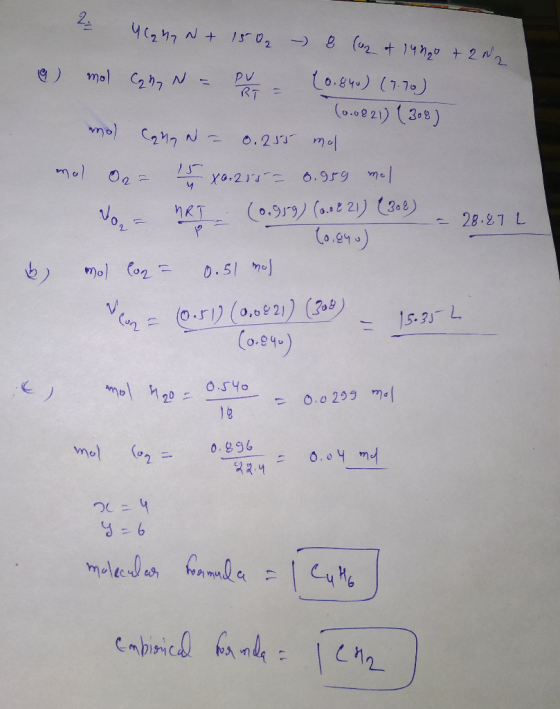
2. Dimethylamine burns in oxygen according to the following equation: 4 C2H7N + 15 O2 →...
2. Dimethylamine burns in oxygen according to the following equation: 4 C2H7N + 15 O2 → 8 CO2 + 14 H2O + 2 N2
(a) How many liters of O2 at 35 °C and 0.840 atm will be needed to burn 7.70 L of C2H7N at 35 °C and 0.840 atm?
(b) How many liters of CO2 at 35 °C and 0.840 atm will be produced? Report your answers to parts (a) and (b) to 3 significant figures.
3. Complete combustion of a 0.0100 mol sample of a hydrocarbon, CxHy, gives 0.896 L of CO2 at STP and 0.540 g of H2O.
(a) What is the molecular formula of the hydrocarbon?
(b) What is the empirical formula of the hydrocarbon?
Homework Answers
Add Answer to:
2. Dimethylamine burns in oxygen according to the following
equation: 4 C2H7N + 15 O2 →...
Complete combustion of a 0.0100 mol sample of a hydrocarbon, CxHy, gives 1.792 L of CO2...
Complete combustion of a 0.0100 mol sample of a hydrocarbon, CxHy, gives 1.792 L of CO2 at STP and 1.261 g of H2O. (a) What is the molecular formula of the hydrocarbon? (b) What is the empirical formula of the hydrocarbon?
Methyl ethyl ether burns in oxygen according to the following equation: 2 C3H8O + 9O2 →...
Methyl ethyl ether burns in oxygen according to the following equation: 2 C3H8O + 9O2 → 6CO2 + 8H2O (a) How many liters of O2 at 37 °C and 0.410 atm will be needed to burn 8.01 L of C3H8O at 37 °C and 0.410 atm? (b) How many liters of CO2 at 37 °C and 0.410 atm will be produced? Report your answers to parts (a) and (b) to 3 significant figures.
35a When 4.752 grams of a hydrocarbon, CxHy, were burned in a combustion analysis apparatus, 16.06...
35a When 4.752 grams of a hydrocarbon, CxHy, were burned in a combustion analysis apparatus, 16.06 grams of CO2 and 3.289 grams of H2O were produced. In a separate experiment, the molar mass of the compound was found to be 26.04 g/mol. Determine the empirical formula and the molecular formula of the hydrocarbon. 35 part b A 4.079 gram sample of an organic compound containing C, H and O is analyzed by combustion analysis and 9.273 grams of CO2 and...
Use this balanced equation to answer the following stoichiometry problem. 2C3H18(1) + 25 O2(g) →16 CO2(g)...
 Use this balanced equation to answer the following stoichiometry problem. 2C3H18(1) + 25 O2(g) →16 CO2(g) + 18 H2O(g) The molar masses in grams are: C8H18 = 114; O2 = 32; CO, = 44; H20 = 18. If you burn 72.9 g of octane, how many liters at STP of CO2 are produced? O 179 L 129 L 83.5L 115L
6.0 grams hydrocarbon sample were made to react with oxygen gas to produce 17.6 grams of...
6.0 grams hydrocarbon sample were made to react with oxygen gas to produce 17.6 grams of carbon dioxide according to the equation: CxHy(g) + O2(g) ---------- CO2(g) + H20(l) where x = subscript for C, y = subscript for H a. How many grams of C are there in 17.6 grams of CO2? b. How many grams of C are there in the hydrocarbon sample? c. How many moles of C are there in the hydrocarbon sample? d. How many...
Isooctane, C8H18, is the component of gasoline from which the term octane rating derives. A. Write a balanced equation f...
Isooctane, C8H18, is the component of gasoline from which the term octane rating derives. A. Write a balanced equation for the combustion of isooctane to yield CO2 and H2O. B. Assuming that gasoline is 100% isooctane, the isooctane burns to produce only CO2 and H2O, and that the density of isooctane is 0.792 g/mL, what mass of CO2 in kilograms is produced each year by the annual US gasoline consumption of 4.6 x 10^10 L? C. What is the volume...
The balanced equation for the combustion of ethanol into carbon dioxide and water is found below.....
The balanced equation for the combustion of ethanol into carbon dioxide and water is found below.. C2H5OH (l) + 3 O2 (g) ----> 2 CO2 (g) + 3 H2O (l) a.calculate how many moles of oxygen gas are contained in 659 ml sample of oxygen at 1.07 atm and 21 degrees celcius b. a glass of wine contains 9.33g of ethanol. how many moles of oxygen would be needed to burn the ethanol contained in one glass of wine c....
How many liters of oxygen at 23° C and 1.12 atm will be required for the...
How many liters of oxygen at 23° C and 1.12 atm will be required for the combustion of 10.0 g of methane, CH4, according to the chemical reaction below: CH4 (g) + 2 O2 (g) ---> CO2 (g) + 2 H2O (g) When magnesium burns in air, the reaction is described by: 2 Mg (s) + O2 (g) ---> 2 MgO (s) What mass of magnesium will react with 10.8 L of oxygen if the temperature and pressure of the...
If we have C3H8 + 5O2 ---> 3CO2 + 4H2O a) How many liters of oxygen...
If we have C3H8 + 5O2 ---> 3CO2 + 4H2O a) How many liters of oxygen gas are required to react with 7.2 L of C3H8 if both gasses are at STP? b) How many grams of CO2 will be produced from 35 L C3H8 at 15 C and 1.65 atm? c) How many grams of water vapor can be produced when 15 L C3H8 at 15 C and 1.65 atm are reacted with 15 L O2 at -20.0 C...
Under STP conditions, 100.0 mL of an unknown hydrocarbon gas was combusted in excess oxygen. The...
Under STP conditions, 100.0 mL of an unknown hydrocarbon gas was combusted in excess oxygen. The only products of the combustion were 300.0 mL of carbon dioxide and 400.0 mL of water vapor. a. What are the intermolecular forces common to hydrocarbon gases? b. Does the behavior of these gases tend to resemble ideal gas behavior? How might these gases be expected to deviate from this behavior? c. How many moles of carbon dioxide are produced in the combustion? d....
 Use this balanced equation to answer the following stoichiometry problem. 2C3H18(1) + 25 O2(g) →16 CO2(g) + 18 H2O(g) The molar masses in grams are: C8H18 = 114; O2 = 32; CO, = 44; H20 = 18. If you burn 72.9 g of octane, how many liters at STP of CO2 are produced? O 179 L 129 L 83.5L 115L
Most questions answered within 3 hours.
-
Where is the error in this code sequence?
String s1 = "Hello";
String s2 = "ello";...
asked 11 months ago -
Financial data for Joel de Paris, Inc., for last year
follow:
Joel de Paris, Inc.
Balance...
asked 11 months ago -
Consider this reaction:
Al2(SO4)3 (aq)+ BaCl3
(aq) Al2Cl6 (aq)- +
3BaSO4(s) . What is the...
asked 11 months ago -
Suppose that Savneet is considering increasing her
recent random sample from 20 car rentals to 40...
asked 11 months ago -
Trucks arrive at an unloading terminal at an average rate of 120
per hour.
Trucks arrive...
asked 11 months ago -
Why are methanol and ethanol completely soluble in water while
octanol is not very little soluble....
asked 11 months ago -
A facilities manager at a university reads in a research report
that the mean amount of...
asked 11 months ago -
When the CuSO4 is rehydrated by adding water to the anhydrous
compound, is this an endothermic...
asked 11 months ago -
A ray of sunlight is passing from diamond into crown glass; the
angle of incidence is...
asked 11 months ago -
A block of mass 0.249 kg is placed on top of a light, vertical
spring of...
asked 11 months ago -
how do the kidneys compensate in the presences of acidosis
a) trigger hyperventilate
b) reserve acid...
asked 11 months ago -
Question 501 pts
The rental rate of capital to the firm increases. Which of the
following...
asked 11 months ago