
Homework Answers
Add Answer to:
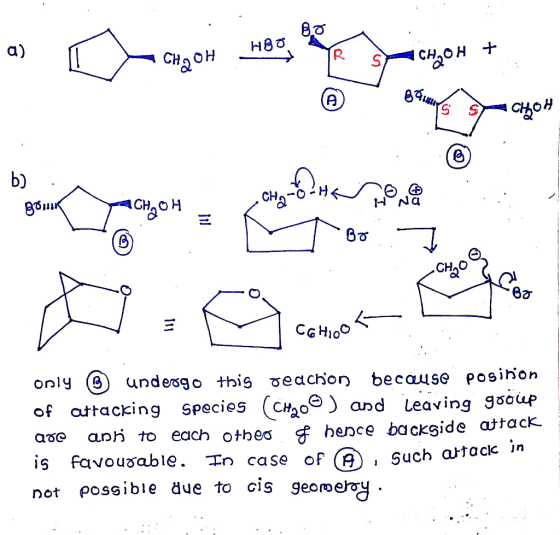
10. a. Draw the two diastereomeric products when HBr reacts with 1. Label each product A...
1a. Draw the product in the following lb. Draw the two diastereomeric substitution products reaction and...
 1a. Draw the product in the following lb. Draw the two diastereomeric substitution products reaction and clearly indicate the obtained in the reaction below. stereochemistry Br CH2OH, CH,OH2 Br reflux CH3OH, Br H.LLDMSO + t-BuOH + KCI 1-BUOK 1 equiv 1c. Draw the reactive conformation (with 1d. The most favored and least favored compounds arrow pushing) and the product for the that could be obtained by treatment of 2,4- reaction below (show stereochemistry). dimethylpenta-1,3-diene with one equivalent of HBr. +...
1a. Draw the product in the following lb. Draw the two diastereomeric substitution products reaction and...
 1a. Draw the product in the following lb. Draw the two diastereomeric substitution products reaction and clearly indicate the obtained in the reaction below. stereochemistry. Br CH2OH, CH.DH, Br reflux H. LL. DMSO CHBuOK. + t-BuOH + KCI t-BuOK 1 equiv 1c. Draw the reactive conformation (with 1d. The most favored and least favored compounds arrow pushing) and the product for the that could be obtained by treatment of 2,4- reaction below (show stereochemistry). dimethylpenta-1,3-diene with one equivalent of HBr....
1a. Draw the product in the following lb. Draw the two diastereomeric substitution products reaction and...
 1a. Draw the product in the following lb. Draw the two diastereomeric substitution products reaction and clearly indicate the obtained in the reaction below. stereochemistry CH OH - CHJÕH, BC DMSO 1-BOK 1 equiv + -BOH +KCI 1e. Draw the reactive conformation (with ld. The most favored and least favored compounds arrow pushing) and the product for the that could be obtained by treatment of 2,4 reaction below (show stereochemistry). dimethylpenta-1,3-diene with one equivalent of HBr. + BOH BUOK +...
Draw the addition products formed when one equivalent of HBr reacts with 2,4-hexadiene. (Draw a single product for eac...
 Draw the addition products formed when one equivalent of HBr reacts with 2,4-hexadiene. (Draw a single product for each. Ignore stereochemical or chiral isomers.)
Draw the kinetic and the thermodynamic addition products formed when one equivalent of HBr reacts with...
 Draw the kinetic and the thermodynamic addition products formed
when one equivalent of HBr reacts with the following compound.
(Draw a single product for each. Ignore stereochemical or chiral
isomers.) Note: Is this a symmetric or an asymmetric diene? Will it
matter which end of the diene you protonate first?
Look at this link to see the compound HBr is reacting with:
//img.homeworklib.com/questions/ffc52d80-4303-11ea-bc58-936001b91635.png
Draw the kinetic and the thermodynamic addition products formed
when one equivalent of HBr reacts with the following compound.
(Draw a single product for each. Ignore stereochemical or chiral
isomers.) Note: Is this a symmetric or an asymmetric diene? Will it
matter which end of the diene you protonate first?
Look at this link to see the compound HBr is reacting with:
//img.homeworklib.com/questions/ffc52d80-4303-11ea-bc58-936001b91635.png
4. Draw expected products when each of the following products reacts with HBr, explain your reasoning (hint: resona...
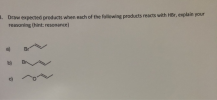 4. Draw expected products when each of the following products reacts with HBr, explain your reasoning (hint: resonance) a Br BV
Hc VCH Draw the organic product formed when CH3CH2CH2OH is treated with each reagent. a H2S04 (180°C) d SOC12, pyri...
 Hc VCH Draw the organic product formed when CH3CH2CH2OH is treated with each reagent. a H2S04 (180°C) d SOC12, pyridine Ig 1) NaH; 2) CH3CH2Br b NaH e PBr3 h 1) TSCI, pyridine; 2) NaSH c HBr f TsCl, pyridine 3. Draw the organic product formed when l-methylcyclohexanol is treaded with each reagent. In some cases, no reaction occurs. a KH c HBr Te NaHCO3 b Nacid HCI f 1) KH; 2) CH3CH2Br Draw two different routes to each of...
10. The following substrate reacts differently with each set of conditions. For each reaction give ALL...
 10. The following substrate reacts differently with each set of conditions. For each reaction give ALL of the products, the mechanism (SN 1, SN2, E1 or E2), and the rate law. You may abbreviate the alkyl halide as R-Br in your rate law. (12) Draw reaction product(s) Mechanism Rate Law NaSH acetone 11. The following compound is shown with no designated stereochemistry. How many stereoisomers are there for this compound? Draw each of them and label them as either chiral...
Draw the product that will occur in the greatest yield. if two or more products are...
 Draw the product that will occur in the greatest yield. if two
or more products are likely draw them both. Do not need to show
full mechanism and it will be assumed appropriate workup for each
reaction.
CH2 Zn (Cu) HBT H3COOCH a. BH3. THE b. H2O2, NaOH H20 Hg(OAC)2 -OH 10. KMnO4 NaOH, HẠO hot
Draw the product that will occur in the greatest yield. if two
or more products are likely draw them both. Do not need to show
full mechanism and it will be assumed appropriate workup for each
reaction.
CH2 Zn (Cu) HBT H3COOCH a. BH3. THE b. H2O2, NaOH H20 Hg(OAC)2 -OH 10. KMnO4 NaOH, HẠO hot
1. Draw all of the constitutional isomers that are formed in each elimination reaction and label...
 1. Draw all of the constitutional isomers that are formed in each elimination reaction and label the mechanism as E2 or E1. a. 2-bromo butane reacts with methoxide b. 1-chloro-1-ethyl 2 methyl cyclopentane reacts with water 2. For which reaction mechanism are each of the following statements true? Mechanism S1, S2, E1 or E2. A statement may be true for one or more mechanisms a. The mechanism involves carbocation intermediates b. The mechanism has two steps C. The reaction rate...
 1a. Draw the product in the following lb. Draw the two diastereomeric substitution products reaction and clearly indicate the obtained in the reaction below. stereochemistry Br CH2OH, CH,OH2 Br reflux CH3OH, Br H.LLDMSO + t-BuOH + KCI 1-BUOK 1 equiv 1c. Draw the reactive conformation (with 1d. The most favored and least favored compounds arrow pushing) and the product for the that could be obtained by treatment of 2,4- reaction below (show stereochemistry). dimethylpenta-1,3-diene with one equivalent of HBr. +...
 1a. Draw the product in the following lb. Draw the two diastereomeric substitution products reaction and clearly indicate the obtained in the reaction below. stereochemistry. Br CH2OH, CH.DH, Br reflux H. LL. DMSO CHBuOK. + t-BuOH + KCI t-BuOK 1 equiv 1c. Draw the reactive conformation (with 1d. The most favored and least favored compounds arrow pushing) and the product for the that could be obtained by treatment of 2,4- reaction below (show stereochemistry). dimethylpenta-1,3-diene with one equivalent of HBr....
 1a. Draw the product in the following lb. Draw the two diastereomeric substitution products reaction and clearly indicate the obtained in the reaction below. stereochemistry CH OH - CHJÕH, BC DMSO 1-BOK 1 equiv + -BOH +KCI 1e. Draw the reactive conformation (with ld. The most favored and least favored compounds arrow pushing) and the product for the that could be obtained by treatment of 2,4 reaction below (show stereochemistry). dimethylpenta-1,3-diene with one equivalent of HBr. + BOH BUOK +...
 Draw the addition products formed when one equivalent of HBr reacts with 2,4-hexadiene. (Draw a single product for each. Ignore stereochemical or chiral isomers.)
 Draw the kinetic and the thermodynamic addition products formed
when one equivalent of HBr reacts with the following compound.
(Draw a single product for each. Ignore stereochemical or chiral
isomers.) Note: Is this a symmetric or an asymmetric diene? Will it
matter which end of the diene you protonate first?
Look at this link to see the compound HBr is reacting with:
//img.homeworklib.com/questions/ffc52d80-4303-11ea-bc58-936001b91635.png
Draw the kinetic and the thermodynamic addition products formed
when one equivalent of HBr reacts with the following compound.
(Draw a single product for each. Ignore stereochemical or chiral
isomers.) Note: Is this a symmetric or an asymmetric diene? Will it
matter which end of the diene you protonate first?
Look at this link to see the compound HBr is reacting with:
//img.homeworklib.com/questions/ffc52d80-4303-11ea-bc58-936001b91635.png
 4. Draw expected products when each of the following products reacts with HBr, explain your reasoning (hint: resonance) a Br BV
 Hc VCH Draw the organic product formed when CH3CH2CH2OH is treated with each reagent. a H2S04 (180°C) d SOC12, pyridine Ig 1) NaH; 2) CH3CH2Br b NaH e PBr3 h 1) TSCI, pyridine; 2) NaSH c HBr f TsCl, pyridine 3. Draw the organic product formed when l-methylcyclohexanol is treaded with each reagent. In some cases, no reaction occurs. a KH c HBr Te NaHCO3 b Nacid HCI f 1) KH; 2) CH3CH2Br Draw two different routes to each of...
 10. The following substrate reacts differently with each set of conditions. For each reaction give ALL of the products, the mechanism (SN 1, SN2, E1 or E2), and the rate law. You may abbreviate the alkyl halide as R-Br in your rate law. (12) Draw reaction product(s) Mechanism Rate Law NaSH acetone 11. The following compound is shown with no designated stereochemistry. How many stereoisomers are there for this compound? Draw each of them and label them as either chiral...
 Draw the product that will occur in the greatest yield. if two
or more products are likely draw them both. Do not need to show
full mechanism and it will be assumed appropriate workup for each
reaction.
CH2 Zn (Cu) HBT H3COOCH a. BH3. THE b. H2O2, NaOH H20 Hg(OAC)2 -OH 10. KMnO4 NaOH, HẠO hot
Draw the product that will occur in the greatest yield. if two
or more products are likely draw them both. Do not need to show
full mechanism and it will be assumed appropriate workup for each
reaction.
CH2 Zn (Cu) HBT H3COOCH a. BH3. THE b. H2O2, NaOH H20 Hg(OAC)2 -OH 10. KMnO4 NaOH, HẠO hot
 1. Draw all of the constitutional isomers that are formed in each elimination reaction and label the mechanism as E2 or E1. a. 2-bromo butane reacts with methoxide b. 1-chloro-1-ethyl 2 methyl cyclopentane reacts with water 2. For which reaction mechanism are each of the following statements true? Mechanism S1, S2, E1 or E2. A statement may be true for one or more mechanisms a. The mechanism involves carbocation intermediates b. The mechanism has two steps C. The reaction rate...
Most questions answered within 3 hours.
-
Where is the error in this code sequence?
String s1 = "Hello";
String s2 = "ello";...
asked 10 months ago -
Financial data for Joel de Paris, Inc., for last year
follow:
Joel de Paris, Inc.
Balance...
asked 10 months ago -
Consider this reaction:
Al2(SO4)3 (aq)+ BaCl3
(aq) Al2Cl6 (aq)- +
3BaSO4(s) . What is the...
asked 10 months ago -
Suppose that Savneet is considering increasing her
recent random sample from 20 car rentals to 40...
asked 10 months ago -
Trucks arrive at an unloading terminal at an average rate of 120
per hour.
Trucks arrive...
asked 10 months ago -
Why are methanol and ethanol completely soluble in water while
octanol is not very little soluble....
asked 10 months ago -
A facilities manager at a university reads in a research report
that the mean amount of...
asked 10 months ago -
When the CuSO4 is rehydrated by adding water to the anhydrous
compound, is this an endothermic...
asked 10 months ago -
A ray of sunlight is passing from diamond into crown glass; the
angle of incidence is...
asked 10 months ago -
A block of mass 0.249 kg is placed on top of a light, vertical
spring of...
asked 10 months ago -
how do the kidneys compensate in the presences of acidosis
a) trigger hyperventilate
b) reserve acid...
asked 10 months ago -
Question 501 pts
The rental rate of capital to the firm increases. Which of the
following...
asked 10 months ago