 Please solve without using
excel: need to see work and steps
Please solve without using
excel: need to see work and steps
Homework Answers
a)
IRR is the rate at which NPV is zero. Internal Rate of Return will be calculated by trail and error method.
IRR for Project A
To have an approximate idea about such rate we can calculate the guidance rate to start with.
It represents the same relationship of investment and cash inflows as in case of payback period calculation, therefore it is known as fake payback period,
F = I/C
where,
F = Fake payback period
I = Original Investment
C = Average Cash Inflow per annum
Factor for the project = 30000/21000
= 1.4286 (also known as fake payback period)
The factor will be located from the Present Value Annuity Factor table,
The Approx. value of 1.4286 is located against 25% in 2 years.
Hence, let discount rate is 25%.,
At 25%,
NPV = PV of Cash inflows - PV of Cash Outflows
= 21000*PVAF(2 years, 25%) - 30000
= 21000*1.440 - 30000
= 30240 - 30000
= 240
To make it zero, the present value of cash inflows is to be reduced. Therefore, a higher discount rate,
let discount rate is 30%,
At 30%,
NPV = PV of Cash inflows - PV of Cash Outflows
= 21000*PVAF(2 years, 30%) - 30000
= 21000*1.361 - 30000
= 28581 - 30000
= - 1419
IRR may be calculated by Forward method and backward method,
By Forward Method,
IRR = 25% + NPV at 25 %/Total difference * Difference in rate
= 25 + 240/1659 * 5
= 25 + 0.72
= 25.72%
IRR for Project A is 25.72 %.
IRR for Project B
In the same way as above,
Factor for the project = 50000/33000
= 1.52 (also known as fake payback period)
The factor will be located from the Present Value Annuity Factor table,
The Approx. value of 1.52 is located against 20% in 2 years.
Hence, let discount rate is 20%.,
At 20%,
NPV = PV of Cash inflows - PV of Cash Outflows
= 33000*PVAF(2 years, 20%) - 50000
= 33000*1.528 - 50000
= 50424 - 50000
= 424
To make it zero, the present value of cash inflows is to be reduced. Therefore, a higher discount rate,
let discount rate is 22%,
At 22%,
NPV = PV of Cash inflows - PV of Cash Outflows
= 33000*PVAF(2 years, 22%) - 50000
= 33000*1.492 - 50000
= 49236 - 50000
= - 764
IRR may be calculated by Forward method and backward method,
By Forward Method,
IRR = 20% + NPV at 20 %/Total difference * Difference in rate
= 20 + 424/1188 * 2
= 20 + 0.71
= 20.71%
IRR for Project B is 20.71 %.
b)
The decision for IRR is to invest in a project if its rate of return is greater than its cost of capital.
In this problem, both project have greater IRR than cost of capital (i.e 10%),
Hence both should be accepted, however project having higher IRR should be accepted, because cost of capital is same for both project.
So, Project A is best.
c)
Decision based on NPV is that Project having positive NPV should be accepted.
However, in case of positive NPV in both Project, Project having higher NPV should be accepted.
Hence, Project B is best.
Add Answer to:
Please solve without using
excel: need to see work and steps
NPVIRR. Consider projects A and...
Consider two mutually exclusive projects A and B: Cash Flows (dollars) Project C0 C1 C2 NPV...
Consider two mutually exclusive projects A and B: Cash Flows (dollars) Project C0 C1 C2 NPV at 11% A −36,500 26,200 26,200 +$8,368 B −56,500 39,500 39,500 +11,145 a. Calculate IRRs for A and B. (Do not round intermediate calculations. Enter your answers as a percent rounded to 2 decimal places.) b. Which project does the IRR rule suggest is best? Project A Project B c. Which project is really best?
Please use Excel to solve. NPV and IRR for Mutually Exclusive Projects 10. A company is...
 Please use Excel to solve.
NPV and IRR for Mutually Exclusive Projects 10. A company is considering two mutually exclusive projects, A and B. Project A requires an initial investment of $200, followed by cash flows of $185, $40, and $15. Project B requires an initial investment of $200, followed by cash flows of S0, $50, and $230. What is the NPV and IRR for each of the projects? Which project should the company choose? The firm's cost of capital...
Please use Excel to solve.
NPV and IRR for Mutually Exclusive Projects 10. A company is considering two mutually exclusive projects, A and B. Project A requires an initial investment of $200, followed by cash flows of $185, $40, and $15. Project B requires an initial investment of $200, followed by cash flows of S0, $50, and $230. What is the NPV and IRR for each of the projects? Which project should the company choose? The firm's cost of capital...
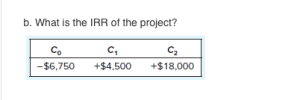
Please solve without using excel: b. What is the IRR of the project? C1 -$6,750 +$4,500...
 Please solve without using
excel:
b. What is the IRR of the project? C1 -$6,750 +$4,500 $18,000 Co
Please solve without using
excel:
b. What is the IRR of the project? C1 -$6,750 +$4,500 $18,000 Co
Please do not use Excel to solve this problem, using financial calculator and show steps. 7....
 Please do not use Excel to solve this problem, using financial
calculator and show steps.
7. Citicorp Inc. is considering two independent projects that can increase the revenue and generate more market share with the following cash flows. The required return for both projects is 16 percent. (20 marks) Project B -$135,000 Project A -$125,000 Year 0 46,000 50,000 2 79,000 30,000 51,000 110,000 iWhat are the NPVS at both Project A and Project B? (8 marks) ii) What are...
Please do not use Excel to solve this problem, using financial
calculator and show steps.
7. Citicorp Inc. is considering two independent projects that can increase the revenue and generate more market share with the following cash flows. The required return for both projects is 16 percent. (20 marks) Project B -$135,000 Project A -$125,000 Year 0 46,000 50,000 2 79,000 30,000 51,000 110,000 iWhat are the NPVS at both Project A and Project B? (8 marks) ii) What are...
please show full steps of the solution for full credit. not excel solutions please. thank you!!!...
 please show full steps of the
solution for full credit. not excel solutions please. thank
you!!!
9. The Ott Group, Inc., has identified the following two mutually exclusive projects: Year 0 Cash Flow (S) - $12,500 4,000 5,000 6,000 1,000 Cash Flow (L) - $12,500 1,000 6,000 5,000 4,000 a. What is the IRR for each of these projects? If you apply the IRR decision rule, which project should the company accept? b. If the required return is 11 percent,...
please show full steps of the
solution for full credit. not excel solutions please. thank
you!!!
9. The Ott Group, Inc., has identified the following two mutually exclusive projects: Year 0 Cash Flow (S) - $12,500 4,000 5,000 6,000 1,000 Cash Flow (L) - $12,500 1,000 6,000 5,000 4,000 a. What is the IRR for each of these projects? If you apply the IRR decision rule, which project should the company accept? b. If the required return is 11 percent,...
Please answer A, B, C with excel thank you! You are choosing between two projects. The cash flows for the projects...
 Please answer A, B, C with excel thank you!
You are choosing between two projects. The cash flows for the projects are given in the following table (5 million) Project Year 0 Year 1 Year 2 - $50 $23 -$102 $20 $40 Year 3 Year $18 $19 $59 a. What are the IRRs of the two projects? b. If your discount rate is 5.2%, what are the NPVs of the two projects? c. Why do IRR and NPV rank the...
Please answer A, B, C with excel thank you!
You are choosing between two projects. The cash flows for the projects are given in the following table (5 million) Project Year 0 Year 1 Year 2 - $50 $23 -$102 $20 $40 Year 3 Year $18 $19 $59 a. What are the IRRs of the two projects? b. If your discount rate is 5.2%, what are the NPVs of the two projects? c. Why do IRR and NPV rank the...
solve using excel Net Present Value and Other Capital Budgeting Measures 6 Consider two mutually exclusive...
 solve using excel
Net Present Value and Other Capital Budgeting Measures 6 Consider two mutually exclusive projects with these cash flows: Year Project A -$28,300 13,700 11,600 8,850 4,750 Project B $28,300 3,950 9,450 14,500 16,100 The required rate of return on both projects is 10% a. Which project should be accepted based on the payback period? b. Which project should be accepted based on the PI? c. Which project should be accepted based on the IRR? d. Which project...
solve using excel
Net Present Value and Other Capital Budgeting Measures 6 Consider two mutually exclusive projects with these cash flows: Year Project A -$28,300 13,700 11,600 8,850 4,750 Project B $28,300 3,950 9,450 14,500 16,100 The required rate of return on both projects is 10% a. Which project should be accepted based on the payback period? b. Which project should be accepted based on the PI? c. Which project should be accepted based on the IRR? d. Which project...
Consider the following project Cash flows Cash flows Cash flows Projects CO C1 C2 A -30...
 Consider the following project Cash flows Cash flows Cash flows Projects CO C1 C2 A -30 20 20 What is the IRR of the project? A) 11.53% B) 21.53% C) 23.15% OD) 33.15%
Solve step by step without excel. 13-15 The after-tax cash flows for two mutually exclusive projects...
 Solve step by step without excel.
13-15 The after-tax cash flows for two mutually exclusive projects have been esti mated, and the following information has been provided: Expected Net Cash Flows Year Machine D Machine Q $(2,500) 2,000 900 100 100 $(2,500) 1,800 1,000 900 The company's required rate of return is 14 percent, and it can get unlimited funds at that cost. What is the IRR of the better project? (Hint: Note that the better project might not be...
Solve step by step without excel.
13-15 The after-tax cash flows for two mutually exclusive projects have been esti mated, and the following information has been provided: Expected Net Cash Flows Year Machine D Machine Q $(2,500) 2,000 900 100 100 $(2,500) 1,800 1,000 900 The company's required rate of return is 14 percent, and it can get unlimited funds at that cost. What is the IRR of the better project? (Hint: Note that the better project might not be...
Please use excel, need help with functions because I am only used to using a financial...
Please use excel, need help with functions because I am only used to using a financial calculator, thanks! The following cash-flows have two IRRs. Draw a graph of the NPV of these cash flows as a function of the discount rate. Then use the IRR function to identify the two IRRs. Would you invest in this project if the opportunity cost were 20%? Year Cash Flow 0 -500 1 600 2 300 3 300 4 200 5 -1,000
 Please use Excel to solve.
NPV and IRR for Mutually Exclusive Projects 10. A company is considering two mutually exclusive projects, A and B. Project A requires an initial investment of $200, followed by cash flows of $185, $40, and $15. Project B requires an initial investment of $200, followed by cash flows of S0, $50, and $230. What is the NPV and IRR for each of the projects? Which project should the company choose? The firm's cost of capital...
Please use Excel to solve.
NPV and IRR for Mutually Exclusive Projects 10. A company is considering two mutually exclusive projects, A and B. Project A requires an initial investment of $200, followed by cash flows of $185, $40, and $15. Project B requires an initial investment of $200, followed by cash flows of S0, $50, and $230. What is the NPV and IRR for each of the projects? Which project should the company choose? The firm's cost of capital...
 Please solve without using
excel:
b. What is the IRR of the project? C1 -$6,750 +$4,500 $18,000 Co
Please solve without using
excel:
b. What is the IRR of the project? C1 -$6,750 +$4,500 $18,000 Co
 Please do not use Excel to solve this problem, using financial
calculator and show steps.
7. Citicorp Inc. is considering two independent projects that can increase the revenue and generate more market share with the following cash flows. The required return for both projects is 16 percent. (20 marks) Project B -$135,000 Project A -$125,000 Year 0 46,000 50,000 2 79,000 30,000 51,000 110,000 iWhat are the NPVS at both Project A and Project B? (8 marks) ii) What are...
Please do not use Excel to solve this problem, using financial
calculator and show steps.
7. Citicorp Inc. is considering two independent projects that can increase the revenue and generate more market share with the following cash flows. The required return for both projects is 16 percent. (20 marks) Project B -$135,000 Project A -$125,000 Year 0 46,000 50,000 2 79,000 30,000 51,000 110,000 iWhat are the NPVS at both Project A and Project B? (8 marks) ii) What are...
 please show full steps of the
solution for full credit. not excel solutions please. thank
you!!!
9. The Ott Group, Inc., has identified the following two mutually exclusive projects: Year 0 Cash Flow (S) - $12,500 4,000 5,000 6,000 1,000 Cash Flow (L) - $12,500 1,000 6,000 5,000 4,000 a. What is the IRR for each of these projects? If you apply the IRR decision rule, which project should the company accept? b. If the required return is 11 percent,...
please show full steps of the
solution for full credit. not excel solutions please. thank
you!!!
9. The Ott Group, Inc., has identified the following two mutually exclusive projects: Year 0 Cash Flow (S) - $12,500 4,000 5,000 6,000 1,000 Cash Flow (L) - $12,500 1,000 6,000 5,000 4,000 a. What is the IRR for each of these projects? If you apply the IRR decision rule, which project should the company accept? b. If the required return is 11 percent,...
 Please answer A, B, C with excel thank you!
You are choosing between two projects. The cash flows for the projects are given in the following table (5 million) Project Year 0 Year 1 Year 2 - $50 $23 -$102 $20 $40 Year 3 Year $18 $19 $59 a. What are the IRRs of the two projects? b. If your discount rate is 5.2%, what are the NPVs of the two projects? c. Why do IRR and NPV rank the...
Please answer A, B, C with excel thank you!
You are choosing between two projects. The cash flows for the projects are given in the following table (5 million) Project Year 0 Year 1 Year 2 - $50 $23 -$102 $20 $40 Year 3 Year $18 $19 $59 a. What are the IRRs of the two projects? b. If your discount rate is 5.2%, what are the NPVs of the two projects? c. Why do IRR and NPV rank the...
 solve using excel
Net Present Value and Other Capital Budgeting Measures 6 Consider two mutually exclusive projects with these cash flows: Year Project A -$28,300 13,700 11,600 8,850 4,750 Project B $28,300 3,950 9,450 14,500 16,100 The required rate of return on both projects is 10% a. Which project should be accepted based on the payback period? b. Which project should be accepted based on the PI? c. Which project should be accepted based on the IRR? d. Which project...
solve using excel
Net Present Value and Other Capital Budgeting Measures 6 Consider two mutually exclusive projects with these cash flows: Year Project A -$28,300 13,700 11,600 8,850 4,750 Project B $28,300 3,950 9,450 14,500 16,100 The required rate of return on both projects is 10% a. Which project should be accepted based on the payback period? b. Which project should be accepted based on the PI? c. Which project should be accepted based on the IRR? d. Which project...
 Consider the following project Cash flows Cash flows Cash flows Projects CO C1 C2 A -30 20 20 What is the IRR of the project? A) 11.53% B) 21.53% C) 23.15% OD) 33.15%
 Solve step by step without excel.
13-15 The after-tax cash flows for two mutually exclusive projects have been esti mated, and the following information has been provided: Expected Net Cash Flows Year Machine D Machine Q $(2,500) 2,000 900 100 100 $(2,500) 1,800 1,000 900 The company's required rate of return is 14 percent, and it can get unlimited funds at that cost. What is the IRR of the better project? (Hint: Note that the better project might not be...
Solve step by step without excel.
13-15 The after-tax cash flows for two mutually exclusive projects have been esti mated, and the following information has been provided: Expected Net Cash Flows Year Machine D Machine Q $(2,500) 2,000 900 100 100 $(2,500) 1,800 1,000 900 The company's required rate of return is 14 percent, and it can get unlimited funds at that cost. What is the IRR of the better project? (Hint: Note that the better project might not be...
Most questions answered within 3 hours.
-
Where is the error in this code sequence?
String s1 = "Hello";
String s2 = "ello";...
asked 11 months ago -
Financial data for Joel de Paris, Inc., for last year
follow:
Joel de Paris, Inc.
Balance...
asked 11 months ago -
Consider this reaction:
Al2(SO4)3 (aq)+ BaCl3
(aq) Al2Cl6 (aq)- +
3BaSO4(s) . What is the...
asked 11 months ago -
Suppose that Savneet is considering increasing her
recent random sample from 20 car rentals to 40...
asked 11 months ago -
Trucks arrive at an unloading terminal at an average rate of 120
per hour.
Trucks arrive...
asked 11 months ago -
Why are methanol and ethanol completely soluble in water while
octanol is not very little soluble....
asked 11 months ago -
A facilities manager at a university reads in a research report
that the mean amount of...
asked 11 months ago -
When the CuSO4 is rehydrated by adding water to the anhydrous
compound, is this an endothermic...
asked 11 months ago -
A ray of sunlight is passing from diamond into crown glass; the
angle of incidence is...
asked 11 months ago -
A block of mass 0.249 kg is placed on top of a light, vertical
spring of...
asked 11 months ago -
how do the kidneys compensate in the presences of acidosis
a) trigger hyperventilate
b) reserve acid...
asked 11 months ago -
Question 501 pts
The rental rate of capital to the firm increases. Which of the
following...
asked 11 months ago