
Homework Answers
If convenient please upvote....
Add Answer to:
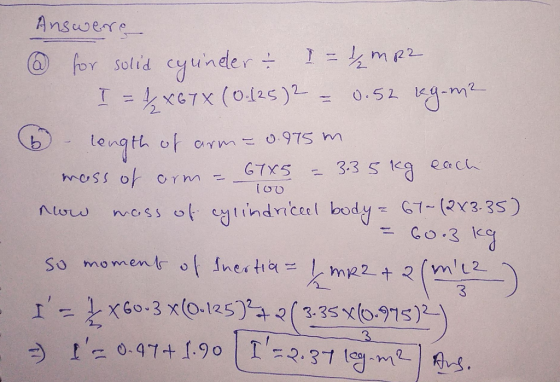
4. Suppose we want to calculate the moment of inertia of a 67 kg skater, relative...
Suppose we want to calculate the moment of inertia of a 67 kg skater, relative to...
 Suppose we want to calculate the
moment of inertia of a 67 kg skater, relative to a vertical axis
through their center of mass.
Part (a) First calculate the
moment of inertia (in kg⋅m2) when the skater has their
arms pulled inward by assuming they are cylinder of radius 0.11 m.
Part
(b) Now calculate the moment of inertia of the skater (in
kg⋅m2) with their arms extended by assuming that each
arm is 5% of the mass of their...
Suppose we want to calculate the
moment of inertia of a 67 kg skater, relative to a vertical axis
through their center of mass.
Part (a) First calculate the
moment of inertia (in kg⋅m2) when the skater has their
arms pulled inward by assuming they are cylinder of radius 0.11 m.
Part
(b) Now calculate the moment of inertia of the skater (in
kg⋅m2) with their arms extended by assuming that each
arm is 5% of the mass of their...
Calculate the moment of inertia (in kg·m2) of a skater given the following information. (a) The...
Calculate the moment of inertia (in kg·m2) of a skater given the following information. (a) The 64.0 kg skater is approximated as a cylinder that has a 0.130 m radius. --- kg·m2 (b) The skater with arms extended is approximately a cylinder that is 57.0 kg, has a 0.130 m radius, and has two 0.950 m long arms which are 3.50 kg each and extend straight out from the cylinder like rods rotated about their ends. ---- kg·m2
Calculate the moment of inertia (in kg·m2) of a skater given the following information. (a) The...
Calculate the moment of inertia (in kg·m2) of a skater given the following information. (a) The 64.0 kg skater is approximated as a cylinder that has a 0.130 m radius. --- kg·m2 (b) The skater with arms extended is approximately a cylinder that is 57.0 kg, has a 0.130 m radius, and has two 0.950 m long arms which are 3.50 kg each and extend straight out from the cylinder like rods rotated about their ends. ---- kg·m2
Calculate the moment of inertia (in kg·m2) of a skater given the following information. The 92.0...
Calculate the moment of inertia (in kg·m2) of a skater given the following information. The 92.0 kg skater is approximated as a cylinder that has a 0.120 m radius. The skater with arms extended is approximately a cylinder that is 86.0 kg, has a 0.120 m radius, and has two 0.850 m long arms which are 3.00 kg each and extend straight out from the cylinder like rods rotated about their ends.
Calculate the moment of inertia for each scenario: (a) An 80.0 kg skater is approximated as...
 Calculate the moment of inertia for each scenario: (a) An 80.0 kg skater is approximated as a cylinder with a 0.140 m radius. (b) The skater extends both her arms, each of which is approximated as a 4.00 kg rod with length 0.850 m rotated about its end. (c) Calculate the angular velocity of the skater during scenario (b) if her angular velocity during scenario (a) is 6.75 rad/s.
Menu Contents Grades Course Contents... w3 10.11T - Dynamics of Rotational Motion Rotational Inertia - Timer...
 Menu Contents Grades Course Contents... w3 10.11T - Dynamics of Rotational Motion Rotational Inertia - Timer Notes Evaluate Calculate the moment of inertia of a skater given the following information. The 49.0-kg Skater is approximated as a cylinder that has a 0.122-m radius. Feedback Print Into Submit Tres 0/10 The skater with arms extended is approximately a cylinder that is 43.0 kg, has a 0.122-m radius, and has two 0.960-m-long arms which are 3.00 kg each and extend straight out...
Main Menu Contents Grades Course Contents ... hw13 10.11T - Dynamics of Rotational Motion Rotational Inertia...
 Main Menu Contents Grades Course Contents ... hw13 10.11T - Dynamics of Rotational Motion Rotational Inertia • Timer Notes Evaluate Calculate the moment of inertia of a skater given the following information. The 49.0-kg skater is approximated as a cylinder that has a 0.122-m radius. 0.365 kg MA2 Feedback Print Into You are correct. Your receipt nois 161-3863 Previous Tres The skater with arms extended is approximately a cylinder that is 43.0 kg, has a 0.122-m radius, and has two...
QUESTION 8 Calculate the moment of inertia of a skater assuming the following model. The skater...
 QUESTION 8 Calculate the moment of inertia of a skater assuming the following model. The skater is approximated as a cylinder (mass of 59 kg and radius 0.11 m) and with arms approacimated as two long rods (mass of 0.9 kg and length 0.95 m for each) extend straight out from the axis of the cylinder Express your answer in Sl units with 3 or more significant Sgures QUESTIONS A playground merry-go-round (a disk) has a mass of 112 kg...
(a) Calculate the angular momentum (in kg.m2/s) of an ice skater spinning at 6.00 rev/s given...
 (a) Calculate the angular momentum (in kg.m2/s) of an ice skater spinning at 6.00 rev/s given his moment of inertia is 0.470 kg.m2 kg-m2/s (b) He reduces his rate of spin (his angular velocity) by extending his arms and increasing his moment of inertia. Find the value of his moment of inertia (in kg m-) if his angular velocity drops to 1.00 rev/s. kg-m2 (c) suppose instead he keeps his arms in and allows friction with the ice to slow...
The 160 lb ice skater with arms extended horizontally spins about a vertical axis with a...
The 160 lb ice skater with arms extended horizontally spins about a vertical axis with a rotational speed of 1 rev/sec. Estimate his rotational speed if he fully retracts his arms, bringing his hands very close to the centerline of his body. As a reasonable approximation, model the extended arms as uniform slender rods, each of which is 27 in. long and weighs 13 lb. Model the torso as a solid 134-lb cylinder 13 in. in diameter. Treat the man...
 Suppose we want to calculate the
moment of inertia of a 67 kg skater, relative to a vertical axis
through their center of mass.
Part (a) First calculate the
moment of inertia (in kg⋅m2) when the skater has their
arms pulled inward by assuming they are cylinder of radius 0.11 m.
Part
(b) Now calculate the moment of inertia of the skater (in
kg⋅m2) with their arms extended by assuming that each
arm is 5% of the mass of their...
Suppose we want to calculate the
moment of inertia of a 67 kg skater, relative to a vertical axis
through their center of mass.
Part (a) First calculate the
moment of inertia (in kg⋅m2) when the skater has their
arms pulled inward by assuming they are cylinder of radius 0.11 m.
Part
(b) Now calculate the moment of inertia of the skater (in
kg⋅m2) with their arms extended by assuming that each
arm is 5% of the mass of their...
 Calculate the moment of inertia for each scenario: (a) An 80.0 kg skater is approximated as a cylinder with a 0.140 m radius. (b) The skater extends both her arms, each of which is approximated as a 4.00 kg rod with length 0.850 m rotated about its end. (c) Calculate the angular velocity of the skater during scenario (b) if her angular velocity during scenario (a) is 6.75 rad/s.
 Menu Contents Grades Course Contents... w3 10.11T - Dynamics of Rotational Motion Rotational Inertia - Timer Notes Evaluate Calculate the moment of inertia of a skater given the following information. The 49.0-kg Skater is approximated as a cylinder that has a 0.122-m radius. Feedback Print Into Submit Tres 0/10 The skater with arms extended is approximately a cylinder that is 43.0 kg, has a 0.122-m radius, and has two 0.960-m-long arms which are 3.00 kg each and extend straight out...
 Main Menu Contents Grades Course Contents ... hw13 10.11T - Dynamics of Rotational Motion Rotational Inertia • Timer Notes Evaluate Calculate the moment of inertia of a skater given the following information. The 49.0-kg skater is approximated as a cylinder that has a 0.122-m radius. 0.365 kg MA2 Feedback Print Into You are correct. Your receipt nois 161-3863 Previous Tres The skater with arms extended is approximately a cylinder that is 43.0 kg, has a 0.122-m radius, and has two...
 QUESTION 8 Calculate the moment of inertia of a skater assuming the following model. The skater is approximated as a cylinder (mass of 59 kg and radius 0.11 m) and with arms approacimated as two long rods (mass of 0.9 kg and length 0.95 m for each) extend straight out from the axis of the cylinder Express your answer in Sl units with 3 or more significant Sgures QUESTIONS A playground merry-go-round (a disk) has a mass of 112 kg...
 (a) Calculate the angular momentum (in kg.m2/s) of an ice skater spinning at 6.00 rev/s given his moment of inertia is 0.470 kg.m2 kg-m2/s (b) He reduces his rate of spin (his angular velocity) by extending his arms and increasing his moment of inertia. Find the value of his moment of inertia (in kg m-) if his angular velocity drops to 1.00 rev/s. kg-m2 (c) suppose instead he keeps his arms in and allows friction with the ice to slow...
Most questions answered within 3 hours.
-
Where is the error in this code sequence?
String s1 = "Hello";
String s2 = "ello";...
asked 11 months ago -
Financial data for Joel de Paris, Inc., for last year
follow:
Joel de Paris, Inc.
Balance...
asked 11 months ago -
Consider this reaction:
Al2(SO4)3 (aq)+ BaCl3
(aq) Al2Cl6 (aq)- +
3BaSO4(s) . What is the...
asked 11 months ago -
Suppose that Savneet is considering increasing her
recent random sample from 20 car rentals to 40...
asked 11 months ago -
Trucks arrive at an unloading terminal at an average rate of 120
per hour.
Trucks arrive...
asked 11 months ago -
Why are methanol and ethanol completely soluble in water while
octanol is not very little soluble....
asked 11 months ago -
A facilities manager at a university reads in a research report
that the mean amount of...
asked 11 months ago -
When the CuSO4 is rehydrated by adding water to the anhydrous
compound, is this an endothermic...
asked 11 months ago -
A ray of sunlight is passing from diamond into crown glass; the
angle of incidence is...
asked 11 months ago -
A block of mass 0.249 kg is placed on top of a light, vertical
spring of...
asked 11 months ago -
how do the kidneys compensate in the presences of acidosis
a) trigger hyperventilate
b) reserve acid...
asked 11 months ago -
Question 501 pts
The rental rate of capital to the firm increases. Which of the
following...
asked 11 months ago