
Homework Answers
Add Answer to:
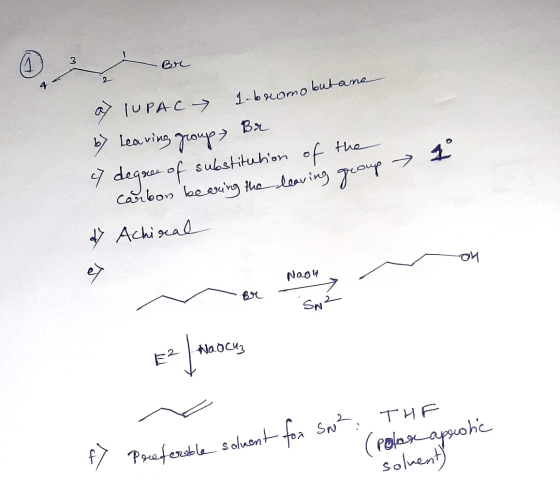
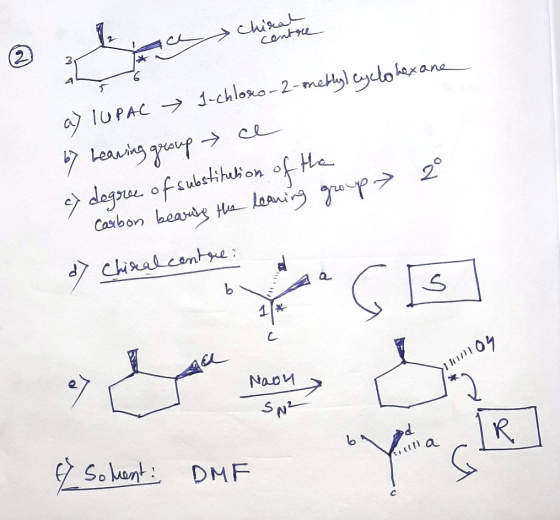
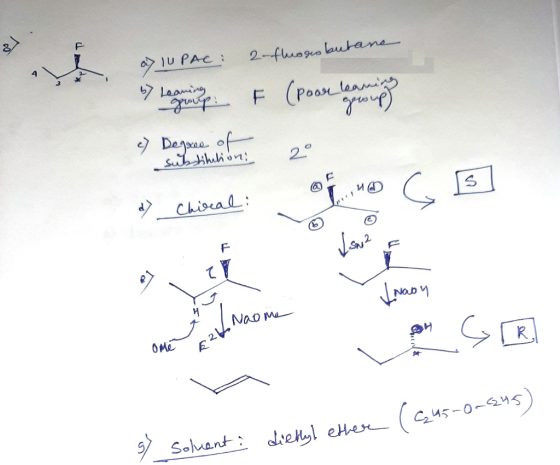
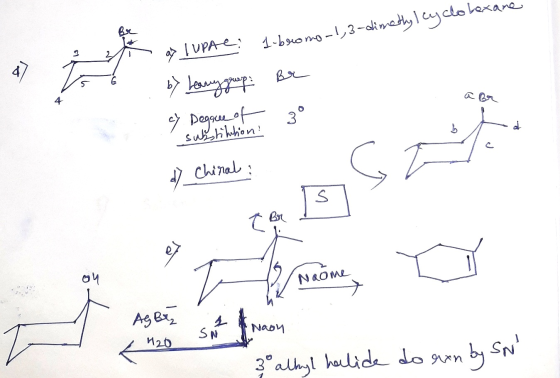
For each of the following structures: (a) Give the IUPAC name. (b) Identify the leaving group....
please answer question For each of the following structures (a) Give the IUPAC name (b) Identify...
 please answer question
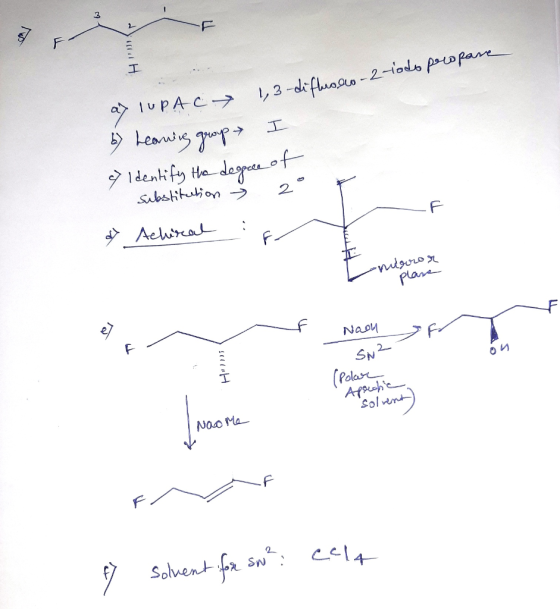
For each of the following structures (a) Give the IUPAC name (b) Identify the leaving group (c) Identify the degree of substitution of the carbon bearing the leaving group. (d) Identify the same carbon as (R) or (S), if applicable. (e) Give the product(s), if any of reaction with NaOH and with NaOCH3 (f) Identify the same carbon as in (e) and (d) in the product as (R) or (S), if applicable (g) Choose the most appropriate...
please answer question
For each of the following structures (a) Give the IUPAC name (b) Identify the leaving group (c) Identify the degree of substitution of the carbon bearing the leaving group. (d) Identify the same carbon as (R) or (S), if applicable. (e) Give the product(s), if any of reaction with NaOH and with NaOCH3 (f) Identify the same carbon as in (e) and (d) in the product as (R) or (S), if applicable (g) Choose the most appropriate...
please answer d e f g For each of the following structures: (a) Give the IUPAC...
 please answer d e f g
For each of the following structures: (a) Give the IUPAC name. (b) Identify the leaving group. (c) Identify the degree of substitution of the carbon bearing the leaving group. (d) Identify the same carbon as (R) or (S), if applicable. (e) Give the product(s), if any of reaction with NaOH and with NaOCH3- (1) Identify the same carbon as in (c) and (d) in the product as (R) or (S), if applicable. (g) Choose...
please answer d e f g
For each of the following structures: (a) Give the IUPAC name. (b) Identify the leaving group. (c) Identify the degree of substitution of the carbon bearing the leaving group. (d) Identify the same carbon as (R) or (S), if applicable. (e) Give the product(s), if any of reaction with NaOH and with NaOCH3- (1) Identify the same carbon as in (c) and (d) in the product as (R) or (S), if applicable. (g) Choose...
For the following three structures, (a) identify the leaving group, LG, by circling it, and (b)...
 For the following three structures, (a) identify the leaving
group, LG, by circling it, and (b) provide the substitution at the
alpha carbon, αC, by designating it as either unsubstituted, 1°,
2°, or 3°.
Apply the designated mechanism to the provided substrate and
nucleophile to predict the product(s).
For the following three structures, (a) identify the leaving group, LG, by circling it, and (b) provide the substitution at the alpha carbon, aC, by designating it as either unsubstituted, 1°, 2°,...
For the following three structures, (a) identify the leaving
group, LG, by circling it, and (b) provide the substitution at the
alpha carbon, αC, by designating it as either unsubstituted, 1°,
2°, or 3°.
Apply the designated mechanism to the provided substrate and
nucleophile to predict the product(s).
For the following three structures, (a) identify the leaving group, LG, by circling it, and (b) provide the substitution at the alpha carbon, aC, by designating it as either unsubstituted, 1°, 2°,...
4. In each case below identify: (a) the leaving group (b) the nucleophile, (c) and if...
 4. In each case below identify: (a) the leaving group (b) the nucleophile, (c) and if the reaction is an Syl reaction or Sn2 reaction. (d) Draw the products of the following substitution reactions. NaSH DMSO MeOH H- Br NaCN DMF
4. In each case below identify: (a) the leaving group (b) the nucleophile, (c) and if...
 4. In each case below identify: (a) the leaving group (b) the nucleophile, (c) and if the reaction is an Snl reaction or Sn2 reaction. (d) Draw the products of the following substitution reactions. NaSH DMSO MeOH H- Br NaCN DMF
give the major product and mechanism used. label leaving group, solvent and Nucliphile and also identify what reactio...
 give the major product and
mechanism used. label leaving group, solvent and Nucliphile and
also identify what reaction it is ( Sn1, sn2, e2 or e1)
use
arrow pushing
LOT с онт CH2CO2Na CH2CO2H
give the major product and
mechanism used. label leaving group, solvent and Nucliphile and
also identify what reaction it is ( Sn1, sn2, e2 or e1)
use
arrow pushing
LOT с онт CH2CO2Na CH2CO2H
I nucleophile substitution. 7.8 Which is the better leaving group in each pair? a a, b,...
 I nucleophile substitution. 7.8 Which is the better leaving group in each pair? a a, b, NH, NH, C. HẠO, HAS 7.9 Which molecules contain good leaving groups? a. CH CH.CH,Br b . CH,CH,CH,OH . CH.CH,OH, d. CH.CH Does the equilibrium favor the reactants or products in each substitution reaction? a. CH,CH-NH, + Br -- CH,CHBr + NH b. n + ON ~ ON + r 7.6 Identify the nucleophile and leaving group and draw the products of each reaction...
1. Write the predicted product and the rate law for the following reaction: CH;CH CH CI...
 1. Write the predicted product and the rate law for the following reaction: CH;CH CH CI + NaCN DMSO 2. In the following reaction, identify a) the leaving group, b) the nucleophile, c) the electrophilic carbon and d) the solvent CH CH Br + NaHS H30 CH CH SH + NaBr 3. Write out the reaction of (R)-2-bromopentane with sodium cyanide in DMSO, including the predicted major product: 4. Rank the following in decreasing order of leaving group ability (with...
Complete the following reactions. Be sure to evaluate each reaction in terms of substrate, nucleophile, leaving...
 Complete the following reactions. Be sure to evaluate each
reaction in terms of substrate, nucleophile, leaving group, and
solvent in order to best judge the nature of the reaction and the
products formed.
Complete the following reactions. Be sure to evaluate each reaction in terms of substrate, nucleophile, leaving group and solvent in order to best judge the nature of the reaction and the product(s) formed. (5 pts) CH2O СН,ОН H₃C & CH₂ H₂O. Ethanol CH3 CH,Br OH CHCN Which...
Complete the following reactions. Be sure to evaluate each
reaction in terms of substrate, nucleophile, leaving group, and
solvent in order to best judge the nature of the reaction and the
products formed.
Complete the following reactions. Be sure to evaluate each reaction in terms of substrate, nucleophile, leaving group and solvent in order to best judge the nature of the reaction and the product(s) formed. (5 pts) CH2O СН,ОН H₃C & CH₂ H₂O. Ethanol CH3 CH,Br OH CHCN Which...
1. Name the following hydrocarbon, identify the functional group and give the product of the following...
1. Name the following hydrocarbon, identify the functional group and give the product of the following addition reaction with hydrogen. CH3-CH2-CH-CH2-CH=CH-CH3 + H2 → │ CH2-CH2-CH3
 please answer question
For each of the following structures (a) Give the IUPAC name (b) Identify the leaving group (c) Identify the degree of substitution of the carbon bearing the leaving group. (d) Identify the same carbon as (R) or (S), if applicable. (e) Give the product(s), if any of reaction with NaOH and with NaOCH3 (f) Identify the same carbon as in (e) and (d) in the product as (R) or (S), if applicable (g) Choose the most appropriate...
please answer question
For each of the following structures (a) Give the IUPAC name (b) Identify the leaving group (c) Identify the degree of substitution of the carbon bearing the leaving group. (d) Identify the same carbon as (R) or (S), if applicable. (e) Give the product(s), if any of reaction with NaOH and with NaOCH3 (f) Identify the same carbon as in (e) and (d) in the product as (R) or (S), if applicable (g) Choose the most appropriate...
 please answer d e f g
For each of the following structures: (a) Give the IUPAC name. (b) Identify the leaving group. (c) Identify the degree of substitution of the carbon bearing the leaving group. (d) Identify the same carbon as (R) or (S), if applicable. (e) Give the product(s), if any of reaction with NaOH and with NaOCH3- (1) Identify the same carbon as in (c) and (d) in the product as (R) or (S), if applicable. (g) Choose...
please answer d e f g
For each of the following structures: (a) Give the IUPAC name. (b) Identify the leaving group. (c) Identify the degree of substitution of the carbon bearing the leaving group. (d) Identify the same carbon as (R) or (S), if applicable. (e) Give the product(s), if any of reaction with NaOH and with NaOCH3- (1) Identify the same carbon as in (c) and (d) in the product as (R) or (S), if applicable. (g) Choose...
 For the following three structures, (a) identify the leaving
group, LG, by circling it, and (b) provide the substitution at the
alpha carbon, αC, by designating it as either unsubstituted, 1°,
2°, or 3°.
Apply the designated mechanism to the provided substrate and
nucleophile to predict the product(s).
For the following three structures, (a) identify the leaving group, LG, by circling it, and (b) provide the substitution at the alpha carbon, aC, by designating it as either unsubstituted, 1°, 2°,...
For the following three structures, (a) identify the leaving
group, LG, by circling it, and (b) provide the substitution at the
alpha carbon, αC, by designating it as either unsubstituted, 1°,
2°, or 3°.
Apply the designated mechanism to the provided substrate and
nucleophile to predict the product(s).
For the following three structures, (a) identify the leaving group, LG, by circling it, and (b) provide the substitution at the alpha carbon, aC, by designating it as either unsubstituted, 1°, 2°,...
 4. In each case below identify: (a) the leaving group (b) the nucleophile, (c) and if the reaction is an Syl reaction or Sn2 reaction. (d) Draw the products of the following substitution reactions. NaSH DMSO MeOH H- Br NaCN DMF
 4. In each case below identify: (a) the leaving group (b) the nucleophile, (c) and if the reaction is an Snl reaction or Sn2 reaction. (d) Draw the products of the following substitution reactions. NaSH DMSO MeOH H- Br NaCN DMF
 give the major product and
mechanism used. label leaving group, solvent and Nucliphile and
also identify what reaction it is ( Sn1, sn2, e2 or e1)
use
arrow pushing
LOT с онт CH2CO2Na CH2CO2H
give the major product and
mechanism used. label leaving group, solvent and Nucliphile and
also identify what reaction it is ( Sn1, sn2, e2 or e1)
use
arrow pushing
LOT с онт CH2CO2Na CH2CO2H
 I nucleophile substitution. 7.8 Which is the better leaving group in each pair? a a, b, NH, NH, C. HẠO, HAS 7.9 Which molecules contain good leaving groups? a. CH CH.CH,Br b . CH,CH,CH,OH . CH.CH,OH, d. CH.CH Does the equilibrium favor the reactants or products in each substitution reaction? a. CH,CH-NH, + Br -- CH,CHBr + NH b. n + ON ~ ON + r 7.6 Identify the nucleophile and leaving group and draw the products of each reaction...
 1. Write the predicted product and the rate law for the following reaction: CH;CH CH CI + NaCN DMSO 2. In the following reaction, identify a) the leaving group, b) the nucleophile, c) the electrophilic carbon and d) the solvent CH CH Br + NaHS H30 CH CH SH + NaBr 3. Write out the reaction of (R)-2-bromopentane with sodium cyanide in DMSO, including the predicted major product: 4. Rank the following in decreasing order of leaving group ability (with...
 Complete the following reactions. Be sure to evaluate each
reaction in terms of substrate, nucleophile, leaving group, and
solvent in order to best judge the nature of the reaction and the
products formed.
Complete the following reactions. Be sure to evaluate each reaction in terms of substrate, nucleophile, leaving group and solvent in order to best judge the nature of the reaction and the product(s) formed. (5 pts) CH2O СН,ОН H₃C & CH₂ H₂O. Ethanol CH3 CH,Br OH CHCN Which...
Complete the following reactions. Be sure to evaluate each
reaction in terms of substrate, nucleophile, leaving group, and
solvent in order to best judge the nature of the reaction and the
products formed.
Complete the following reactions. Be sure to evaluate each reaction in terms of substrate, nucleophile, leaving group and solvent in order to best judge the nature of the reaction and the product(s) formed. (5 pts) CH2O СН,ОН H₃C & CH₂ H₂O. Ethanol CH3 CH,Br OH CHCN Which...
Most questions answered within 3 hours.
-
Where is the error in this code sequence?
String s1 = "Hello";
String s2 = "ello";...
asked 11 months ago -
Financial data for Joel de Paris, Inc., for last year
follow:
Joel de Paris, Inc.
Balance...
asked 11 months ago -
Consider this reaction:
Al2(SO4)3 (aq)+ BaCl3
(aq) Al2Cl6 (aq)- +
3BaSO4(s) . What is the...
asked 11 months ago -
Suppose that Savneet is considering increasing her
recent random sample from 20 car rentals to 40...
asked 11 months ago -
Trucks arrive at an unloading terminal at an average rate of 120
per hour.
Trucks arrive...
asked 11 months ago -
Why are methanol and ethanol completely soluble in water while
octanol is not very little soluble....
asked 11 months ago -
A facilities manager at a university reads in a research report
that the mean amount of...
asked 11 months ago -
When the CuSO4 is rehydrated by adding water to the anhydrous
compound, is this an endothermic...
asked 11 months ago -
A ray of sunlight is passing from diamond into crown glass; the
angle of incidence is...
asked 11 months ago -
A block of mass 0.249 kg is placed on top of a light, vertical
spring of...
asked 11 months ago -
how do the kidneys compensate in the presences of acidosis
a) trigger hyperventilate
b) reserve acid...
asked 11 months ago -
Question 501 pts
The rental rate of capital to the firm increases. Which of the
following...
asked 11 months ago