Descriptive statistics does not involve ___________ data. a-summarizing b-presenting c-analyzing d-generalizing
Descriptive statistics does not involve ___________ data. a-summarizing b-presenting c-analyzing d-generalizing
Homework Answers
Correct option:
d generalizing
EXPLANATION:
Descriptive statistics are numbers that are used to summarize and describe data. They do not involve generalizing beyond the data at hnd. Generalizing is done by inferential statistics.
Add Answer to:
Descriptive statistics does not involve ___________ data.
a-summarizing b-presenting c-analyzing d-generalizing
1)[x] theory developed from the study of games of chance. __________ 2)Presenting data in the form...
1)[x] theory developed from the study of games of chance. __________ 2)Presenting data in the form of tables and charts are part of [x] statistics. ______________ 3)Descriptive statistics does not involve ___________ data. a)summarizing b)presenting c)analyzing d)generalizing 4.Determine whether the following type of data is nominal level, ordinal level, interval level or ratio level: Colors of new cars. [x] ____________
Key Terms ---------------------------------------------------------------------------------------------------------------------------- Descriptive statistics --- The area of statistics concerned with organizing and summarizing information...
Key Terms ---------------------------------------------------------------------------------------------------------------------------- Descriptive statistics --- The area of statistics concerned with organizing and summarizing information about a collection of actual observations. Inferential statistics --- The area of statistics concerned with generalizing beyond actual observations. Data --- A collection of observations from a survey or experiment. Quantitative data --- A set of observations where any single observation is a number that represents an amount or a count. Qualitative data --- A set of observations where any single observation is a...
The process of collection, organization, and description of data is commonly called: A. descriptive statistics B....
The process of collection, organization, and description of data is commonly called: A. descriptive statistics B. statistical inference C. predictive statistics D. operational statistics
While calculating descriptive statistics for Data Set A and Data Set B, you note that both...
While calculating descriptive statistics for Data Set A and Data Set B, you note that both data sets have the same mean. However, Data Set A has a smaller standard deviation than Data Set B. What does this indicate about the measurements in Data Set A as compared to those in Data Set B? Group of answer choices The data in set A is more spread out than the data in set B. The data in set A is more...
Calculate the following descriptive statistics for both variables: a. Mean b. Median c. Mode d. 25th...
 Calculate the following descriptive statistics for both
variables:
a. Mean
b. Median
c. Mode
d. 25th Percentile
e. 75th Percentile
f. Variance
g. Standard Deviation
h. Correlation
Question 3 (60 points): A department of transportation's study on driving speed and miles per gallon for midsize automobiles resulted in the following data Speed (miles erhr30 50 40 55 30 25 60 25 50 55 Miles per Gallon28 2525 23 30 32 21 35 2625
Calculate the following descriptive statistics for both
variables:
a. Mean
b. Median
c. Mode
d. 25th Percentile
e. 75th Percentile
f. Variance
g. Standard Deviation
h. Correlation
Question 3 (60 points): A department of transportation's study on driving speed and miles per gallon for midsize automobiles resulted in the following data Speed (miles erhr30 50 40 55 30 25 60 25 50 55 Miles per Gallon28 2525 23 30 32 21 35 2625
Identify the following: Theory and method of collecting, organizing, presenting, analyzing and interpreting data. Characteristics of...
Identify the following: Theory and method of collecting, organizing, presenting, analyzing and interpreting data. Characteristics of a person or an object being studied. Raw material which the statistician works. A finite group of objects selected from the population and processing identical characteristics as that of the population. Characteristic of a sample. A phase of statistics that seeks only to describe and analyze a given group without drawing any conclusions or inferences about a larger group. Type of data that represent...
Data dashboards are a type of _________ analytics. a. prescriptive b. descriptive c. predictive d. decision
Data dashboards are a type of _________ analytics. a. prescriptive b. descriptive c. predictive d. decision
a. Distinguish between description and inference as reasons for using statistics. b. Suppose you have data...
a. Distinguish between description and inference as reasons for using statistics. b. Suppose you have data for a population, such as obtained in a census. Explain why descriptive statistics are helpful, but inferential statistics are not needed. a. Which statement below best distinguishes description from inference? A. Statistical inference provides useful summaries of the data, while description helps make predictions and decide whether observed patterns are meaningful. B. Statistical inference provides useful summaries of data for a sample, while description...
1) Use the following descriptive statistics. The descriptive statistics are based on daily stock price returns...
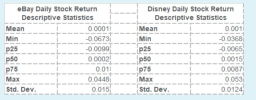 1) Use the following
descriptive statistics. The descriptive statistics are based on
daily stock price returns over the last year for two companies:
eBay and Disney.
a) Does Disney appear to be more or less risky than eBay?
b) Which company's stock performed better in the past year?
Describe which measures you rely on to make this conclusion.
c) Are Disney's returns normally distributed, right-skewed, or
left-skewed?
- 1 -1 1 1- 1 eBay Daily Stock Return Descriptive Statistics -...
1) Use the following
descriptive statistics. The descriptive statistics are based on
daily stock price returns over the last year for two companies:
eBay and Disney.
a) Does Disney appear to be more or less risky than eBay?
b) Which company's stock performed better in the past year?
Describe which measures you rely on to make this conclusion.
c) Are Disney's returns normally distributed, right-skewed, or
left-skewed?
- 1 -1 1 1- 1 eBay Daily Stock Return Descriptive Statistics -...
Statistics can be used to: a. reduce data to more easily understood, descriptive terms. b. generalize...
Statistics can be used to: a. reduce data to more easily understood, descriptive terms. b. generalize results. c. determine when an observed difference between two or more groups is the result of chance, or when it is the result of “real” differences between groups. d. all of the above A sociologist examines the relationship between political party affiliation and how this impacts views on the War in Afghanistan. Group of answer choices a. Political party affiliation is the independent variable,...
 Calculate the following descriptive statistics for both
variables:
a. Mean
b. Median
c. Mode
d. 25th Percentile
e. 75th Percentile
f. Variance
g. Standard Deviation
h. Correlation
Question 3 (60 points): A department of transportation's study on driving speed and miles per gallon for midsize automobiles resulted in the following data Speed (miles erhr30 50 40 55 30 25 60 25 50 55 Miles per Gallon28 2525 23 30 32 21 35 2625
Calculate the following descriptive statistics for both
variables:
a. Mean
b. Median
c. Mode
d. 25th Percentile
e. 75th Percentile
f. Variance
g. Standard Deviation
h. Correlation
Question 3 (60 points): A department of transportation's study on driving speed and miles per gallon for midsize automobiles resulted in the following data Speed (miles erhr30 50 40 55 30 25 60 25 50 55 Miles per Gallon28 2525 23 30 32 21 35 2625
 1) Use the following
descriptive statistics. The descriptive statistics are based on
daily stock price returns over the last year for two companies:
eBay and Disney.
a) Does Disney appear to be more or less risky than eBay?
b) Which company's stock performed better in the past year?
Describe which measures you rely on to make this conclusion.
c) Are Disney's returns normally distributed, right-skewed, or
left-skewed?
- 1 -1 1 1- 1 eBay Daily Stock Return Descriptive Statistics -...
1) Use the following
descriptive statistics. The descriptive statistics are based on
daily stock price returns over the last year for two companies:
eBay and Disney.
a) Does Disney appear to be more or less risky than eBay?
b) Which company's stock performed better in the past year?
Describe which measures you rely on to make this conclusion.
c) Are Disney's returns normally distributed, right-skewed, or
left-skewed?
- 1 -1 1 1- 1 eBay Daily Stock Return Descriptive Statistics -...
Most questions answered within 3 hours.
-
Where is the error in this code sequence?
String s1 = "Hello";
String s2 = "ello";...
asked 10 months ago -
Financial data for Joel de Paris, Inc., for last year
follow:
Joel de Paris, Inc.
Balance...
asked 10 months ago -
Consider this reaction:
Al2(SO4)3 (aq)+ BaCl3
(aq) Al2Cl6 (aq)- +
3BaSO4(s) . What is the...
asked 10 months ago -
Suppose that Savneet is considering increasing her
recent random sample from 20 car rentals to 40...
asked 10 months ago -
Trucks arrive at an unloading terminal at an average rate of 120
per hour.
Trucks arrive...
asked 10 months ago -
Why are methanol and ethanol completely soluble in water while
octanol is not very little soluble....
asked 10 months ago -
A facilities manager at a university reads in a research report
that the mean amount of...
asked 10 months ago -
When the CuSO4 is rehydrated by adding water to the anhydrous
compound, is this an endothermic...
asked 10 months ago -
A ray of sunlight is passing from diamond into crown glass; the
angle of incidence is...
asked 10 months ago -
A block of mass 0.249 kg is placed on top of a light, vertical
spring of...
asked 10 months ago -
how do the kidneys compensate in the presences of acidosis
a) trigger hyperventilate
b) reserve acid...
asked 10 months ago -
Question 501 pts
The rental rate of capital to the firm increases. Which of the
following...
asked 10 months ago