
Homework Answers
Part (a)
(P0 - PX) / D = (1 - 0) / (1 - 0) = 1
Hence, P0 - Px = Decline in price = D = 1D
Hence please enter 1 in the first answer box.
Part (b)
(P0 - PX) / D = (1 - 15%) / (1 - 0) = 0.85
Hence, P0 - Px = Decline in price = D = 0.85D
Hence please enter 0.85 in the first answer box.
Part (c)
(P0 - PX) / D = (1 - 15%) / (1 - 30%) = 0.85/ 0.7 = 1.2143
Hence, P0 - Px = Decline in price = D = 1.2143D
Hence please enter 1.2143 in the first answer box.
Part (d)
(P0 - PX) / D = [1 - 21% x (1 - 80%)] / (1 - 21%) = 0.85/ 0.7 = 1.2127
Hence, P0 - Px = Decline in price = D = 1.2127D
Hence please enter 1.2127 in the first answer box.
Add Answer to:
Chapter 14 - Dividends and Dividend Policy Saved AS aiscussea in tne text, in tne apsence...
As discussed in the text, in the absence of market imperfections and tax effects, we would...
 As discussed in the text, in the absence of market imperfections and tax effects, we would expect the share price to decline by the amount of the dividend payment when the stock goes ex dividend. Once we consider the role of taxes, however, this is not necessarily true. One model has been proposed that incorporates tax effects into determining the ex-dividend price: (Po-PxID (1Tp/(1 TG where Po is the price just before the stock goes ex, Px is the ex-dividend...
As discussed in the text, in the absence of market imperfections and tax effects, we would...
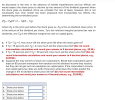 As discussed in the text, in the absence of market imperfections and tax effects, we would expect the share price to decline by the amount of the dividend payment when the stock goes ex dividend. Once we consider the role of taxes, however, this is not necessarily true. One model has been proposed that incorporates tax effects into determining the ex-dividend price: (Po-PX)/D= (1 - Tp)/(1 – TG) where Po is the price just before the stock goes ex, Px...
As discussed in the text, in the absence of market imperfections and tax effects, we would...
As discussed in the text, in the absence of market imperfections and tax effects, we would expect the share price to decline by the amount of the dividend payment when the stock goes ex dividend. Once we consider the role of taxes, however, this is not necessarily true. One model has been proposed that incorporates tax effects into determining the ex-dividend price: (P0 – PX) / D = (1 – TP) / (1 – TG) Here P0 is the...
As discussed in the text, in the absence of market imperfections and tax effects, we would...
As discussed in the text, in the absence of market imperfections and tax effects, we would expect the share price to decline by the amount of the dividend payment when the stock goes ex dividend. Once we consider the role of taxes, however, this is not necessarily true. One model has been proposed that incorporates tax effects into determining the ex-dividend price: (P0 – PX) / D = (1 – TP) / (1 – TG) Here P0 is the...
As discussed in the text, in the absence of market imperfections and tax effects, we would...
As discussed in the text, in the absence of market imperfections and tax effects, we would expect the share price to decline by the amount of the dividend payment when the stock goes ex dividend. Once we consider the role of taxes, however, this is not necessarily true. One model has been proposed that incorporates tax effects into determining the ex-dividend price:1 (P0 – PX)/D = (1 – TP)/(1 – TG) where P0 is the price just before...
As discussed in the text, in the absence of market imperfections and tax effects, we would...
As discussed in the text, in the absence of market imperfections and tax effects, we would expect the share price to decline by the amount of the dividend payment when the stock goes ex-dividend. Once we consider the role of taxes, however, this is not necessarily true. One model has been proposed that incorporates tax effects into determining the ex-dividend price: (P0 – PX) / D = (1 – tP) / (1 – tG) Here P0 is the price just...
As discussed in the text, in the absence of market imperfections and tax effects, we would...
As discussed in the text, in the absence of market imperfections and tax effects, we would expect the share price to decline by the amount of the dividend payment when the stock goes ex dividend. Once we consider the role of taxes, however, this is not necessarily true. One model has been proposed that incorporates tax effects into determining the ex-dividend price:1 (P0 – PX) / D = (1 – TP) / (1 – TG) where P0 is...
As discussed in the text in the absence of market imperfections and tax effects, we would...
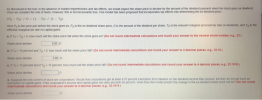 As discussed in the text in the absence of market imperfections and tax effects, we would expect the share price to decine by the amount of the dividend payment when the stock oes ex dividend Once we consider the role of taxes, however, this is not necessarily true. One model has been proposed that incorporates tax effects into determining the ex-dividend price (Po - PW) /D- (1 - Tp) / (1 - TO) Here Po is the price just before...
Chapter 14 - Dividends and Dividend Policy Saved Bermuda Triangle Corporation (BTC) currently has 395,000 shares...
 Chapter 14 - Dividends and Dividend Policy Saved Bermuda Triangle Corporation (BTC) currently has 395,000 shares of stock outstanding that sell for $83 per share. Assume no market imperfections or tax effects exist. Determine the share price and new number of shares outstanding if (Do not round intermediate calculations. Round your price per share answers to 2 decimal places, e.g.. 32.16, and shares outstanding answers to the nearest whole number, e.g., 32.) Sipped a. BTC has a five-for-three stock split....
Chapter 14 - Dividends and Dividend Policy Saved The company with the common equity accounts shown...
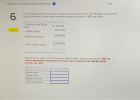 Chapter 14 - Dividends and Dividend Policy Saved The company with the common equity accounts shown here has declared a 13 percent stock dividend at a time when the market value of its stock is $53 per share. $410,000 Common stock (51 par value) Capital surplus Skipped 1,573,000 3,866,000 Retained earnings Total owners' equity $5,849,000 Show the new equity account balances after the stock dividend distribution. (Do not round intermediate calculations and round your answers to the nearest whole number,...
 As discussed in the text, in the absence of market imperfections and tax effects, we would expect the share price to decline by the amount of the dividend payment when the stock goes ex dividend. Once we consider the role of taxes, however, this is not necessarily true. One model has been proposed that incorporates tax effects into determining the ex-dividend price: (Po-PxID (1Tp/(1 TG where Po is the price just before the stock goes ex, Px is the ex-dividend...
 As discussed in the text, in the absence of market imperfections and tax effects, we would expect the share price to decline by the amount of the dividend payment when the stock goes ex dividend. Once we consider the role of taxes, however, this is not necessarily true. One model has been proposed that incorporates tax effects into determining the ex-dividend price: (Po-PX)/D= (1 - Tp)/(1 – TG) where Po is the price just before the stock goes ex, Px...
 As discussed in the text in the absence of market imperfections and tax effects, we would expect the share price to decine by the amount of the dividend payment when the stock oes ex dividend Once we consider the role of taxes, however, this is not necessarily true. One model has been proposed that incorporates tax effects into determining the ex-dividend price (Po - PW) /D- (1 - Tp) / (1 - TO) Here Po is the price just before...
 Chapter 14 - Dividends and Dividend Policy Saved Bermuda Triangle Corporation (BTC) currently has 395,000 shares of stock outstanding that sell for $83 per share. Assume no market imperfections or tax effects exist. Determine the share price and new number of shares outstanding if (Do not round intermediate calculations. Round your price per share answers to 2 decimal places, e.g.. 32.16, and shares outstanding answers to the nearest whole number, e.g., 32.) Sipped a. BTC has a five-for-three stock split....
 Chapter 14 - Dividends and Dividend Policy Saved The company with the common equity accounts shown here has declared a 13 percent stock dividend at a time when the market value of its stock is $53 per share. $410,000 Common stock (51 par value) Capital surplus Skipped 1,573,000 3,866,000 Retained earnings Total owners' equity $5,849,000 Show the new equity account balances after the stock dividend distribution. (Do not round intermediate calculations and round your answers to the nearest whole number,...
Most questions answered within 3 hours.
-
Where is the error in this code sequence?
String s1 = "Hello";
String s2 = "ello";...
asked 10 months ago -
Financial data for Joel de Paris, Inc., for last year
follow:
Joel de Paris, Inc.
Balance...
asked 10 months ago -
Consider this reaction:
Al2(SO4)3 (aq)+ BaCl3
(aq) Al2Cl6 (aq)- +
3BaSO4(s) . What is the...
asked 10 months ago -
Suppose that Savneet is considering increasing her
recent random sample from 20 car rentals to 40...
asked 10 months ago -
Trucks arrive at an unloading terminal at an average rate of 120
per hour.
Trucks arrive...
asked 10 months ago -
Why are methanol and ethanol completely soluble in water while
octanol is not very little soluble....
asked 10 months ago -
A facilities manager at a university reads in a research report
that the mean amount of...
asked 10 months ago -
When the CuSO4 is rehydrated by adding water to the anhydrous
compound, is this an endothermic...
asked 10 months ago -
A ray of sunlight is passing from diamond into crown glass; the
angle of incidence is...
asked 10 months ago -
A block of mass 0.249 kg is placed on top of a light, vertical
spring of...
asked 10 months ago -
how do the kidneys compensate in the presences of acidosis
a) trigger hyperventilate
b) reserve acid...
asked 10 months ago -
Question 501 pts
The rental rate of capital to the firm increases. Which of the
following...
asked 10 months ago