Suppose a perfectly competitive firm produces 2 outputs. The firm’s price for the first output is...
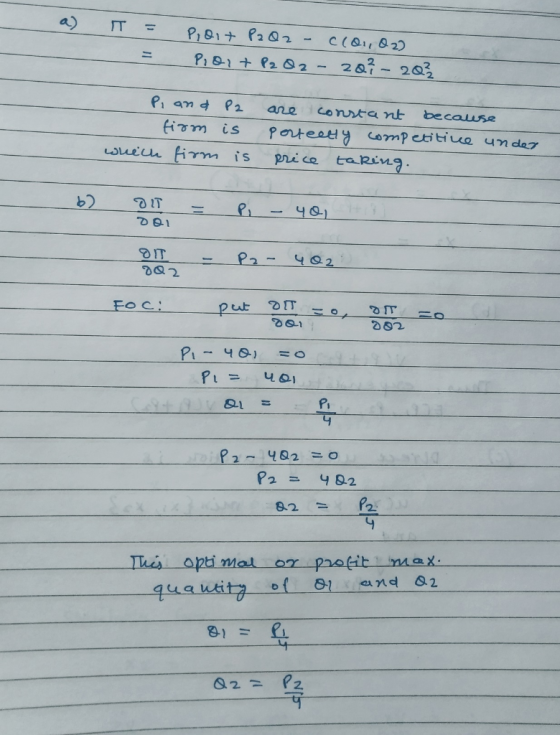
Suppose a perfectly competitive firm produces 2 outputs. The firm’s price for the first output is P1 and the price for the second output is P2. The cost function is given by:
C(Q1, Q2) = 2Q12 + 2Q22
a) Give the profit function for the firm.
b) Find the FOC’s for profit maximization and interpret them economically.
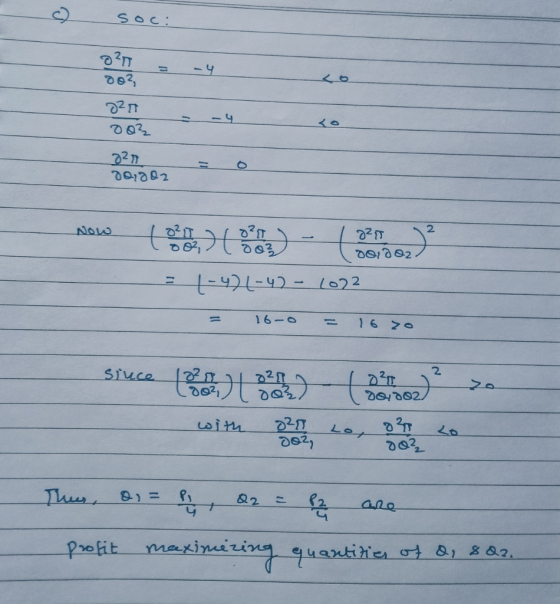
c) Find the SOC’s.
Homework Answers
Add Answer to:
Suppose a perfectly competitive firm produces 2 outputs. The
firm’s price for the first output is...
suppose a perfectly competitive firm produces 2 outputs. The firm's price for the first output is...
 suppose a perfectly competitive firm produces 2 outputs. The firm's price for the first output is Pi and the price for the second output is P2. The cost function is given by: C(Q1, Q2) = 20,2 + 2022 a) Give the profit function for the firm. b) Find the FOC's for profit maximization and interpret them economically. c) Find the SOC's.
Given a perfectly competitive firm in the output market where: P0= exogenous price, C(Q) = cost...
Given a perfectly competitive firm in the output market where: P0= exogenous price, C(Q) = cost function where: C’ > 0, C” > 0. a)State the firm’s profit function in terms of Q. b)Find the F.O.C. that maximizes profits at Q*. c)Interpret the F.O.C. d)Find the S.O.C. that maximizes profits at Q*. e)Interpret the S.O.C. f)Find dQ*/dP0using the implicit function rule on the F.O.C. g)Interpret the derivative in (f) economically.
A firm operates in a perfectly competitive market with a price of P = 50 for...
A firm operates in a perfectly competitive market with a price of P = 50 for the product. TVC = 0.5Q3 − 18Q2 + 170Q Q (output) TFC = 300. Write an equation expressing the firm’s total revenue (TR) as function of Q. Write an equation expressing the firm’s total cost (TC), as a function of Q. Write an equation expressing the firm’s profit (π), as a function of Q.Find the first-order condition for the firm’s profit-maximization decision. Find the...
Given a perfectly competitive firm in the input and output markets where: P0= exogenous price, Q...
Given a perfectly competitive firm in the input and output markets where: P0= exogenous price, Q = f(L, K0) where dQ/dL > 0 and d2Q/dL2< 0, the cost function where: C(L, K0) = r0K0+ w0L; r0= exogenous rental rate of capital, K0= exogenous capital stock, and w0= exogenous wage. a)State the firm’s profit function in terms of L. b)Find the F.O.C. that maximizes profit at L*. c)Interpret the F.O.C. d)Find the S.O.C. that maximizes profit at L*. e)Interpret the S.O.C....
2. Suppose a monopoly firm is allowed to price discriminate in 3 markets where the prices...
 2. Suppose a monopoly firm is allowed to price discriminate in 3 markets where the prices for the good in each market are given by: P1 = 63 - 401 P2 = 105 - 502 P3 = 75 - 603 where: Q = Q1 + Q2 + Q3 The cost of the output is (Q) = 20 + 15Q+Q2 a) Give the profit function for the firm. b) Find the FOC's and find the p*'s and Q*'s that maximize profit....
7. Suppose a perfectly competitive firm uses capital and labor to produce a single output. The...
 7. Suppose a perfectly competitive firm uses capital and labor to produce a single output. The firm's exogenous price for output is Po. The firm's exogenous cost for capital is ro. The firm's exogenous cost for labor is wo. The firm's production function is given by Q = f(K, L) where: 8f/8K, 8f/OL>0, 62f/8K2, 82f/8L2 <0, and 82f/8KOL = 0 a) Given the profit function for the firm. b) Find the FOC's for K* and L* that allow profit maximization....
3. Suppose a perfectly competitive firm uses capital and labor to produce a single output. The...
 3. Suppose a perfectly competitive firm uses capital and labor to produce a single output. The firm's exogenous price for output is Po. The firm's exogenous cost for capital is ro. The firm's exogenous cost for laboris Wo. The firm's production function is given by Q = f(K, L) where: 8f/8K, 8f/8L >0, 82f/8K2, 82f/8L2 <0, and 82f/8K6L = 0 a) Given the profit function for the firm. b) Find the FOC's for K* and L* that allow profit maximization....
7) If, for a given output level, a perfectly competitive firm’s price is less than its...
7) If, for a given output level, a perfectly competitive firm’s price is less than its average variable cost, the firm a. should increase output. b. should shut down. c. should increase price. d. is earning a profit.
Suppose a perfectly competitive firm has the short-run cost function C = 125 + q2. Use...
Suppose a perfectly competitive firm has the short-run cost function C = 125 + q2. Use the derivative formula or marginal cost to determine the firm’s output level and profit at prices of $30 and $20. At what price does the firm reach the shut-down point?
2. Suppose a monopoly firm is allowed to price discriminate in 3 markets where the prices for the good in each mark...
 2. Suppose a monopoly firm is allowed to price discriminate in 3 markets where the prices for the good in each market are given by: P1 = 63 - 401 P2 = 105-502 P3 = 75 - 6Q3 The cost of the output is (Q) = 20 + 15Q+Q? where: Q = Q1 + Q2 + Q3 a) Give the profit function for the firm. b) Find the FOC's and find the p*'s and Qo's that maximize profit c) Find...
 suppose a perfectly competitive firm produces 2 outputs. The firm's price for the first output is Pi and the price for the second output is P2. The cost function is given by: C(Q1, Q2) = 20,2 + 2022 a) Give the profit function for the firm. b) Find the FOC's for profit maximization and interpret them economically. c) Find the SOC's.
 2. Suppose a monopoly firm is allowed to price discriminate in 3 markets where the prices for the good in each market are given by: P1 = 63 - 401 P2 = 105 - 502 P3 = 75 - 603 where: Q = Q1 + Q2 + Q3 The cost of the output is (Q) = 20 + 15Q+Q2 a) Give the profit function for the firm. b) Find the FOC's and find the p*'s and Q*'s that maximize profit....
 7. Suppose a perfectly competitive firm uses capital and labor to produce a single output. The firm's exogenous price for output is Po. The firm's exogenous cost for capital is ro. The firm's exogenous cost for labor is wo. The firm's production function is given by Q = f(K, L) where: 8f/8K, 8f/OL>0, 62f/8K2, 82f/8L2 <0, and 82f/8KOL = 0 a) Given the profit function for the firm. b) Find the FOC's for K* and L* that allow profit maximization....
 3. Suppose a perfectly competitive firm uses capital and labor to produce a single output. The firm's exogenous price for output is Po. The firm's exogenous cost for capital is ro. The firm's exogenous cost for laboris Wo. The firm's production function is given by Q = f(K, L) where: 8f/8K, 8f/8L >0, 82f/8K2, 82f/8L2 <0, and 82f/8K6L = 0 a) Given the profit function for the firm. b) Find the FOC's for K* and L* that allow profit maximization....
 2. Suppose a monopoly firm is allowed to price discriminate in 3 markets where the prices for the good in each market are given by: P1 = 63 - 401 P2 = 105-502 P3 = 75 - 6Q3 The cost of the output is (Q) = 20 + 15Q+Q? where: Q = Q1 + Q2 + Q3 a) Give the profit function for the firm. b) Find the FOC's and find the p*'s and Qo's that maximize profit c) Find...
Most questions answered within 3 hours.
-
Where is the error in this code sequence?
String s1 = "Hello";
String s2 = "ello";...
asked 11 months ago -
Financial data for Joel de Paris, Inc., for last year
follow:
Joel de Paris, Inc.
Balance...
asked 11 months ago -
Consider this reaction:
Al2(SO4)3 (aq)+ BaCl3
(aq) Al2Cl6 (aq)- +
3BaSO4(s) . What is the...
asked 11 months ago -
Suppose that Savneet is considering increasing her
recent random sample from 20 car rentals to 40...
asked 11 months ago -
Trucks arrive at an unloading terminal at an average rate of 120
per hour.
Trucks arrive...
asked 11 months ago -
Why are methanol and ethanol completely soluble in water while
octanol is not very little soluble....
asked 11 months ago -
A facilities manager at a university reads in a research report
that the mean amount of...
asked 11 months ago -
When the CuSO4 is rehydrated by adding water to the anhydrous
compound, is this an endothermic...
asked 11 months ago -
A ray of sunlight is passing from diamond into crown glass; the
angle of incidence is...
asked 11 months ago -
A block of mass 0.249 kg is placed on top of a light, vertical
spring of...
asked 11 months ago -
how do the kidneys compensate in the presences of acidosis
a) trigger hyperventilate
b) reserve acid...
asked 11 months ago -
Question 501 pts
The rental rate of capital to the firm increases. Which of the
following...
asked 11 months ago