
Homework Answers
Option B
Explanation: When the inflation is higher than expected, the borrower is benefited because he/she now needs to return money worth less than what was borrowed.
Add Answer to:
Suppose that the inflation rate turns out to be much higher than most people expected. In...
9. Suppose that a borrower and a lender agree on the nominal interest rate to be...
 9. Suppose that a borrower and a lender agree on the nominal interest rate to be paid on a loan. Then infla- tion turns out to be higher than they both expected. a. Is the real interest rate on this loan higher or lower than expected? b. Does the lender gain or lose from this unexpectedly high inflation? Does the borrower c. Inflation during the 1970s was much higher than most people had expected when the decade began. How did...
A borrower and a lender agree on a mortgage interest rate. If inflation turns out to...
A borrower and a lender agree on a mortgage interest rate. If inflation turns out to be less than expected A. the actual real interest rate will be less than the expected real interest rate. B. the actual nominal interest rate will be higher than expected. C. the actual nominal interest rate will be less than expected. D. the actual real interest rate will exceed the expected real interest rate.
If actual inflation is smaller than expected inflation, would lender and borrower lose or benefit from...
If actual inflation is smaller than expected inflation, would lender and borrower lose or benefit from this unexpected change?
If inflation this year is higher than expected, then both lenders and borrowers will gain and...
If inflation this year is higher than expected, then both lenders and borrowers will gain and the government will lose borrowers will gain at the expense of lenders both lenders and borrowers will lose lenders will gain at the expense of borrowers the government will lose unless it has implemented an indexed tax system
Suppose that a lender's desired real rate of interest is 2%, the expected rate of inflation...
Suppose that a lender's desired real rate of interest is 2%, the expected rate of inflation is 2% and the actual rate of inflation is 4%: a) What's the nominal rate of interest? b. What's the actual rate real rate of interest? Explain who benefits from expectations error--the lender or the borrower.
please print out words show the answer,thanks! 8. Suppose real interest rate r-4% and expected inflation...
 please print out words show the
answer,thanks!
8. Suppose real interest rate r-4% and expected inflation rate for the following year En 4%. (a) What is the nominal interest rate? (2 points) (b) What is the ex ante real interest rate? (2 points) Suppose the actual inflation rate at the end of the following year π turned out to be 6%. (c) What is the ex post real interest rate? (3 points) (d) Borrowers (gain/oseand lende and lenders (gain/lose) (4...
please print out words show the
answer,thanks!
8. Suppose real interest rate r-4% and expected inflation rate for the following year En 4%. (a) What is the nominal interest rate? (2 points) (b) What is the ex ante real interest rate? (2 points) Suppose the actual inflation rate at the end of the following year π turned out to be 6%. (c) What is the ex post real interest rate? (3 points) (d) Borrowers (gain/oseand lende and lenders (gain/lose) (4...
True False Answer Bank Borrowers gain when inflation is higher than expected. Loan contracts specify the...
 True False Answer Bank Borrowers gain when inflation is higher than expected. Loan contracts specify the nominal interest rate. Real interest rates will never go negative. If inflation is higher than the nominal interest rate, the real interest rate is negative. Borrowers lose when inflation is higher than expected.
Suppose the nominal interest rate equals 9%, the expected inflation rate is 5%, and actual inflation...
 Suppose the nominal interest rate equals 9%, the expected inflation rate is 5%, and actual inflation turns out to be 3%. In this case, the: a. ex ante real interest rate is 4%. b. ex post real interest rate is 4%. C. ex ante real interest rate is 6%. d. ex post real interest rate is 2%
Calvin is borrowing money from Ethan. Calvin anticipates the inflation rate for the year will be...
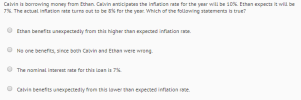 Calvin is borrowing money from Ethan. Calvin anticipates the inflation rate for the year will be 10%. Ethan expects it will be 7%. The actual inflation rate turns out to be 8% for the year. Which of the following statements is true? Ethan benefits unexpectedly from this higher than expected inflation rate. O No one benefits, since both Calvin and Ethan were wrong. O The nominal interest rate for this loan is 7%. Calvin benefits unexpectedly from this lower than...
Suppose that US inflation rate is higher than Japan’s inflation rate. How would this affect the...
Suppose that US inflation rate is higher than Japan’s inflation rate. How would this affect the exchange rate between the $ US and the yen?
 9. Suppose that a borrower and a lender agree on the nominal interest rate to be paid on a loan. Then infla- tion turns out to be higher than they both expected. a. Is the real interest rate on this loan higher or lower than expected? b. Does the lender gain or lose from this unexpectedly high inflation? Does the borrower c. Inflation during the 1970s was much higher than most people had expected when the decade began. How did...
 please print out words show the
answer,thanks!
8. Suppose real interest rate r-4% and expected inflation rate for the following year En 4%. (a) What is the nominal interest rate? (2 points) (b) What is the ex ante real interest rate? (2 points) Suppose the actual inflation rate at the end of the following year π turned out to be 6%. (c) What is the ex post real interest rate? (3 points) (d) Borrowers (gain/oseand lende and lenders (gain/lose) (4...
please print out words show the
answer,thanks!
8. Suppose real interest rate r-4% and expected inflation rate for the following year En 4%. (a) What is the nominal interest rate? (2 points) (b) What is the ex ante real interest rate? (2 points) Suppose the actual inflation rate at the end of the following year π turned out to be 6%. (c) What is the ex post real interest rate? (3 points) (d) Borrowers (gain/oseand lende and lenders (gain/lose) (4...
 True False Answer Bank Borrowers gain when inflation is higher than expected. Loan contracts specify the nominal interest rate. Real interest rates will never go negative. If inflation is higher than the nominal interest rate, the real interest rate is negative. Borrowers lose when inflation is higher than expected.
 Suppose the nominal interest rate equals 9%, the expected inflation rate is 5%, and actual inflation turns out to be 3%. In this case, the: a. ex ante real interest rate is 4%. b. ex post real interest rate is 4%. C. ex ante real interest rate is 6%. d. ex post real interest rate is 2%
 Calvin is borrowing money from Ethan. Calvin anticipates the inflation rate for the year will be 10%. Ethan expects it will be 7%. The actual inflation rate turns out to be 8% for the year. Which of the following statements is true? Ethan benefits unexpectedly from this higher than expected inflation rate. O No one benefits, since both Calvin and Ethan were wrong. O The nominal interest rate for this loan is 7%. Calvin benefits unexpectedly from this lower than...
Most questions answered within 3 hours.
-
Where is the error in this code sequence?
String s1 = "Hello";
String s2 = "ello";...
asked 11 months ago -
Financial data for Joel de Paris, Inc., for last year
follow:
Joel de Paris, Inc.
Balance...
asked 11 months ago -
Consider this reaction:
Al2(SO4)3 (aq)+ BaCl3
(aq) Al2Cl6 (aq)- +
3BaSO4(s) . What is the...
asked 11 months ago -
Suppose that Savneet is considering increasing her
recent random sample from 20 car rentals to 40...
asked 11 months ago -
Trucks arrive at an unloading terminal at an average rate of 120
per hour.
Trucks arrive...
asked 11 months ago -
Why are methanol and ethanol completely soluble in water while
octanol is not very little soluble....
asked 11 months ago -
A facilities manager at a university reads in a research report
that the mean amount of...
asked 11 months ago -
When the CuSO4 is rehydrated by adding water to the anhydrous
compound, is this an endothermic...
asked 11 months ago -
A ray of sunlight is passing from diamond into crown glass; the
angle of incidence is...
asked 11 months ago -
A block of mass 0.249 kg is placed on top of a light, vertical
spring of...
asked 11 months ago -
how do the kidneys compensate in the presences of acidosis
a) trigger hyperventilate
b) reserve acid...
asked 11 months ago -
Question 501 pts
The rental rate of capital to the firm increases. Which of the
following...
asked 11 months ago