What is dollarization, and what is a currency board?
What is dollarization, and what is a currency board?
Homework Answers
Before we get into the terms like Dollarization or Currency Board, let's understand the concept behind them.
Consider an economy which
- Doesn't have a central bank or has a central bank but with very limited regulatory control and powers or
- Has a political system that resorts to printing currency every now and then even when economy doesn't require it.
What will happen in this situation?
The economy will face:
- Hyperinflation
- Monetary destability
- Local currency will lose value because it's inflated.
- Residents, traders, investors etc will then start using some foreign currency to store value because local currency is hyperinflated and doesn't store any value for them.
Let's now look into each of the terms.
What is dollarization?
Dollarization is this phenomena where the citizens of a country start using foreign currency extensively either along with or in lieu of the local currency. Since USD is the most popular and tradable foreign currency, the local citizens will actuallys tart holding dollars and start transacting in dollars. So, informally, the entire economy is "Dollarized". Such a phenomenon is called Dollarization where nearly the entire country starts using Dollars. It can be an official dollarization when government declares the foreign currency as a legal tender.
and what is a currency board?
Recall the situation we looked at the beginning.
In order to monetarily stabilize the economy, a currency board is constituted that issues local currency only:
- This local currency is supported fully by the foreign currency.
- The legal currency can be converted into a foreign currency on demand and at a fixed exchange rate.
- This foreign currency then becomes the anchor foreign currency.
- The currency board will have reserves that will be 100% of the total local currency in circulation.
Question 29 Flag qu Not yet answered Points out of 2.0 If a country applies dollarization...
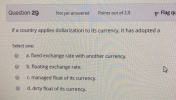 Question 29 Flag qu Not yet answered Points out of 2.0 If a country applies dollarization to its currency, it has adopted a Select one: O a. fixed exchange rate with another currency. O b. floating exchange rate O c. managed float of its currency. O d. dirty float of its currency
Which of the following is true about a strict Currency board system? Multiple Choice ) The...
 Which of the following is true about a strict Currency board system? Multiple Choice ) The currency board system enhances the ability of the government to print money Ο The government lacks the ability to set interest rates C ) A currency board system is govemed by the market forces of demand and supply C ) A currency boud cannot issue additional domestic notes and coins despite the presence of foreign exchange reserves to back Ο A currency board system...
Compare the condition of dollarization between Brazil and Argentina.
Compare the condition of dollarization between Brazil and Argentina.
Provide a written summary of the pros and cons of dollarization.
Provide a written summary of the pros and cons of dollarization.
Compare Argentina to the performance of another country who did not dollarize to analyze how dollarization...
Compare Argentina to the performance of another country who did not dollarize to analyze how dollarization helped or hurt Argentina.
Find another country who did not dollarize to compare to Argentina to analyze how dollarization helped...
Find another country who did not dollarize to compare to Argentina to analyze how dollarization helped or hurt Argentina.
The Argentine peso was fixed through a currency board at Ps1.00/$ throughout the 1990s. In Januar...
The Argentine peso was fixed through a currency board at Ps1.00/$ throughout the 1990s. In January 2002, the Argentine peso was floated. On January 29, 2003, it was trading at Ps3.20/$. During that one-year period, Argentina’s inflation rate was 20% on an annualized basis. Inflation in the United States during that same period was 2.2% annualized. a. What should have been the exchange rate in January 2003 if PPP held? b. By what percentage was the Argentine peso undervalued on...
Argentine Tears. The Argentine peso was fixed through a currency board at Ps1.00/$ throughout the 1990s....
Argentine Tears. The Argentine peso was fixed through a currency board at Ps1.00/$ throughout the 1990s. In January 2002 the Argentine peso was floated. On January 29, 2003 it was trading at Ps3.15/$. During that one year period Argentina's inflation rate was 19% on an annualized basis. Inflation in the United States during that same period was 2.4% annualized. a. What should have been the exchange rate in January 2003 if PPP held? (Round to five decimal places) b. By...
8) The price of one currency in terms of another is called A) the terms of...
 8) The price of one currency in terms of another is called A) the terms of trade. C) purchasing power parity B) a currency band D) the exchange rate. 19) -- exchange rates are either held constant or allowed to fluctuate( ) only within very narrow boundaries, A) managed float exchange rate system B) Freely exchange rate system ) pegged exchange rate system D) fixed exchange rate system : ------- Is the replacement (Jap) of a foreign currency with U.S...
To analyze how dollarization helped/hurt Argentina, you could also compare Argentina to the performance of another...
To analyze how dollarization helped/hurt Argentina, you could also compare Argentina to the performance of another country who did not dollarize. One of the criticism of fixed exchange rate (dollarizing is fixing your exchange rate) is that you lose monetary power. Perhaps you can assess this statement by looking at how the country responded / failed to respond to a crisis?
 Question 29 Flag qu Not yet answered Points out of 2.0 If a country applies dollarization to its currency, it has adopted a Select one: O a. fixed exchange rate with another currency. O b. floating exchange rate O c. managed float of its currency. O d. dirty float of its currency
 Which of the following is true about a strict Currency board system? Multiple Choice ) The currency board system enhances the ability of the government to print money Ο The government lacks the ability to set interest rates C ) A currency board system is govemed by the market forces of demand and supply C ) A currency boud cannot issue additional domestic notes and coins despite the presence of foreign exchange reserves to back Ο A currency board system...
 8) The price of one currency in terms of another is called A) the terms of trade. C) purchasing power parity B) a currency band D) the exchange rate. 19) -- exchange rates are either held constant or allowed to fluctuate( ) only within very narrow boundaries, A) managed float exchange rate system B) Freely exchange rate system ) pegged exchange rate system D) fixed exchange rate system : ------- Is the replacement (Jap) of a foreign currency with U.S...
Most questions answered within 3 hours.
-
Where is the error in this code sequence?
String s1 = "Hello";
String s2 = "ello";...
asked 10 months ago -
Financial data for Joel de Paris, Inc., for last year
follow:
Joel de Paris, Inc.
Balance...
asked 10 months ago -
Consider this reaction:
Al2(SO4)3 (aq)+ BaCl3
(aq) Al2Cl6 (aq)- +
3BaSO4(s) . What is the...
asked 10 months ago -
Suppose that Savneet is considering increasing her
recent random sample from 20 car rentals to 40...
asked 10 months ago -
Trucks arrive at an unloading terminal at an average rate of 120
per hour.
Trucks arrive...
asked 10 months ago -
Why are methanol and ethanol completely soluble in water while
octanol is not very little soluble....
asked 10 months ago -
A facilities manager at a university reads in a research report
that the mean amount of...
asked 10 months ago -
When the CuSO4 is rehydrated by adding water to the anhydrous
compound, is this an endothermic...
asked 10 months ago -
A ray of sunlight is passing from diamond into crown glass; the
angle of incidence is...
asked 10 months ago -
A block of mass 0.249 kg is placed on top of a light, vertical
spring of...
asked 10 months ago -
how do the kidneys compensate in the presences of acidosis
a) trigger hyperventilate
b) reserve acid...
asked 10 months ago -
Question 501 pts
The rental rate of capital to the firm increases. Which of the
following...
asked 10 months ago