In time 0, an investor takes a calendar spread by selling two-year European call option and...
In time 0, an investor takes a calendar spread by selling two-year European call option and buying three-year European call option. These two options have the same strike price of $80 and are for the same stock that pays no dividends. The two-year option sells for $5 and the three-year option sells for $7. Two years later, the stock price turns out to be $90. The risk-free rate is 2% per annum. What is the minimum of the profit from this strategy? (We assume that we sell the longer-term option in year two)
Homework Answers
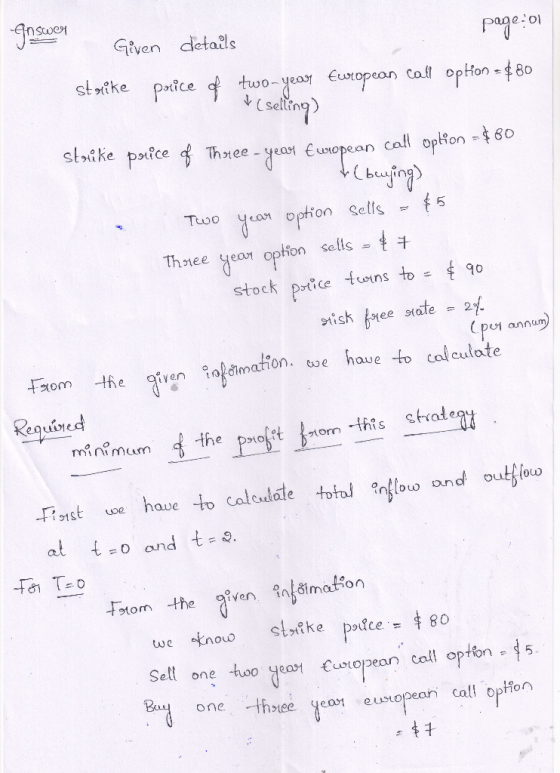
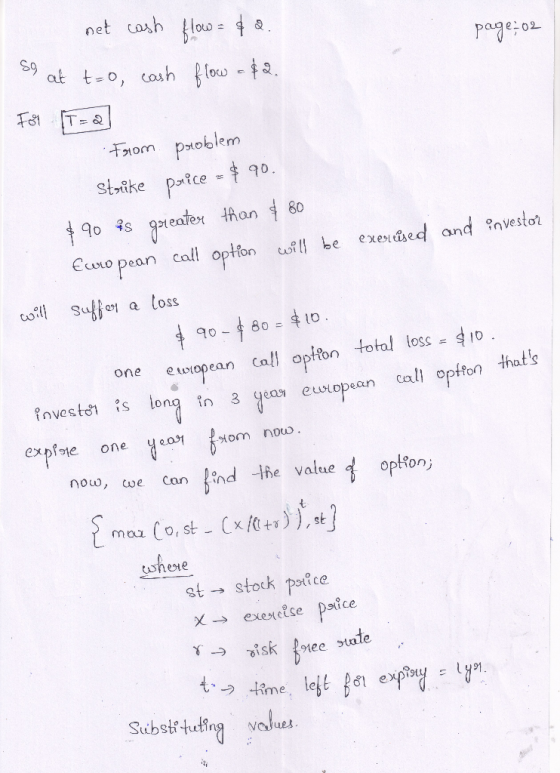
![page-03 80 value of option = Max 0, 90- 18.) - Max Co, 90- 78.43134] value & option = 44.5686. if investor sell the 3 year eu](http://img.homeworklib.com/questions/d4fed5f0-71e8-11ea-896f-b5d879f939fa.png?x-oss-process=image/resize,w_560)
Add Answer to:
In time 0, an investor takes a calendar spread by selling
two-year European call option and...
In time 0, an investor takes a calendar spread by selling two-year European call option and...
In time 0, an investor takes a calendar spread by selling two-year European call option and buying three-year European call option. These two options have the same strike price of $80 and are for the same stock that pays no dividends. The two-year option sells for $5 and the three-year option sells for $7. Two years later, the stock price turns out to be $90. The risk-free rate is 2% per annum. What is the minimum of the profit from...
An investor buys a ratio spread of 1-year European calls. He buys 1 call option with...
An investor buys a ratio spread of 1-year European calls. He buys 1 call option with strike price 40 and sells 2 call options with strike price 50. Option prices are Strike price Call option premium 40 10 50 5 Determine the investor's profit if the ending price of the underlying stock is (a) 45, (b) 55, (c) 65. (math Finance)
Consider a three-year European call option with the strike price of $150. The underlying stock will...
Consider a three-year European call option with the strike price of $150. The underlying stock will pay $10-dividend two years later from now. The current stock price is $170. The risk-free rate is 3% per annum. Find the range of the call prices that do not allow any arbitrage.
A stock that does not pay dividend is trading at $50. A European call option with...
A stock that does not pay dividend is trading at $50. A European call option with strike price of $60 and maturing in one year is trading at $10. An American call option with strike price of $60 and maturing in one year is trading at $15. You can borrow or lend money at any time at risk-free rate of 5% per annum with continuous compounding. Devise an arbitrage strategy. So I know that usually american calls are never exercised...
A trader buys a European call option and sells (short) a European put option. The options...
A trader buys a European call option and sells (short) a European put option. The options have the same underlying asset, strike price, and maturity. Describe the trader’s position. The trader monitors the market continuously and finds at one point that the call is significantly overpriced relative to fair value. What strategy is available for the trader to lock in a profit at current prices?
4. A trader buys a European call option and sells a European put option. The options...
 4. A trader buys a European call option and sells a European put option. The options have the same underlying asset, strike price and maturity. Show that the trader's position is equivalent to a forward contract with delivery price that is equal to the strike price of the options.
ABC, a non-dividend paying stock Details of European option prices follows on are as Option type...
 ABC, a non-dividend paying stock Details of European option prices follows on are as Option type Exercise price Option premium Call on Stock ABC $17.50 $20 $5.50 $3.50 Required: Create a call ratio spread by using the above options. A call ratio spread consists of taking a long position in a bull spread and selling another call on the same stock with the strike price of $20. Draw the profit and loss diagram (on the following page) of the call...
A 10-month European call option on a stock is currently selling for $5. The stock price...
A 10-month European call option on a stock is currently selling for $5. The stock price is $64, the strike price is $60. The continuously-compounded risk-free interest rate is 5% per annum for all maturities. a) Suppose that the stock pays no dividend in the next ten months, and that the price of a 10-month European put with a strike price of $60 on the same stock is trading at $1. Is there an arbitrage opportunity? If yes, how can...
(b) A 6-month European call option on a non-dividend paying stock is cur- rently selling for $3. The stock price is...
 (b) A 6-month European call option on a non-dividend paying stock is cur- rently selling for $3. The stock price is $50, the strike price is $55, and the risk-free interest rate is 6% per annum continuously compounded. The price for 6-months European put option with same strike, underlying and maturity is 82. What opportunities are there for an arbitrageur? Describe the strategy and compute the gain.
1. A 10-month European call option on a stock is currently selling for $5. The stock...
1. A 10-month European call option on a stock is currently selling for $5. The stock price is $64, the strike price is $60. The continuously-compounded risk-free interest rate is 5% per annum for all maturities. 1) Suppose that the stock pays no dividend in the next ten months, and that the price of a 10-month European put with a strike price of $60 on the same stock is trading at $1. Is there an arbitrage opportunity? If yes, how...
 4. A trader buys a European call option and sells a European put option. The options have the same underlying asset, strike price and maturity. Show that the trader's position is equivalent to a forward contract with delivery price that is equal to the strike price of the options.
 ABC, a non-dividend paying stock Details of European option prices follows on are as Option type Exercise price Option premium Call on Stock ABC $17.50 $20 $5.50 $3.50 Required: Create a call ratio spread by using the above options. A call ratio spread consists of taking a long position in a bull spread and selling another call on the same stock with the strike price of $20. Draw the profit and loss diagram (on the following page) of the call...
 (b) A 6-month European call option on a non-dividend paying stock is cur- rently selling for $3. The stock price is $50, the strike price is $55, and the risk-free interest rate is 6% per annum continuously compounded. The price for 6-months European put option with same strike, underlying and maturity is 82. What opportunities are there for an arbitrageur? Describe the strategy and compute the gain.
Most questions answered within 3 hours.
-
Where is the error in this code sequence?
String s1 = "Hello";
String s2 = "ello";...
asked 11 months ago -
Financial data for Joel de Paris, Inc., for last year
follow:
Joel de Paris, Inc.
Balance...
asked 11 months ago -
Consider this reaction:
Al2(SO4)3 (aq)+ BaCl3
(aq) Al2Cl6 (aq)- +
3BaSO4(s) . What is the...
asked 11 months ago -
Suppose that Savneet is considering increasing her
recent random sample from 20 car rentals to 40...
asked 11 months ago -
Trucks arrive at an unloading terminal at an average rate of 120
per hour.
Trucks arrive...
asked 11 months ago -
Why are methanol and ethanol completely soluble in water while
octanol is not very little soluble....
asked 11 months ago -
A facilities manager at a university reads in a research report
that the mean amount of...
asked 11 months ago -
When the CuSO4 is rehydrated by adding water to the anhydrous
compound, is this an endothermic...
asked 11 months ago -
A ray of sunlight is passing from diamond into crown glass; the
angle of incidence is...
asked 11 months ago -
A block of mass 0.249 kg is placed on top of a light, vertical
spring of...
asked 11 months ago -
how do the kidneys compensate in the presences of acidosis
a) trigger hyperventilate
b) reserve acid...
asked 11 months ago -
Question 501 pts
The rental rate of capital to the firm increases. Which of the
following...
asked 11 months ago